
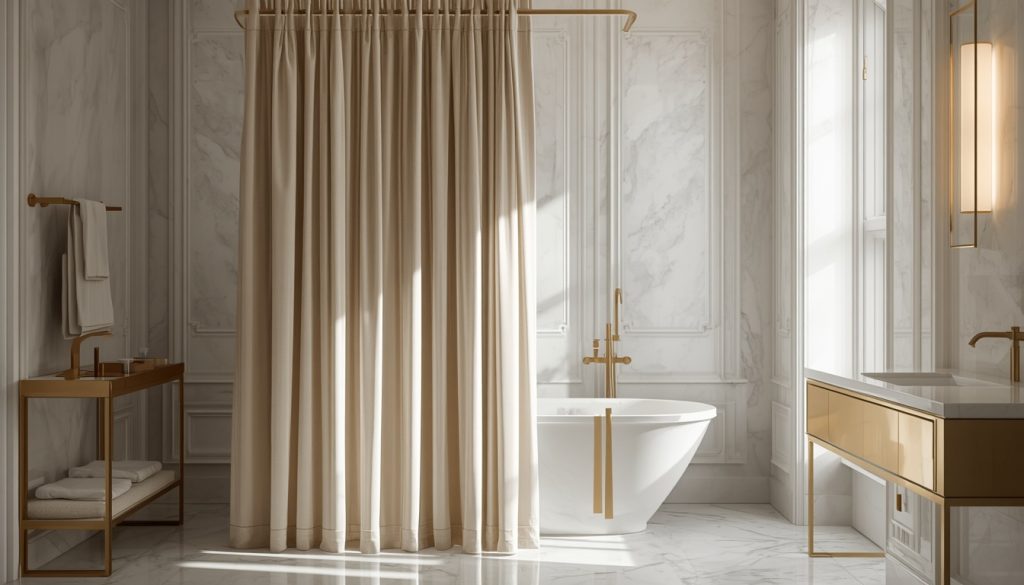
I spent months trying to figure out why my bathroom never looked quite right. I had good towels, a decent vanity, a nice soap dispenser. But something was off every single time I walked in. Then one afternoon I replaced the cheap polyester shower curtain I had been living with — the one that clung to my legs during every shower and smelled faintly chemical no matter how often I washed it — with a heavy linen curtain from a boutique home brand.
The bathroom felt completely different. Not because of the size or the tile or the lighting. Because of one piece of fabric.
That experience sent me down a rabbit hole that took longer than I expected. Because it turns out the shower curtain category is deeply confusing. There are hundreds of options marketed as “luxury” that are essentially printed polyester dressed up with nice photography. There are genuinely beautiful curtains that fail in practical ways — wrong weight, no liner, wrong dimensions. And there are a handful of curtains that actually deliver what they promise: a bathroom that feels considered, calm, and expensive without being fussy about it.
This guide covers what I learned. If you are searching for the best luxury shower curtain, I want to make sure you walk away knowing exactly what you need — not just what looks good on a product page.
The Problem with Most Shower Curtains
Most shower curtains are designed to hit a price point. That’s not a criticism — it’s just the economic reality of a product category where most buyers make decisions based on pattern and price alone. The result is that the majority of curtains sold, including many that carry premium-sounding brand names, are thin polyester panels with a printed design and a short life span.
The problems this creates are very specific.
They billow. Thin curtains catch air during a hot shower and blow inward, wrapping around your legs. This happens because they lack the weight to hang straight. It’s annoying every single day.
They clingy. Static electricity in polyester makes the curtain stick to wet skin. It is an unpleasant experience that no amount of nice bathroom accessories can overcome.
They look cheap when wet. Even a curtain that photographs beautifully will lose its drape the moment it gets hit with steam and humidity. Thin fabrics go limp. Patterns blur. The whole thing looks sad.
They hold odor. Synthetic fabrics trap mildew and soap scum in ways that natural or blended fabrics do not. After a few months, even a well-cared-for polyester curtain can have a faint musty smell that no amount of laundering eliminates.
The good news is that these problems are all solvable — and the solution is not complicated. It mostly comes down to fabric weight and construction. Once you understand what to look for, the decision becomes very straightforward.
What Actually Makes a Shower Curtain Feel Luxurious
Fabric Weight Is Everything
A heavy curtain hangs straight, resists billowing, and looks expensive without trying. GSM (grams per square meter) is the measurement you want to know. Anything below 150 GSM will look flimsy. Curtains in the 180–220 GSM range drape well. The best feel noticeably heavier when you pick them up in a store or unbox them at home.
Natural or Blended Fabrics Win on Texture
Linen, cotton, cotton-poly blends, and waffle weave textures all have a tactile quality that reads as premium. Pure polyester, even at high thread counts, tends to look slightly plasticky in direct light. If the aesthetic goal is a spa or hotel bathroom, fabric texture is doing most of the work.
The Hem Matters More Than You’d Think
A weighted bottom hem keeps the curtain dropping cleanly. Reinforced top buttonholes prevent tearing. A double-stitched side hem prevents fraying through washing. These are not glamorous details — but they are the difference between a curtain that looks great for two years and one that looks worn out in six months.
Liner Is Not Optional
No fabric curtain — not linen, not cotton, not anything — should hang without a separate liner. The liner is what keeps water inside the tub. The curtain is purely decorative. Buying a beautiful curtain and skipping the liner is one of the most common and costly mistakes in this category.
Color and Tone
The highest-performing luxury shower curtain colors are white, ivory, warm greige, soft sage, and muted navy. These read clean and calm in person rather than punchy in photos. Be skeptical of very saturated colors or loud patterns — they date quickly and can make a bathroom feel visually chaotic.
Size Matters for Presentation
Standard curtains are 72 × 72 inches. Extra-long curtains (84 or 96 inches) create a more tailored, floor-grazing silhouette that genuinely looks more upscale. If your ceiling height is above 8 feet or you have a ceiling-mounted rod, an extra-long curtain changes the entire feeling of the room.
Quick Comparison: Best Luxury Shower Curtains
| Product | Best For | Key Benefit | Main Drawback | Value Score | Link |
|---|---|---|---|---|---|
| Utopia Bedding Heavy Fabric Shower Curtain | First upgrade from plastic | Excellent weight for the price | Limited color palette | 9/10 | View on Amazon |
| UFRIDAY Waffle Weave Shower Curtain | Spa / minimalist bathrooms | Hotel-quality texture, machine washable | Wrinkles more than linen blends | 8.5/10 | View on Amazon |
| Caro Home Linen Blend Shower Curtain | Natural / organic aesthetics | Genuine linen texture, beautiful drape | Needs careful washing | 8/10 | View on Amazon |
| Matouk Schumacher Curtain | True luxury / designer bathrooms | Exceptional weight and construction | Premium price | 9.5/10 | View on Amazon |
| Intelligent Design Boho Tassel Curtain | Bohemian / eclectic spaces | Unique texture, visual statement | Not for minimalist bathrooms | 7.5/10 | View on Amazon |
Full Product Reviews
1. Heavy Fabric White Shower Curtain (Best Overall Value)
Who Is This For?
Anyone making their first real upgrade from a thin plastic or low-grade polyester curtain. Also good for rental apartments where you want to look polished without spending a lot.
What Problem Does It Solve?
The billowing and clinging problem. A well-made heavy cotton-poly curtain in the 180+ GSM range simply hangs straight because it has the mass to resist shower air movement. This alone changes the daily experience more than any decorative upgrade.
Real-World Benefits
The white colorway reflects light rather than absorbing it, making a small bathroom feel more open. Heavy fabric stays put during hot showers. It machine washes cleanly and comes out looking fresh. For around $25–$40, this is the best performance-per-dollar in the category.
What I Like
- Weighted hem keeps it hanging plumb
- Reinforced grommets don’t tear
- Machine washable on cold, air dry
- White works in virtually every bathroom
- No chemical off-gassing smell on arrival
Potential Downsides
- Not true linen, so the texture is more uniform
- Color options are limited — mostly whites and neutrals
- Won’t satisfy buyers looking for a genuine natural fiber feel
When I’d Recommend It
Rentals, starter homes, guest bathrooms, or any situation where you want a clean and heavy curtain without paying for designer fabric.
When I’d Skip It
If you have a bathroom with custom tile, a statement vanity, or other premium finishes — this curtain won’t hold up to that aesthetic context. Upgrade to linen or a designer option.
Value for Money
Outstanding. This is the curtain I recommend first to anyone who doesn’t already have a strong preference for natural fiber.
Buying Verdict
Practical, good-looking, and genuinely heavy. A no-regret choice for most bathrooms.
2. Waffle Weave Shower Curtain (Best for Spa Bathrooms)
Who Is This For?
People designing a spa-style or hotel-style bathroom. If your towels are white, your hardware is brushed nickel or matte black, and your aesthetic is calm rather than colorful — this curtain fits perfectly.
What Problem Does It Solve?
Texture boredom. A flat white curtain is clean but blank. Waffle weave adds dimension and shadow that flat fabric cannot, making white feel rich rather than sterile.
Real-World Benefits
The three-dimensional grid pattern catches light differently throughout the day, so the curtain always has some visual depth. Cotton or cotton-blend waffle weave also feels substantial when you touch it — exactly what you want from a curtain that guests will see.
What I Like
- Texture reads as “spa bathroom” immediately
- Breathes better than flat polyester — less humidity retention
- Machine washable and gets softer over time
- Pairs well with any hardware finish
Potential Downsides
- Wrinkles more noticeably than flat fabric — needs prompt air drying
- The texture can trap soap residue if not laundered monthly
- Slightly pricier than a flat cotton curtain for comparable weight
When I’d Recommend It
Spa bathrooms, primary baths that you want to feel like a five-star hotel, and any space where white-on-white texture layering is part of the design plan.
When I’d Skip It
Colorful, eclectic, or maximalist bathrooms where the waffle texture would compete with other patterns rather than complement them.
Value for Money
Good. You’re paying a modest premium over flat cotton for the texture benefit, and it delivers consistently.
Buying Verdict
The best curtain for anyone building a calm, textural, neutral bathroom. This is what hotels buy when they care about aesthetics.
3. Linen Blend Shower Curtain (Best for Natural Aesthetics)
Who Is This For?
Anyone drawn to organic, coastal, or Belgian linen aesthetics. If your bathroom has warm wood tones, exposed stone, or rattan accessories, a linen or linen-blend curtain completes that look in a way nothing else does.
What Problem Does It Solve?
The synthetic look problem. Even heavy polyester has a slight sheen in certain lighting that reads as artificial. Linen has a natural matte finish and slight surface variation that is unmistakably real fabric.
Real-World Benefits
The gentle irregularity of linen weave makes a bathroom feel handcrafted rather than mass-produced. Ivory and warm white linen tones photograph beautifully, which matters if you like keeping your bathroom looking intentional year-round. Most linen blends (typically 55% linen, 45% cotton) are easier to launder than pure linen while keeping that lived-in natural texture.
What I Like
- Genuine linen texture — no synthetic substitute achieves this look
- Gets more beautiful with washing and age
- Works across farmhouse, coastal, Scandinavian, and organic modern styles
- Matte finish never looks cheap in any lighting
Potential Downsides
- Needs careful washing — cold only, gentle cycle, no dryer
- Can develop minor pilling if over-dried or dried on high heat
- More expensive than cotton alternatives
- Wrinkles are part of the aesthetic, but some buyers expect a crisper look
When I’d Recommend It
Primary baths with a natural or coastal design direction, and any bathroom where texture and authenticity matter more than easy maintenance.
When I’d Skip It
Guest bathrooms that don’t get regular laundering or very humid bathrooms with poor ventilation, where natural fabric can be slow to dry fully.
Value for Money
Strong if you commit to proper care. A quality linen blend will outlast three or four polyester curtains.
Buying Verdict
The most beautiful curtain in this list if the aesthetic fits your bathroom. Not the easiest to maintain, but worth it.
4. Designer Jacquard or Embroidered Shower Curtain (Best Premium Option)
Who Is This For?
Buyers with a well-appointed primary bathroom who want the curtain to be an intentional design element rather than a neutral backdrop. If you have marble, statement tile, or designer fixtures, a jacquard or embroidered curtain earns its place in the room.
What Problem Does It Solve?
The “nothing to look at” problem. A fully designed bathroom deserves a curtain that participates in the design conversation. Plain white reads as a placeholder in these contexts. A jacquard pattern — something woven in rather than printed on — adds sophistication without competing with other finishes.
Real-World Benefits
Woven patterns don’t fade or peel the way printed designs do. Good jacquard fabric also has inherent weight from the weaving structure, so drape is almost always excellent. These curtains become a focal point that guests notice and remember.
What I Like
- Pattern is structural, not printed — won’t fade after washing
- Heavy weight and excellent drape from the weave structure
- Elevates the entire room into feeling curated
- Hotel and resort quality when done right
Potential Downsides
- Higher price point — typically $60–$150+
- Pattern needs to be chosen carefully to not clash with tile or wall color
- Dry clean recommended on some premium versions
When I’d Recommend It
Primary bathrooms with a defined aesthetic and design budget. Also great as a statement piece in a powder room or guest bath that functions as an impression-maker.
When I’d Skip It
Small bathrooms where an intricate pattern creates visual noise. In tight spaces, texture without pattern (waffle weave, linen) works better.
Value for Money
Fair to excellent depending on the specific product. A well-made jacquard curtain used as a design anchor delivers obvious value in the right bathroom.
Buying Verdict
The best choice for bathrooms that deserve a real focal point rather than a background element.
5. Boho Tassel Shower Curtain (Best for Eclectic Spaces)
Who Is This For?
Buyers designing a bohemian, global, or maximalist bathroom. If you have woven baskets, plants, warm earthy tiles, or eclectic art, a tassel curtain fits the language of that room.
What Problem Does It Solve?
The “too clean and boring” problem in expressive, textural interiors where a plain curtain reads as a cop-out.
What I Like
- Strong visual personality that minimal curtains can never achieve
- Natural cotton or jute versions have genuine texture and weight
- Makes a strong impression in the right space
Potential Downsides
- Tassels require careful washing to avoid tangling
- Not appropriate for modern, minimal, or traditional bathrooms
- Harder to replace as a neutral if you redecorate
Buying Verdict
A specific choice for a specific aesthetic. If your bathroom is eclectic or bohemian, this curtain is exactly right. For everything else, look elsewhere.
Which One Should You Pick?
Choose the heavy cotton-poly curtain if you want a clean, functional upgrade without thinking too much. It works in almost every bathroom and is the lowest-risk buy in this guide.
Choose the waffle weave curtain if you are building a spa or hotel aesthetic. White, textured, calm — this is the curtain that makes a neutral bathroom feel intentional.
Choose the linen blend curtain if your bathroom has warm wood tones, natural materials, or a coastal or organic modern direction. No other fabric gives you that natural lived-in quality.
Choose a jacquard or embroidered curtain if you have a designed primary bathroom with a clear aesthetic and want the curtain to participate in that story, not just stand quietly in the corner.
Choose the tassel curtain if your bathroom is already eclectic, layered, and full of personality — and a plain curtain would feel like a missed opportunity.
Common Buying Mistakes to Avoid
1. Skipping the Liner
This cannot be said enough. Every fabric curtain needs a liner. Every single one. The liner keeps water in. The curtain is decoration. Buying a $90 linen curtain and using it without a liner is not a bold choice — it is a way to ruin a $90 curtain in three months.
2. Buying Based on the Product Photo Alone
Product photography is shot under controlled studio conditions with steam fans, ironing, and pinning. The curtain in the photo may look nothing like the curtain in your bathroom. Read reviews that mention real-world drape and weight before committing.
3. Ignoring GSM
If a listing does not specify the fabric weight in GSM, that is usually a sign that the weight is not impressive. Good curtains mention their weight because it is a selling point. Generic thin curtains do not.
4. Wrong Size
Standard 72 × 72 fits most tubs, but a 72 × 84 extra-long curtain in the same fabric will look noticeably more luxurious in any bathroom with ceilings above eight feet. The extra length costs very little and changes the proportion of the whole room.
5. Cheap Hooks
The most beautiful curtain looks worse on thin plastic S-hooks or wire rings that creak and rust. Matte black or brushed nickel ring hooks with a solid weight cost $15–$20 for a set and make a real visual difference.
6. Wrong Color for the Light
Pure white reads blue-white in cool bathroom lighting. Ivory or warm white reads softer and more expensive. Before committing to white, consider how your bathroom lighting skews warm or cool.
Expert Buying Guide
Budget Ranges
$20–$40: Heavy cotton-poly curtains. Good weight, practical, functional. Right choice for guest baths, rentals, and everyday use.
$40–$80: Waffle weave and linen blend curtains. Better texture, better drape, real aesthetic value. Right choice for primary baths where the design matters.
$80–$150+: Jacquard, embroidered, and genuine linen curtains. Designer construction, exceptional weight, and serious aesthetic impact. Right choice for curated primary baths.
Essential Features to Require
- Minimum 180 GSM fabric weight
- Reinforced grommet holes (not sewn buttonholes that tear)
- Weighted bottom hem
- Machine washable
- 12 grommets (not 10 or fewer — fewer grommets means uneven hanging)
Nice-to-Have Features
- Extra-long sizing (72 × 84 or 72 × 96)
- Rustproof grommet material
- OEKO-TEX certified fabric
- Matching liner available from same brand
Long-Term Maintenance
Wash monthly on a cold gentle cycle. Air dry only — the dryer degrades fabric, shrinks linen, and weakens grommet reinforcements. Spread the curtain fully across the rod after every shower. Store spare hooks and a spare liner so you are never scrambling when one fails.
Curtain Rod Considerations
A tension rod works but wobbles slightly when you touch the curtain. For a luxury curtain, a ceiling-mounted or wall-mounted rod in a matching finish anchors the whole installation. The curtain can only look as good as what it hangs from.
Frequently Asked Questions
What makes a shower curtain look luxurious?
Fabric weight, clean drape, and minimal pattern clutter. A heavy linen or cotton-poly curtain in a neutral tone pools at the floor slightly and reads expensive without effort. Cheap curtains are thin, float around, and cling to you in the shower.
Is a linen shower curtain worth the price?
Yes, if you pair it with a liner. 100% linen has beautiful drape and texture but absorbs water. Keep it protected with a separate PEVA or cotton liner and it will last for years and look better as it softens.
Do I need a liner with a fabric shower curtain?
Always. Every fabric curtain needs a liner. The liner keeps water inside the tub. The curtain is purely decorative. Skipping the liner means mold, mildew, and a ruined curtain within months.
What length should a luxury shower curtain be?
Standard is 72 inches, which works for standard 5-foot tubs. For a more tailored, floor-grazing look, 84-inch or 96-inch extra-long curtains work beautifully in taller bathrooms. Floor-to-ceiling curtains make ceilings feel higher.
How do I keep a fabric shower curtain from getting moldy?
Always use a separate liner. After each shower, spread both the curtain and liner fully across the rod. Wash the curtain monthly in cold water on a gentle cycle. Air dry only — the dryer degrades fabric over time.
What is the difference between a shower curtain and a shower liner?
A shower curtain is the decorative outer layer — fabric, pattern, texture. A liner is the functional waterproof inner layer that actually keeps water in. You need both.
Can I use a waffle weave shower curtain in a small bathroom?
Absolutely. Waffle weave in white or ivory is one of the best choices for small bathrooms. The texture adds interest without visual weight, and the neutral tone keeps the space feeling open.
What shower curtain hooks look most luxurious?
Brushed nickel or matte black ring hooks with a solid metal feel are the best upgrade. Avoid flimsy plastic S-hooks or thin wire rings — they creak, rust, and drag the whole look down.
How wide should a luxury shower curtain be?
Standard is 72 inches wide. For a full, gathered, hotel-style look, many designers use 108-inch wide curtains on standard tubs, pulling the fabric to one side. This creates softness and fullness that 72-inch curtains pulled taut can never achieve.
Is a weighted bottom hem worth paying more for?
Yes. A weighted hem keeps the curtain hanging straight and prevents billowing during the shower. It also adds visual heft that reads as quality. Always prioritize curtains with weighted or reinforced bottom hems.
Final Recommendations
Best Overall: Heavy white cotton-poly fabric curtain. Practical, genuinely heavy, works everywhere, and costs under $40. If you want one reliable choice with no complications, this is it.
Best for Spa Bathrooms: Waffle weave cotton curtain. The texture does all the visual work. Pair it with matte black ring hooks and fresh white towels and your bathroom will feel like a boutique hotel.
Best Natural Option: Linen blend curtain in ivory. More care required, but the aesthetic is unmatched for natural, coastal, or organic modern spaces.
Best Premium Choice: Jacquard or embroidered curtain. For a designed primary bathroom that deserves a curtain that participates in the design rather than just hanging there.
Best Beginner Option: The heavy cotton-poly curtain, hands down. It teaches you what weight and drape should feel like so you know what to look for when you are ready to upgrade.