I’ve spent more money on Christmas decorations than I’ll ever admit to my wife. These are the ideas that actually survived year after year — and the ones I wish I’d skipped.
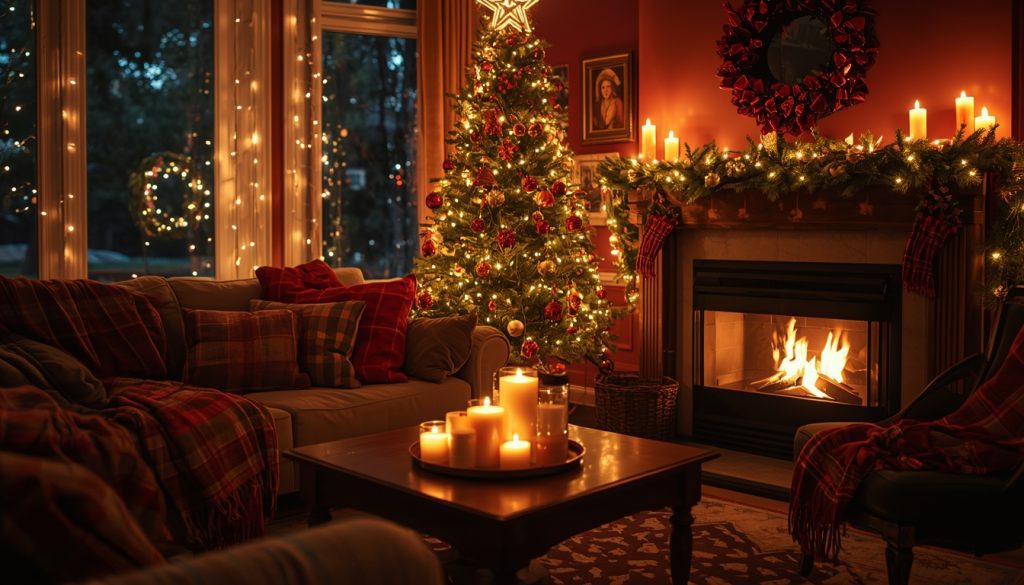
My living room used to look terrible at Christmas. Not bad-terrible. More like… trying-too-hard-terrible. I’d buy a bunch of stuff, spread it around, and end up with a room that felt busy without feeling festive. Decorations everywhere and somehow no atmosphere at all.
The turning point was the year I spent maybe $180 on new Christmas stuff and my mom walked in and said “oh, did you not decorate yet?” That was a low moment. A clarifying one, though.
I started paying attention to what was actually working versus what I was just buying because it was December and I felt like I should. These 17 decorating ideas living room for Christmas are the ones that survived that sorting process. Some I’ve used for years. A couple I stumbled onto by accident. All of them genuinely change how the room feels — not just how it looks in photos.
How to Make Your Living Room Feel Magical This Christmas
Here’s what I figured out after years of getting this wrong: the rooms that actually feel magical at Christmas aren’t the ones with the most stuff. They’re the ones where the lighting is right. That’s it. Lighting is doing 60% of the work in any Christmas room that actually feels good. Everything else is secondary.
Get warm light going — tree lights, a few candles, some string lights tucked in around the room — and even a half-decorated space looks genuinely festive. Bright overhead lighting on everything kills the atmosphere instantly no matter how many decorations you have out.
Second thing: pick a color and stick to it. I’ll say more on this in idea #3. But one color story throughout the room is what separates “decorated” from “looks like a store display.” Those are the two big ones. The 17 ideas below do the rest.
17 Decorating Ideas Living Room for Christmas
None of these are complicated. Some take ten minutes. A couple need an afternoon. I’ve included rough costs in US dollars where it’s relevant because most of these are genuinely affordable — Christmas decorating doesn’t have to cost a fortune to look good.
1. Add Warm String Lights for a Soft Festive Glow
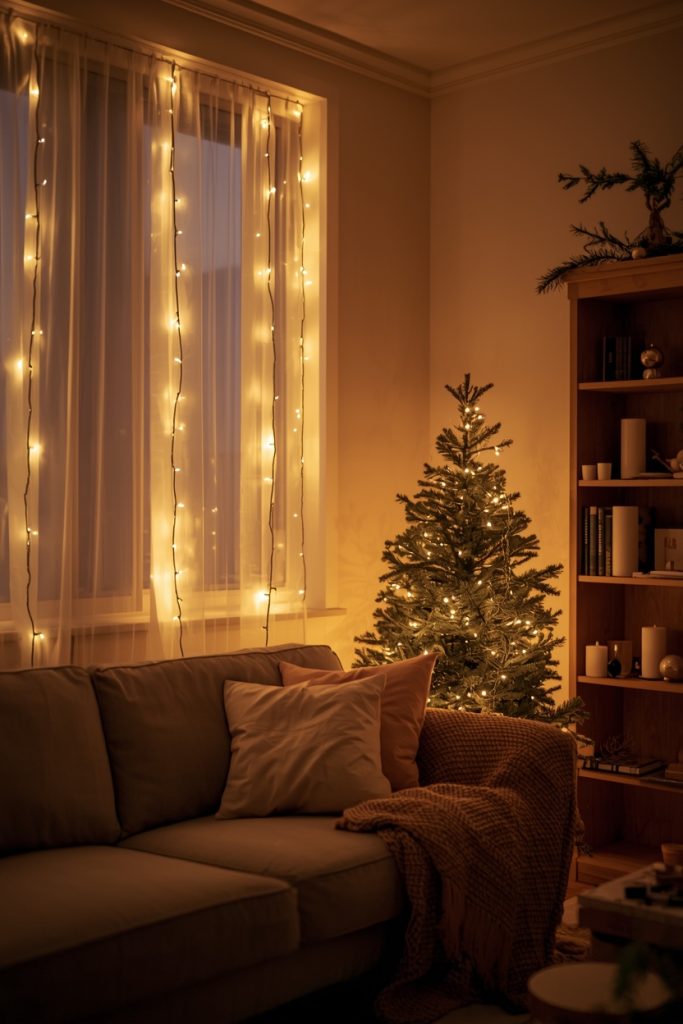
Okay so I went a little overboard with string lights for a few years. We’re talking seven or eight sets draped over everything. My wife called it “the incident” and refused to help put them up. Eventually I dialed it back and learned that two or three sets in the right spots beat eight sets hung randomly.
Warm white only — and I mean specifically warm white, not the cool blue-tinted kind that comes in most big box store packs. Look for anything labeled “soft white” or “warm white” or 2700K. That’s the amber-honey glow that actually looks like Christmas. The cool white ones look like an office party. A decent 33-foot set of warm white lights runs about $10–$14 at Target or Amazon.
Best spots: tucked behind a sheer curtain so the fabric diffuses the glow. Along the top of a bookshelf. Wound through a garland on the mantle. Not draped loosely over a window frame — that looks like you ran out of ideas halfway through. I put mine on a timer ($8 at any hardware store) so they click on automatically at 5pm. Walking into the house in December and having the room already glowing when you open the door is one of those small things that genuinely makes the holiday feel different.
2. Layer Cushions and Throws for a Cozy Look
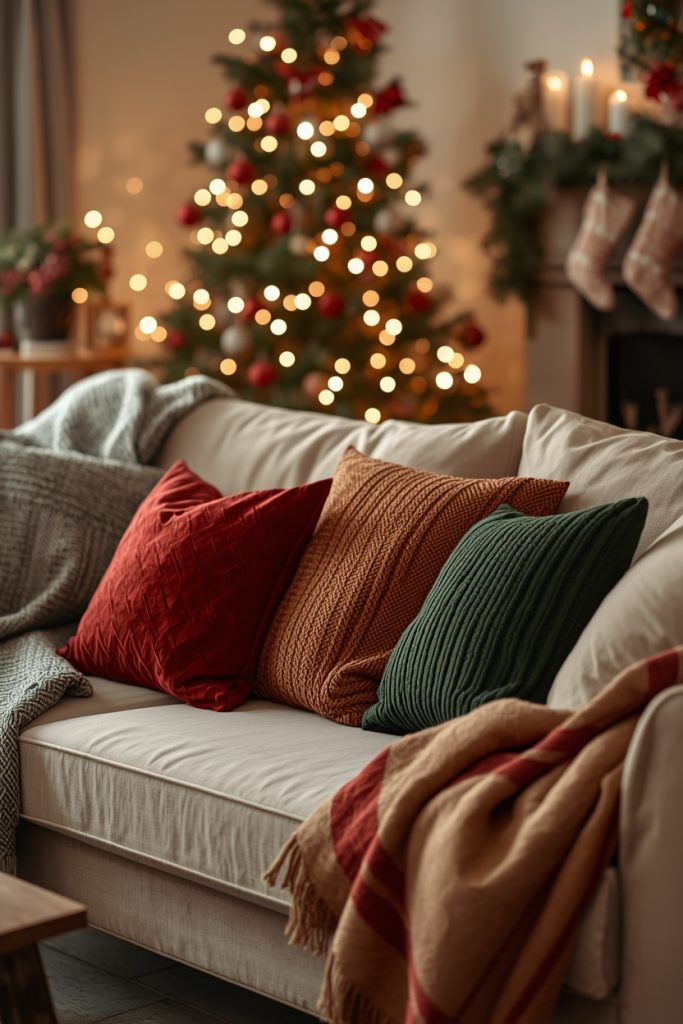
My couch sits there in its boring beige all year long and I don’t think much about it. Then the first weekend of December I throw two red velvet cushion covers on it (same inserts I use all year — just swapped the covers, cost me $16 for the pair at HomeGoods), toss a plaid throw over one arm, and suddenly the whole sofa looks intentional. Seasonal. Like someone who actually cares about their home lives there.
The mistake most people make here is buying a whole matching set of Christmas cushions. All the same red. All the same pattern. All put out at the same time. Looks like the couch was dressed by a store mannequin. Instead: keep two of your regular cushions in place and just add two festive ones in. Mix the textures — one velvet, one knit, one plaid. The variety is the thing that looks good.
Throws are even easier. Chunky knit in cream or ivory — about $25–$30 at any home store — draped loosely over the armrest. Not folded. Not draped symmetrically. Just casually left there like you were using it. That lived-in look is what makes a room feel cozy versus staged. Staged is the enemy of cozy.
3. Choose a Simple Festive Color Palette
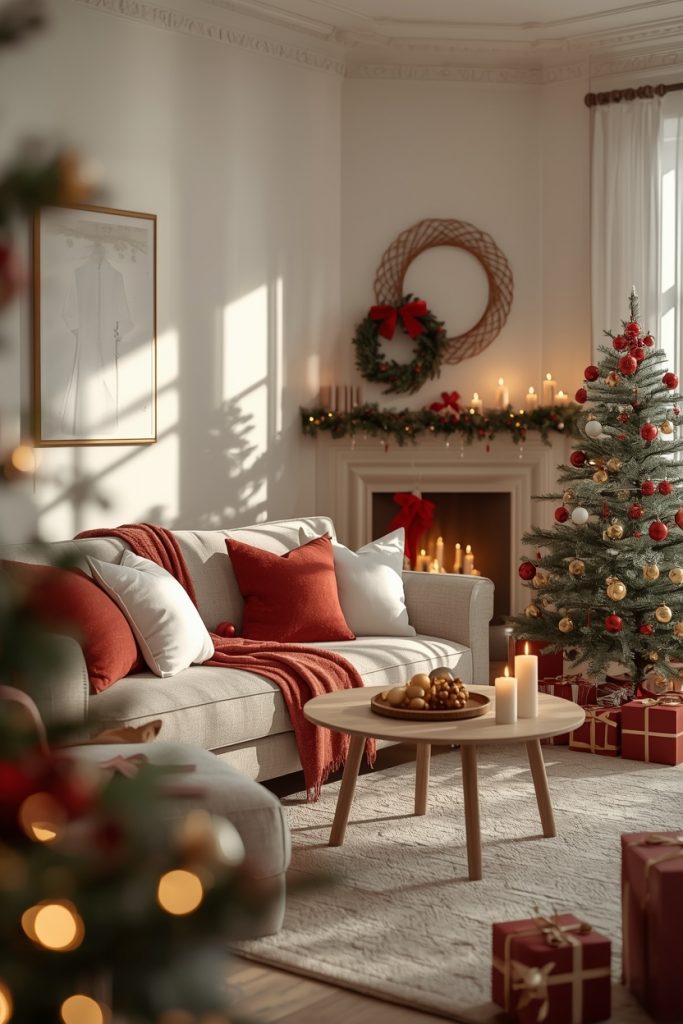
The worst Christmas my living room ever looked was the year I decided to use “all the colors.” Red ribbon on the tree. Blue ornaments on the mantle. Silver garland. Gold candle holders. Green wreaths. Burgundy cushion covers. I stood back and looked at it and it looked like a Christmas aisle at a dollar store exploded in my living room.
Two colors. Three maximum. That’s the whole rule. My current setup is deep red and cream with touches of natural green. That’s it. Red ribbon through the garland. Cream and red ornaments on the tree. Red velvet cushion covers. Cream throw. Everything speaking the same two-color language and it looks a hundred times more expensive than that dollar store explosion did, despite me spending about $40 total on seasonal items that year versus the $120 I’d spent on the chaos year.
Classic combos that never go wrong: deep red and cream. Forest green and gold. Burgundy and blush (more modern). Navy and silver. Pick one combination, buy everything in those tones, and don’t deviate. When you find an ornament you love that’s the wrong color — leave it in the store. The discipline is everything. Why this matters for christmas decorated living rooms: The rooms that look like they were designed rather than just decorated all have one thing in common — you can tell what the color story is within about three seconds of walking in. A room with no color story just looks busy.
4. Use Candles to Create a Relaxing Holiday Mood
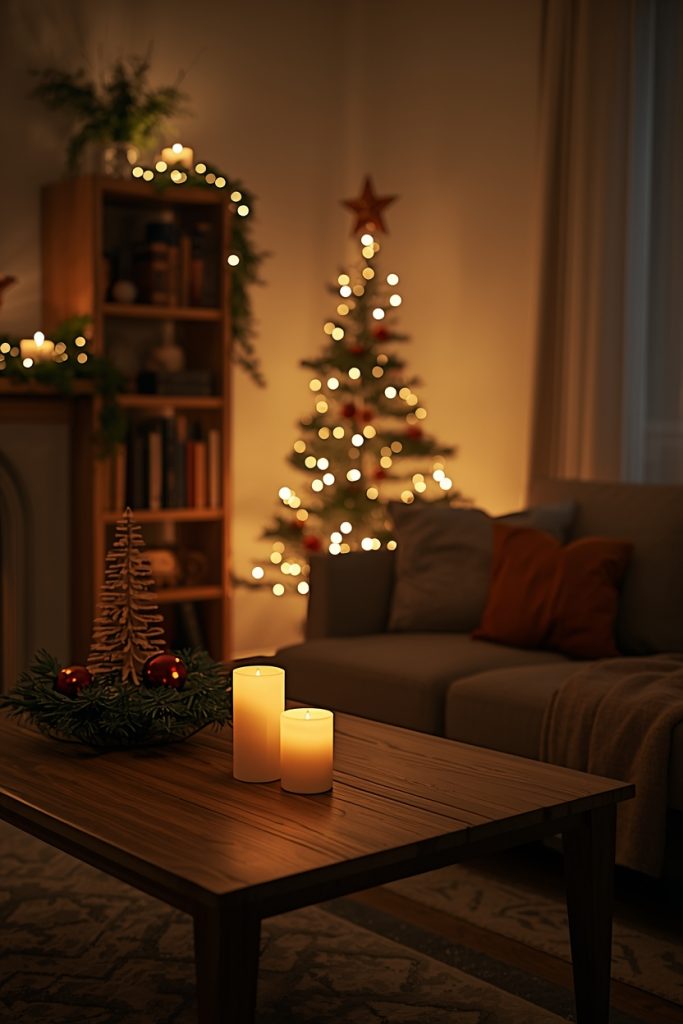
I don’t use a single ceiling light in my living room after about 5pm in December. Just candles, the tree lights, and one lamp on a dimmer. People walk into our place in December and immediately say something about how it feels — warm, calm, like Christmas should feel. The candles are doing most of that work.
How I arrange mine: a wooden serving board (already owned, cost nothing extra) on the coffee table as the base. Three white pillar candles at different heights — I buy mine from IKEA for about $3–$5 each. A couple of pine cones tucked between them. One sprig of rosemary or eucalyptus from the grocery store florist section, maybe $2. Total cost: under $20 and it looks like something out of a magazine.
If you’ve got kids or pets and open flames are genuinely a bad idea — totally fair — the battery-operated LED pillar candles from Amazon have gotten so realistic that I’ve had guests lean in to blow them out. Around $15–$20 for a set of three and they run for weeks on batteries. For scent (since flameless obviously won’t do that), a plug-in wax warmer nearby handles it. One scent. Don’t mix multiple scents in one room — it gets overwhelming fast.
Scent tip: Cinnamon-clove is the classic American Christmas scent. Cedarwood-and-vanilla reads warmer and less spicy if that’s more your vibe. Either way, pick one and use it consistently through December — it becomes part of the memory of your holidays.
You may also like: 11 Aesthetic Living Room Decor Ideas to Instantly Elevate Your Space in 2026 – 23 Green and Beige Living Room Designs That Will Make You Fall in Love With Earthy Tones
5. Make Your Christmas Tree the Center of Attention
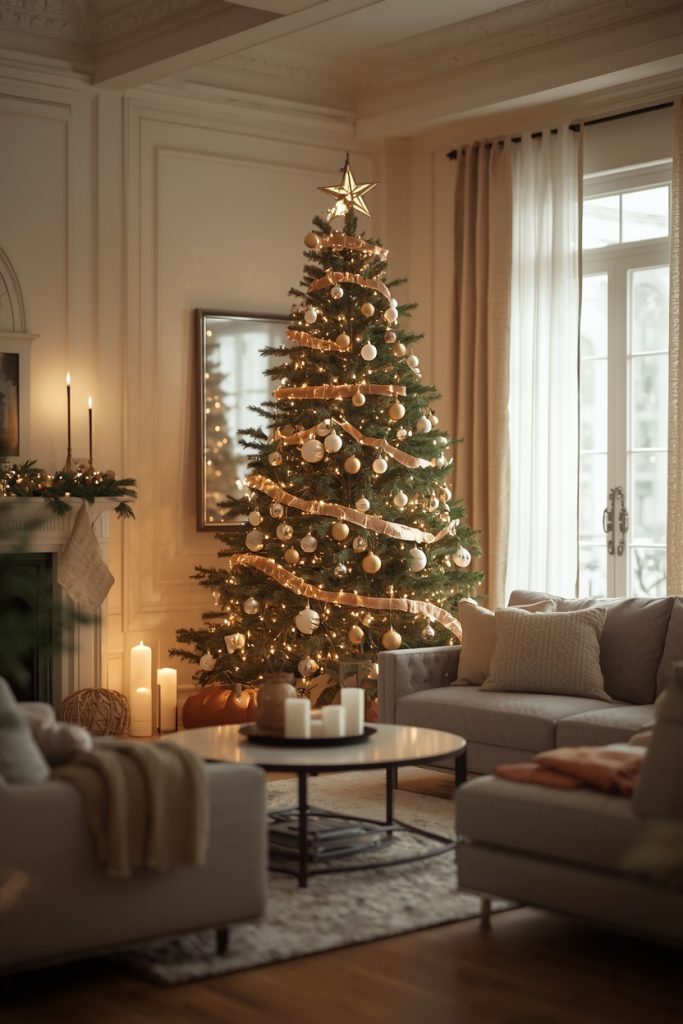
For the first three years in our current house I put the tree in front of the window because that’s what you do, right? You can see it from outside. Looks festive from the street. Except our main seating all faces the opposite wall. So my family sat on the couch and looked at the back of the tree all December.
Move the tree to where your seating faces. That sounds obvious but most people default to “in front of the window” without thinking about the actual sightlines. Corner placement near the sofa — so you see the tree while sitting — makes the living room feel completely different during the holidays. Every evening you’re sitting in the glow of it rather than having it exist in a part of the room you’re not looking at.
For decorating the tree: string lights first, starting at the trunk and working outward and upward. This gives depth. Then larger ornaments on the inner branches, smaller ones toward the tips. Edit your ornament collection before you start — pull out anything that doesn’t fit your color palette and box it. A tree with 35 ornaments in two colors looks better than a tree with 90 ornaments in eight colors. Trust me on this. I own about 200 ornaments and I only put maybe 50 of them out at a time now.
Don’t skip the tree skirt: A bare trunk in a plastic stand at the bottom of the tree will ruin the whole look. Any tree skirt — even just a length of burlap at about $5 from a craft store, or a woven basket around the base — makes an enormous difference to how finished the tree looks from the bottom up.
6. Style Your Fireplace for a Classic Holiday Feel
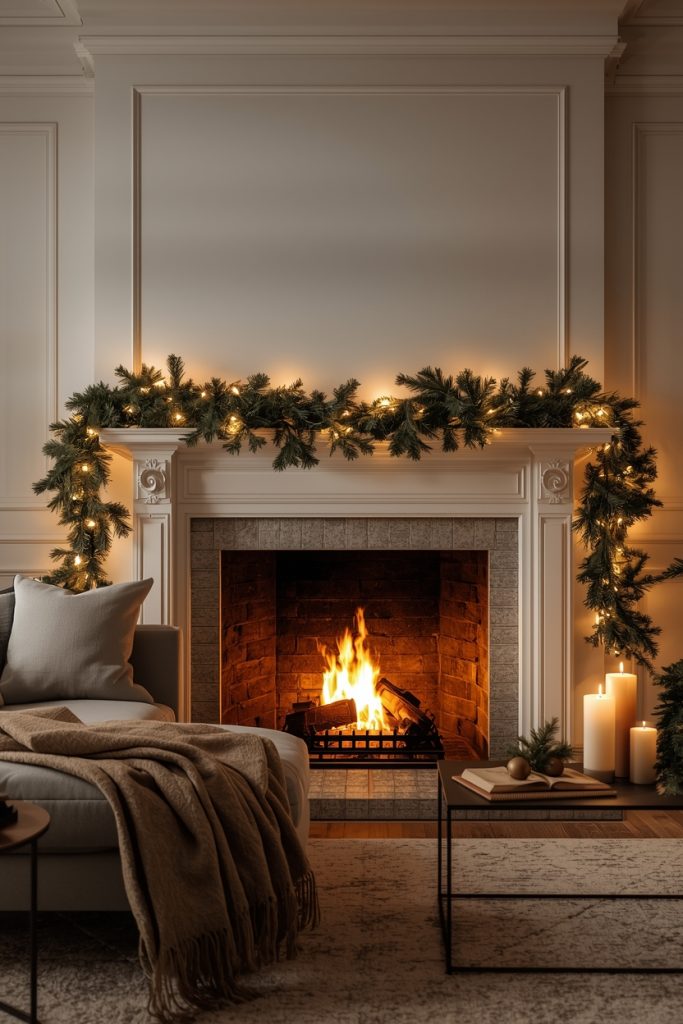
We got our first house with a fireplace three years ago and I genuinely didn’t know how much it would change December. It’s the anchor of the whole living room once it’s decorated. If you have one — use it properly. A neglected or bare mantle in an otherwise decorated room is a missed opportunity.
The garland goes on first. I drape a mixed fir-and-eucalyptus garland across the mantle every year — real when I can get a fresh one from the tree farm for about $20–$25, a good quality faux one the years I can’t (the IKEA VINTERFINT garland is about $10 and looks genuinely decent once you fluff it out and add lights). Let it drape naturally rather than stretching it flat and tight. A garland that sags a bit in the middle looks real and abundant. A garland stretched taut looks like wallpaper.
On top: two brass candlestick holders at the outer ends (I found mine secondhand for $8 total), a couple of small lanterns in the middle, pine cones scattered across the garland. Stockings hung from hooks — actual stocking hooks, not just draped over the edge. Don’t have a fireplace? A large cluster of varying-height candles in front of a floor mirror achieves a surprisingly similar warm-hearthside effect. Seriously, try it.
7. Create a Cozy Corner for Relaxing Evenings
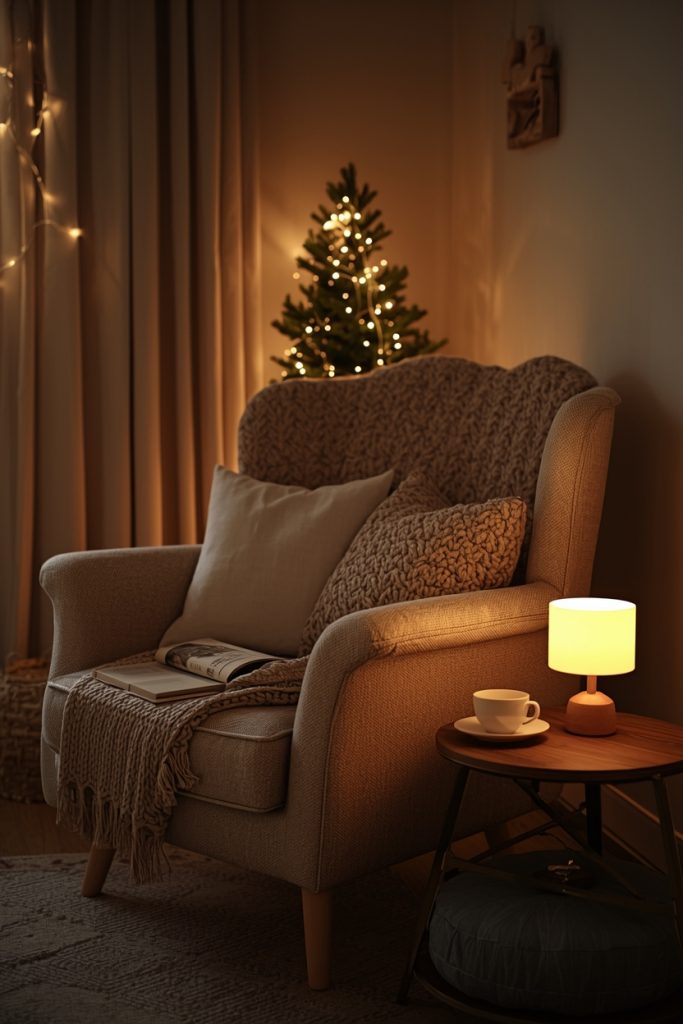
This one sounds too simple to be on the list. It’s not. This is the idea that changed how December actually felt in our house — not just how it looked.
My wife turned the armchair in the corner of our living room into her Christmas spot. Plaid throw over the back. A small lamp on the side table beside it (warm bulb, dimmed low). A candle. Space for her coffee. That’s the whole thing. But every evening in December she goes and sits in that corner with a book or just sits there in the tree light and the lamp glow, and it’s the spot in the house that feels most like Christmas. More than anywhere else.
Set one up deliberately. Chair, lamp, throw, side table. Pick the spot with the best view of your tree. Tell yourself — and mean it — that this corner is for sitting and being in December, not working, not scrolling, not multitasking. That distinction matters more than the decorations. You spend all this money and effort making the room feel good and then you sit in it staring at your phone. Don’t.
8. Use Natural Decor for a Budget-Friendly Setup
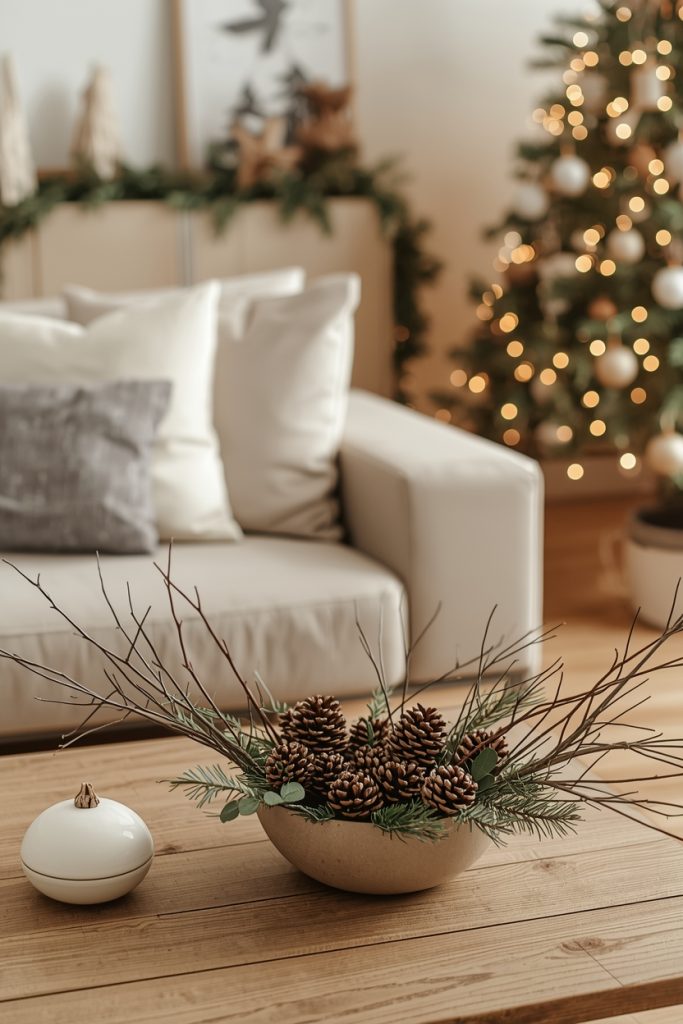
Some of my favorite Christmas decorations cost me almost nothing and they’re the ones I’ve had the longest. A bowl of pine cones I collected at a state park in October — free. I hit them with gold spray paint from a $4 can and they’ve looked good every year since. Cinnamon sticks bundled together with kitchen twine and placed in a mason jar — maybe $3 total. Dried orange slices I made myself: slice thin, lay on a baking rack at 200°F for two to three hours, done. They smell incredible and look gorgeous scattered on the mantle or in a bowl. Cost: one orange.
Natural elements are special because they make the room smell as good as it looks. A $6 bundle of fresh eucalyptus from Trader Joe’s or a grocery store florist fills the entire room with a clean, fresh scent and looks stunning draped anywhere — over a lamp, tucked into a garland, in a vase on its own. Fresh rosemary is similar and even cheaper. A sprig of rosemary tied with a red ribbon on a table is genuinely beautiful and costs maybe fifty cents.
Free decor worth trying: Walk your neighborhood or a local park before buying anything. Pine cones, interesting seed pods, bare branches you can spray white or gold — all of these become genuine Christmas decor for zero dollars. Some of our most-complimented pieces every year are things we found on a walk.
9. Decorate with Simple Ornaments That Still Look Beautiful
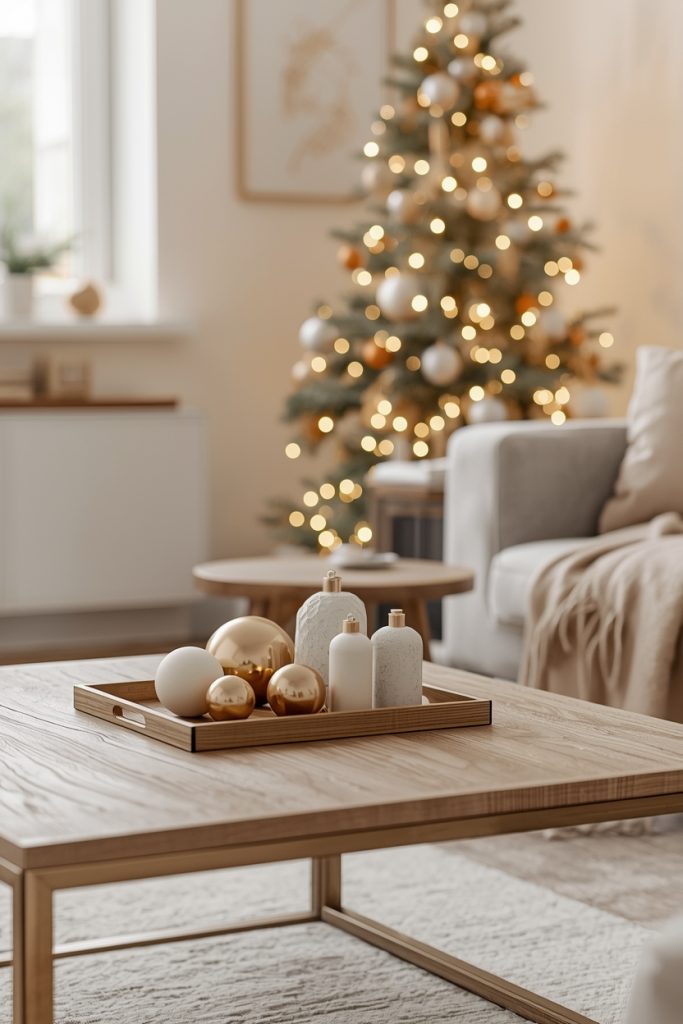
I have way too many ornaments. Like, genuinely too many — my wife has pointed this out multiple times. So a few years ago when the tree was full and I still had a box left over, I put some in a big glass bowl on the coffee table just to deal with the overflow situation. Then I looked at it and thought — oh that actually looks really good.
A clear glass bowl or a wooden bowl filled with ornaments in your color palette is one of the easiest Christmas displays you can create. It takes literally four minutes and looks intentional and styled. Just pick ornaments in consistent tones — all glass in reds and golds, or all matte in cream and copper, whatever your palette is — and pile them in. Don’t mix colors randomly or it just looks like overflow storage. Keep the tones consistent and it looks like a design decision.
Individual ornaments work on shelves too. A single mercury glass ornament standing among your books on the bookshelf. A large glass ball ornament hung from a bookshelf bracket. Two or three small ornaments nested in a little bowl beside the lamp. None of these take any time to set up and they make the room feel more decorated everywhere rather than just at the tree.
10. Rearrange Furniture for a Fresh Holiday Layout
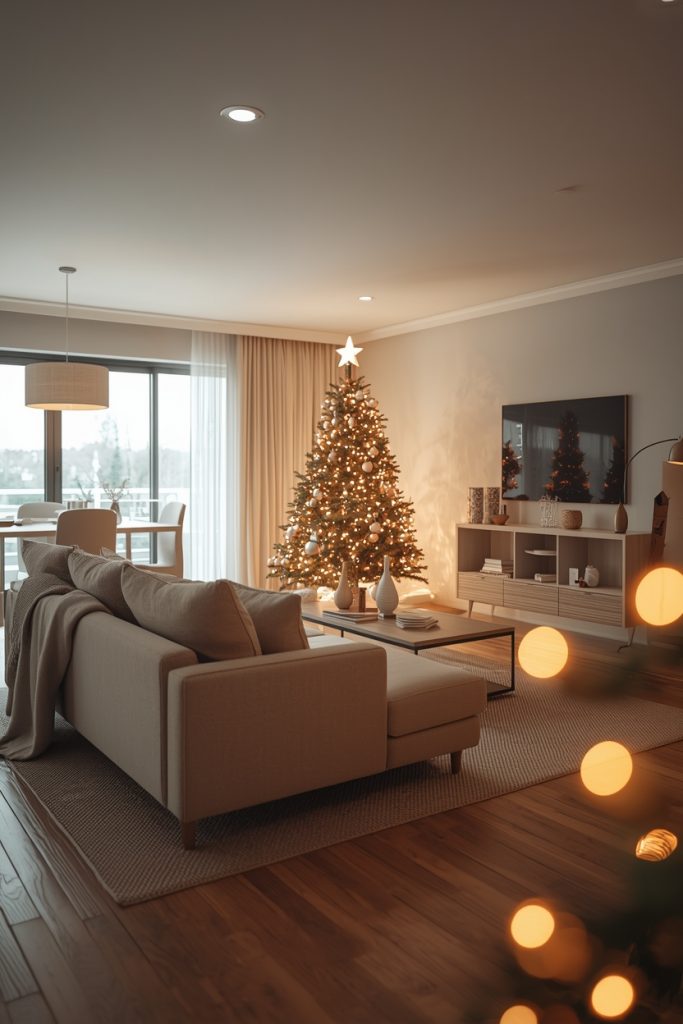
Before a single decoration goes up every year, I move the furniture. Not a big rearrangement — but specific moves that make the Christmas version of the room work better than the regular version. Our living room is laid out for everyday life, not for living around a six-foot tree and wanting clear views of it from the couch.
The sofa comes forward about a foot so the tree can go in the corner behind and beside it. The armchair rotates slightly toward the tree. The coffee table shifts closer to the sofa. These three moves take maybe fifteen minutes and they fundamentally change how the room functions for Christmas. Suddenly the tree is in direct sightlines from every seat. The walking path to it is clear. The room has been adjusted for the season rather than forcing the season into the room as-is.
Also part of the furniture rearrangement: clearing out non-Christmas decorative objects. The regular stuff that lives on the shelves and the mantle all year gets boxed up and stored. Christmas decorations go in. You can’t layer seasonal decor on top of your year-round stuff without the room looking cluttered and confused. Clear it out first. Put it all back in January. The seasonal edit is part of what makes the Christmas room feel properly festive.
11. Add Gold Accents for a Touch of Luxury
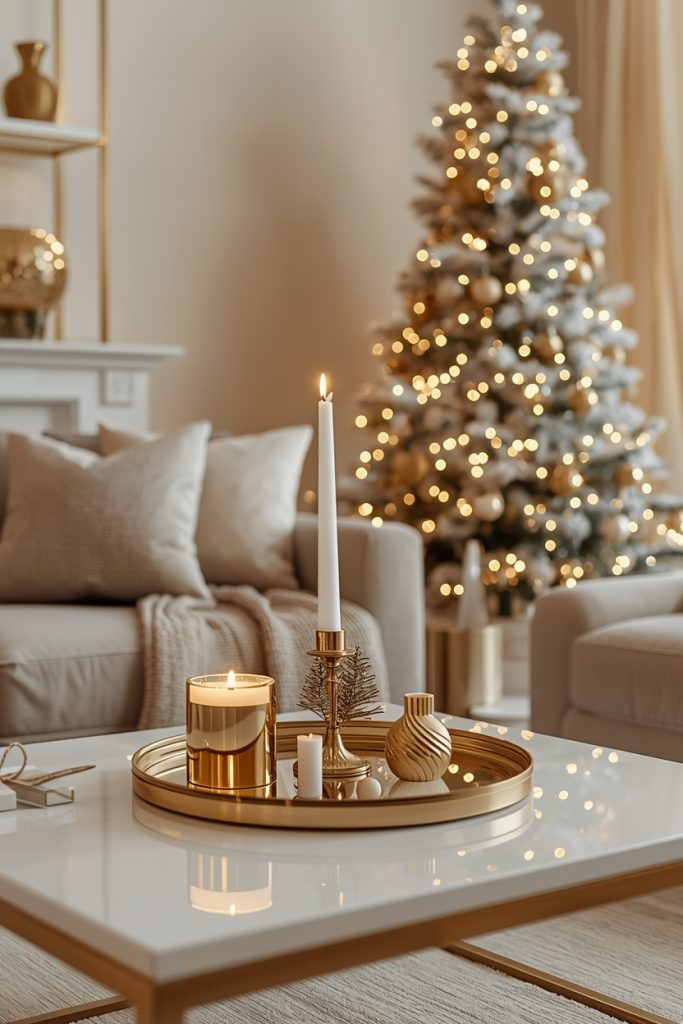
There is a big difference between garish gold and warm gold and it matters a lot at Christmas. The cheap shiny gold — the kind on a lot of dollar store ornaments and foil garland — looks harsh and fake in candlelight and photographs terribly. Brushed gold or antique brass looks warm, expensive, and genuinely beautiful.
I found a set of three brass candlestick holders at a thrift store for $6 total. They’ve been on my Christmas mantle every year since. They look incredible next to the fir garland and the warm string lights woven through it. Old brass tones actually photograph better than polished gold because they catch the warm light instead of reflecting it.
Other spots for gold: a few gold glass ornaments mixed into the tree. Gold ribbon woven through the garland instead of or alongside the usual red. A gold serving tray on the coffee table holding the candle arrangement — Target usually has these for around $15–$20. A gold star tree topper (about $8–$12 at most stores). None of these items need to be expensive. What matters is that they’re warm-toned and brushed rather than shiny, and that they appear throughout the room rather than clustered in one place.
You may also like: 13 Stunning Green and Yellow Living Room Ideas That Will Transform Your Space in 2026 – Brighten Up Your Home: 13 Spring Living Room Decor Ideas 2026
12. Use Garlands to Elevate the Space
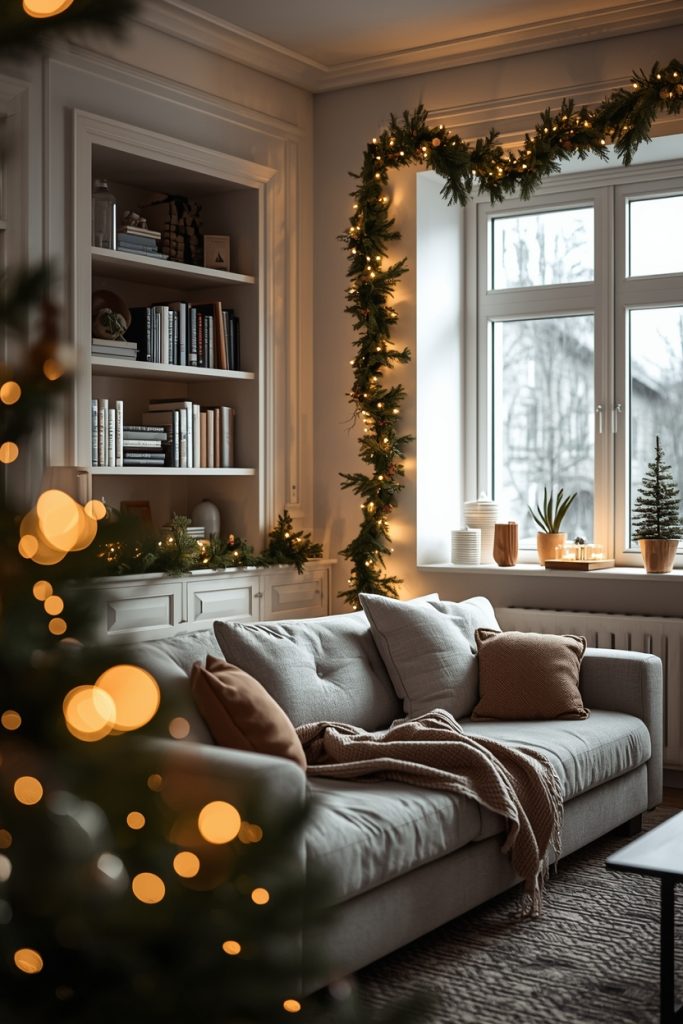
If I had to pick one Christmas decoration that does the most work in a living room, it’s a garland. Not the tree, not the lights, not the cushions. A well-placed garland with some lights woven through it turns a regular room into a Christmas room faster than anything else I’ve tried.
The mantle is the obvious spot and for good reason — a garland draped across a fireplace mantle with lights woven through it is genuinely one of the most beautiful things a living room can look like in December. Let it sag slightly in the middle rather than pulling it tight. The natural drape looks real and lush. Pulled tight it looks like a garland-shaped thing on a surface rather than an actual garland.
Beyond the mantle: the top of a tall bookcase is my second favorite garland spot. It brings the Christmas decoration up to the top of the room and makes the whole space feel more festive without taking up any surface area at eye level. A 6-foot garland from Target or Home Depot runs about $15–$25 depending on quality. A decent faux one with micro-lights already built in is the most convenient option — prices start around $25 and last for years.
Real vs. faux: Fresh garland from a tree farm smells incredible for the first week — pure pine and fir smell, nothing artificial comes close. But it starts dropping needles around day ten. If your decorations go up before December 10th, buy fresh as late as possible and mist it with water every day or two. Faux is more practical for anyone who wants the garland up for the full season.
13. Try a Minimal Christmas Style for a Clean Look
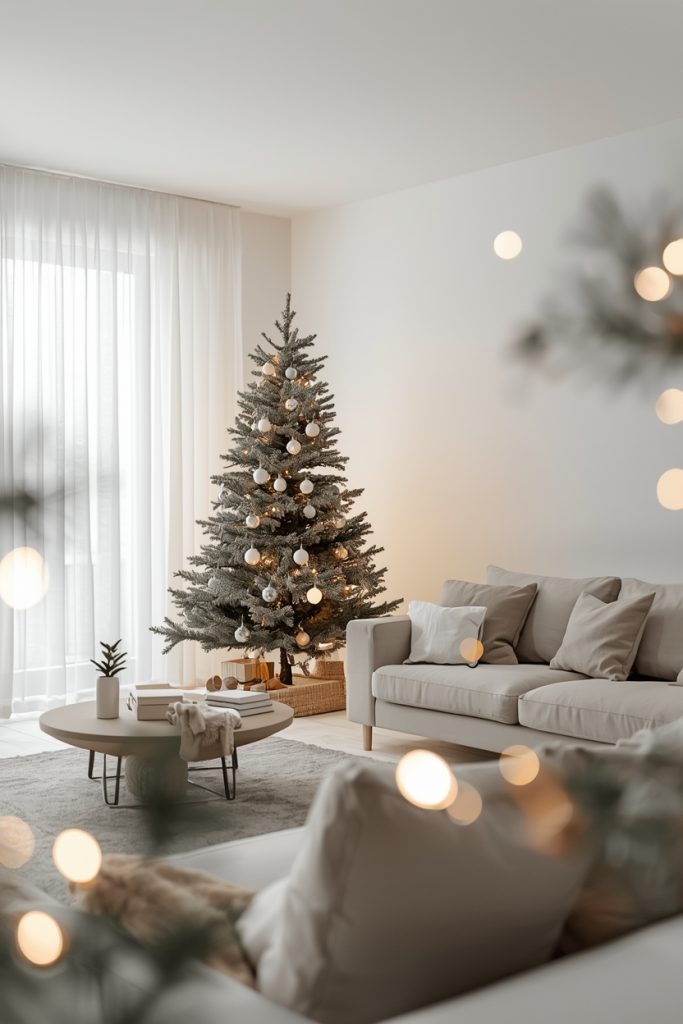
My neighbor has the most minimal Christmas living room I’ve ever seen and it’s consistently the most beautiful one on our street. One slim tree in the corner. White lights only, no ornaments except for about twenty clear glass balls. One wreath on the wall. A single candle on the coffee table. That’s it. The whole room. And it looks more peaceful and intentional and genuinely festive than any over-decorated room I’ve been in.
Minimal Christmas is harder than it looks because you have to resist everything. Every cute ornament at the store. Every sale on throw pillows. Every new garland idea. The room only works because she edits ruthlessly. She told me once that before she puts anything Christmas-related out, she has to answer yes to: “does this add to the room or just add to the room?” That question has stuck with me.
If this style appeals to you: pick cream and natural green as your palette. One tree with only white lights. One piece of art on the wall — a simple wreath or a framed botanical print. One good candle. Resist everything else. The payoff is a room that feels calm and refined rather than busy, and that actually looks better in photos than most maximalist setups do.
14. Decorate a Small Living Room Without Clutter
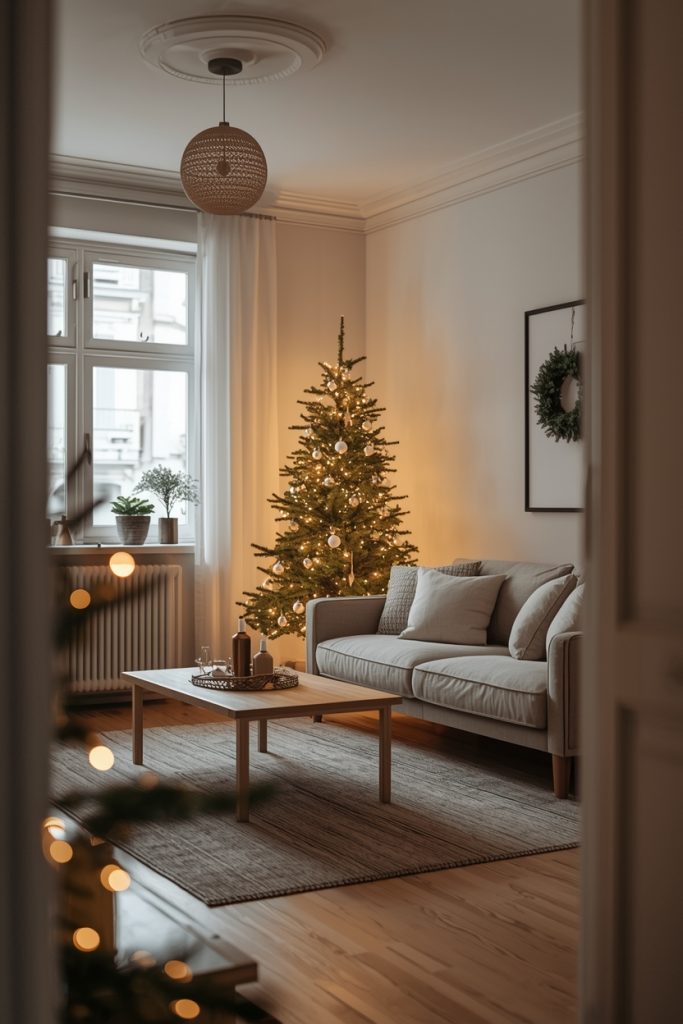
Our first apartment had a living room that was maybe 140 square feet. Getting it decorated for Christmas without it feeling like a storage unit was genuinely challenging. What I learned: everything has to go up, not out. Horizontal surface space in a small room is too limited and too valuable. Vertical space — walls, shelves, window frames — is where Christmas decorating happens in a small room.
A large wreath hung on the main wall above the sofa (not on the door — on the actual living room wall) takes up zero floor or surface space and instantly makes the room feel decorated. A slim, upright tree rather than a wide bushy one — the skinny ones that look like they’re standing at attention are perfect for tight spaces and actually look more elegant than a wide tree in a small room. Floating shelf displays instead of table displays. Garland along the top of the window frame rather than across every surface.
The other rule for small rooms: three well-chosen items in your palette look better than ten mixed ones fighting for space. A small room amplifies clutter. It also amplifies intentionality. Three perfect things in a small room make a bigger impact than the same three things in a large one.
15. Use Wall Space Instead of Floor Decor
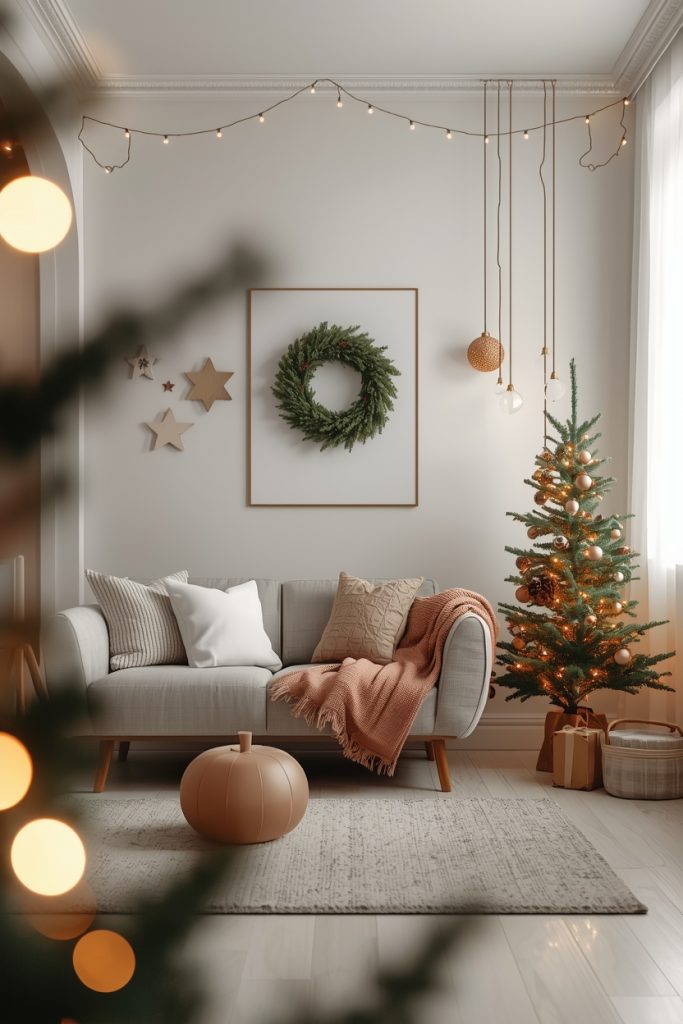
I ran out of surfaces a few years back. Every shelf was full, every table had something on it, the coffee table display was as full as it could be. Then I stood back and looked at the walls — mostly bare. Missed opportunity. Huge one.
A large wreath hung above the sofa on the main wall is probably the single best wall Christmas decoration in a living room. It’s a statement piece that costs nothing in terms of floor or surface space. A 24-inch wreath with warm white lights costs about $25–$40 and completely transforms the main wall of the room. It draws the eye immediately when you walk in and gives the room a proper Christmas focal point that doesn’t compete with the tree.
Other wall ideas worth trying: three small wreaths hung in a vertical line on a blank wall — looks intentional and interesting, about $10–$15 total if you buy simple ones. String lights pinned in the shape of a Christmas tree on a blank wall ($14 worth of lights, fifteen minutes, impressive result). A length of garland draped horizontally across the top of a large window frame. All of these use the vertical space that most living rooms waste at Christmas.
16. Add Holiday Scents for a Complete Experience
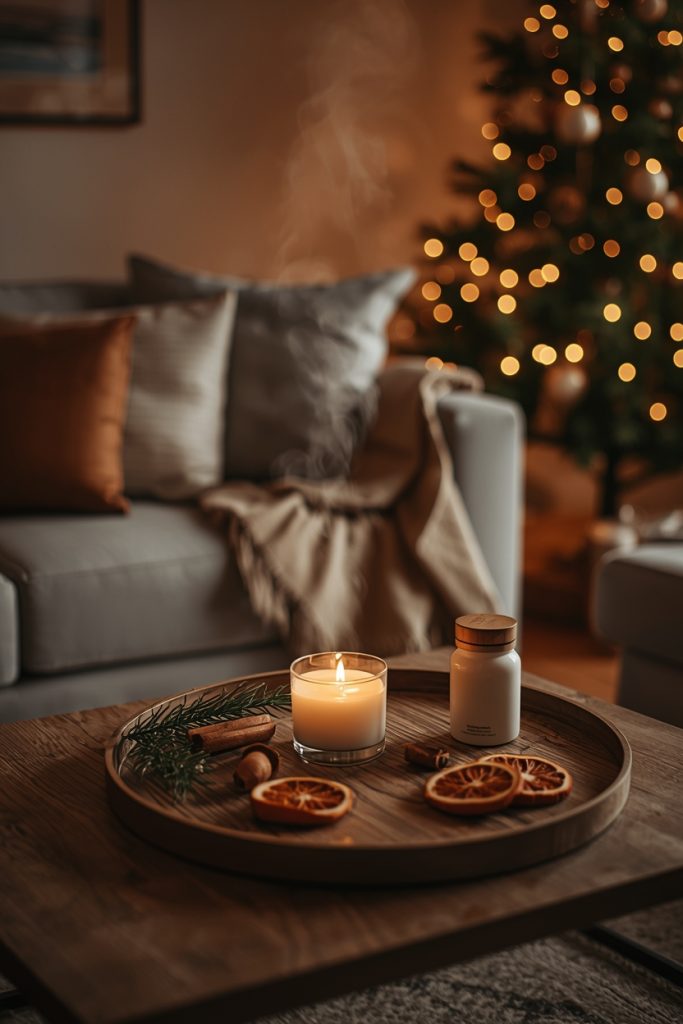
My mom’s house always smelled a specific way at Christmas. Cinnamon and clove from the candles she burned in the kitchen, the fresh pine from the tree, something warm and vanilla in the background. Walking into that house in December was — and still is — one of the most immediately comforting sensory experiences I know. The smell is doing something that no visual decoration can do.
My approach at home: one primary scented candle as the anchor. I’ve been buying the same Balsam & Cedar candle from Bath & Body Works ($16.95 — they run sales frequently) for five years now because December smells like that in our house now and I don’t want to change it. Around that: a bowl of dried orange slices and cinnamon sticks on the coffee table that gives off a gentle spice scent passively all day. Fresh eucalyptus from Trader Joe’s (about $4 a bundle) tucked into the garland adds a clean, herbal note.
The rule is simple: one strong primary scent, one or two subtle passive scents. More than that and they start to compete. If the room smells like three different things at once it’s just confusing rather than festive. Less is more with scent — even more so than with visual decoration.
17. Style Your Coffee Table with Simple Decor
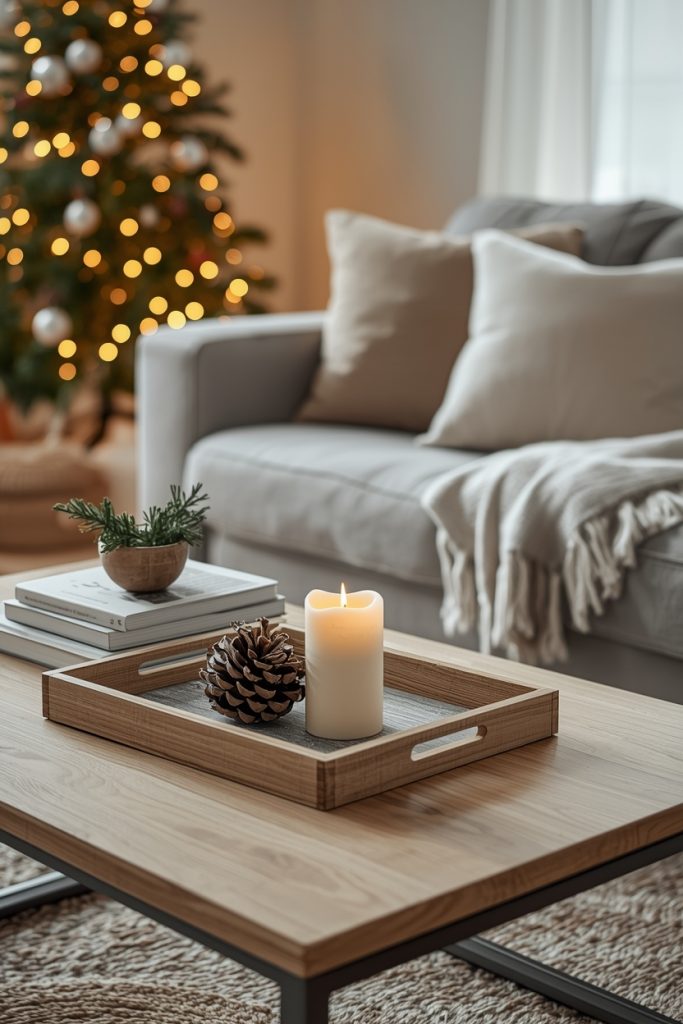
The coffee table is the most-looked-at surface in a living room. Everyone who sits on the sofa stares at it. It’s in your eyeline from basically every seat. Every time someone comes in, they walk past it. Getting the Christmas coffee table right is worth the attention.
The tray method: put a tray down first, then build the display inside it. This is the single most useful styling trick I know for surfaces. Without the tray, a collection of objects on a coffee table looks like stuff you left there. Inside a tray, the exact same objects look like a curated display. I use a wooden serving tray I already owned — no extra cost. Inside it: three white pillar candles in different heights from IKEA ($3–$5 each), a couple of pine cones, a small red ribbon bow, and a sprig of eucalyptus. Total cost including the tray I already owned: about $15.
The one thing I always remind myself: leave some of the coffee table outside the tray clear. It needs to function as an actual table — drinks, remotes, books. A coffee table you can’t use because it’s been fully converted into a Christmas display is annoying. The tray keeps the festive arrangement self-contained and the rest of the table functional.
Practical tip: Press one or two pine cones and the eucalyptus sprig gently against the inside edge of the tray so they look tucked in. Objects that look “placed” inside a tray look casual and real. Objects sitting rigidly in the center look staged.
Simple Christmas Decorating Checklist
If you want a logical order to work through this, here it is. I do the lighting and furniture moves first because those set the foundation — everything else builds on them.
✅ CHRISTMAS LIVING ROOM — THE ORDER I GO IN
- ◻ Move furniture for Christmas layout (sofa forward, chair toward tree)
- ◻ Clear out year-round decorative objects and box them
- ◻ Swap bulbs to 2700K warm white throughout the room
- ◻ Decide on 2–3 color palette — commit to it before buying anything
- ◻ Set up and light the Christmas tree — skirt, lights, then ornaments
- ◻ Add string lights — behind curtains, along bookshelf, in garland
- ◻ Style the fireplace mantle — garland, candles, stockings
- ◻ Set up cozy corner — chair, throw, lamp, side table
- ◻ Swap in festive cushion covers, add throw to sofa
- ◻ Set up coffee table tray display
- ◻ Add garland to bookcase top or window frame
- ◻ Hang wall wreath above sofa
- ◻ Place natural decor — pine cones, eucalyptus, dried oranges
- ◻ Add gold accents — ribbon, candlestick holders, tray, tree topper
- ◻ Set up scent layer — primary candle, passive bowl display
- ◻ Put overflow ornaments in a bowl display on a side table
- ◻ Set lights on a timer ($8 at hardware store — completely worth it)
- ◻ Final edit — remove anything that doesn’t fit the color palette
Common Mistakes to Avoid
I’ve made every single one of these. Some repeatedly.
❌ WHAT ACTUALLY GOES WRONG IN CHRISTMAS LIVING ROOMS
- Too many colors. Red and blue and silver and gold and green all in one room. It looks like the Christmas aisle at a drug store. Two colors, max three. That’s it.
- Cool white string lights. They look cold and harsh. Warm white only. This matters more than almost any other single decision.
- Keeping the overhead lights on. Bright ceiling lights kill Christmas atmosphere completely. Switch to lamps, tree lights, and candles after 5pm. The room changes immediately.
- Decorating without clearing. Adding Christmas stuff on top of your regular stuff. The room ends up looking crammed rather than festive. Clear out the year-round objects first.
- Tree in front of the window when your seating faces the other wall. Put it where you’ll actually be looking at it.
- Garland stretched tight on the mantle. It looks flat and fake. Let it drape naturally with a gentle sag in the middle.
- Spending a lot hoping it’ll look better. A $200 collection of mismatched decorations will always look worse than $60 worth of things in a consistent color palette. It’s the cohesion, not the cost.
Conclusion
December is one month. The living room is where the whole family spends most of it — watching movies, opening gifts, having people over, or just sitting in the quiet after everyone else has gone to bed. It’s worth getting it right.
You don’t need to do all 17 of these. Pick five that feel most achievable for your room and budget, do those well, and stop there. A few things done thoughtfully beat a lot of things done randomly every single time.
Start with the lights. Warm white string lights on a timer, overhead light off. The room will tell you what it needs next.
📌 Save this to Pinterest so you can find it when December rolls around. And if one of these ideas genuinely changed how your living room looked this year, drop it in the comments. I actually read them — the specific ones, not the “great post!” ones.
FAQs
What is the easiest way to decorate a living room for Christmas?
Start with lighting and a few soft textures. These changes instantly improve how the space feels.
How can I decorate on a budget?
Use what you already have and add natural elements. Many simple living room xmas decor ideas require little to no cost.
What colors work best for Christmas decor?
Classic tones like red, green, and gold work well, while neutral palettes create a more modern feel.
How do I make my living room feel cozy?
Focus on soft lighting, comfortable fabrics, and simple styling — just like most christmas decorated living rooms.
Can I decorate a small living room effectively?
Yes, by keeping things minimal and focusing on one main area.