I spent two years and more money than I planned converting a boring rental into a full bohemian home. Most of what I know came from getting it wrong first. This is all of it.
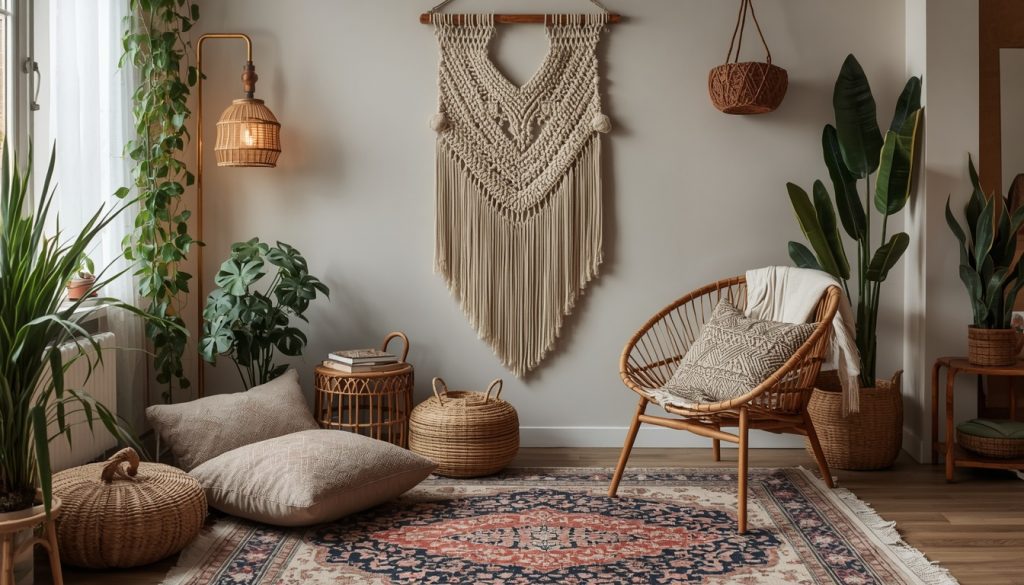
When my wife and I first moved into our current rental, the living room had grey carpet, white walls, and one of those overhead lights with a fan attached that vibrated slightly when on full speed. I’d describe the vibe as an apartment that has given up on itself. We knew immediately we wanted something different, warmer, more layered, more us and over the next two years we figured out how to get there without buying everything at once or spending money we didn’t have.
What we landed on is bohemian home decor. Not the hyper-curated Instagram version where everything matches and the plants are suspiciously perfect. The real version, where things get collected over time, nothing quite matches on purpose, and the room actually looks better with more in it rather than less. That’s the version I’m writing about here.
These 17 ideas cover every room and every budget range. I’ve put real US dollar costs throughout because articles that say affordable without saying what that actually means are useless when you’re standing in a store trying to decide what to buy.
What Makes Bohemian Home Decor Actually Work
The reason most attempts at bohemian interior design fall flat isn’t a lack of things, it’s a lack of layering. Boho rooms that look good in person and in photos almost always have three layers of visual activity happening simultaneously: something on the floor (a rug, cushions, a low table), something at eye level (furniture, wall hangings, shelves), and something overhead or at the ceiling (hanging plants, macramé, a pendant lamp, draped fabric). Flatten that into one layer and the room just looks busy. Build all three and it looks intentional.
The other thing worth knowing before you buy anything: bohemian interior spaces accumulate rather than get designed. They look best when they develop over time a rug from one store, a chair from a thrift shop six months later, a wall hanging someone gave you as a gift. The rooms that read as genuinely boho almost always have that slow-collected quality. The ones that look off are usually the ones where everything arrived in the same Target run.
17 Bohemian Home Decor Ideas
01- Layer Two Rugs Instead of Using One
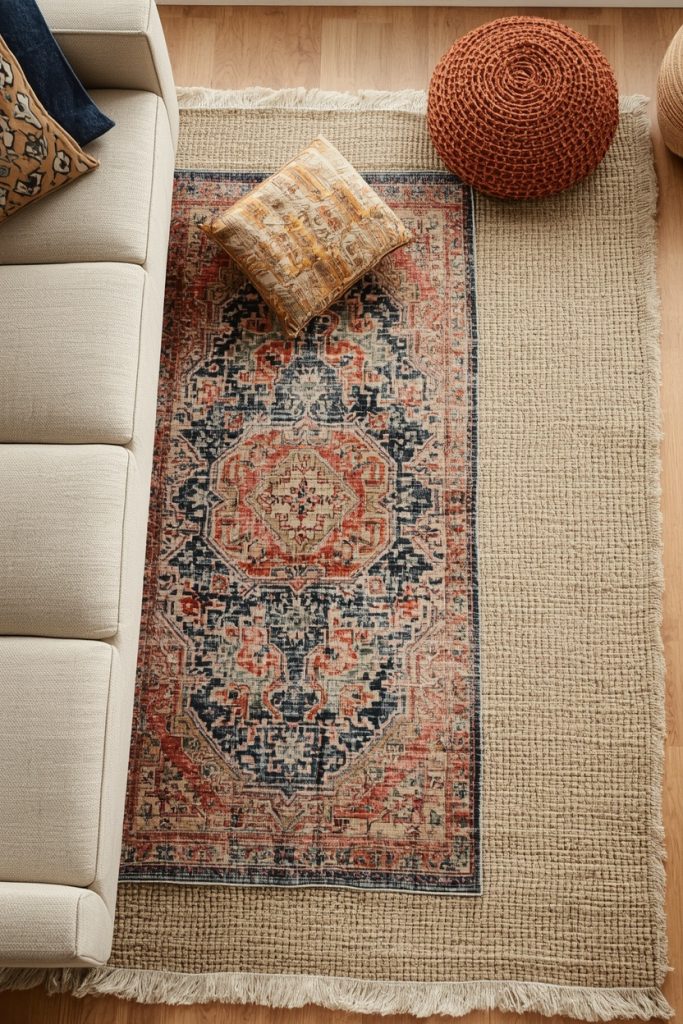
The first thing I did in our living room was put a small vintage-style printed rug on top of the larger jute one I already owned. I’d read about rug layering online and thought it sounded like one of those design ideas that looks good in theory and weird in practice. It looked great immediately. Our neighbor came over a week later and asked if we’d gotten new flooring.
A bohemian rug layered on top of a plain flatweave base creates the kind of depth and warmth that a single rug on bare carpet or hardwood never achieves. The base layer jute, sisal, or a simple flatweave in a neutral tone grounds everything. The top layer is where the personality comes in: a faded Persian-style print, a Moroccan diamond pattern, a kilim in warm reds and oranges. Position the top rug slightly off-center, maybe 30 degrees rotated from the base, so the two layers don’t just look like a bigger rug.
Jute base rugs at 8×10 feet run $80–$140 at World Market or Ruggable. Vintage-style printed top rugs in the 5×7 range cost $60–$120 at the same places or on Wayfair during sales. Thrift stores occasionally have real vintage kilims for $20–$60. Those are worth picking up whenever they appear because the age adds a visual authenticity that new rugs printed to look old don’t quite replicate.
02- Hang a Large Macramé Piece on the Main Wall
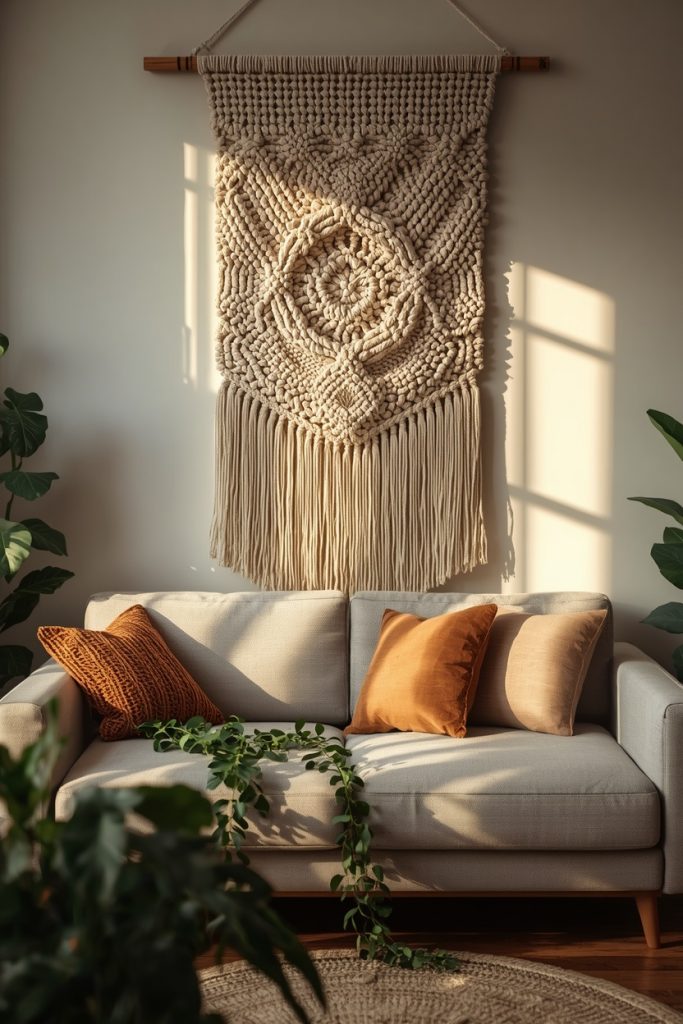
Our living room wall sat empty for eight months after we moved in because I couldn’t figure out what to put on it. I tried a gallery of framed prints that looked too formal. I tried a large canvas that looked too deliberate, so we decorated this wall. A macramé wall hanging from an Etsy seller fixed both problems simultaneously. It reads as handmade and slightly imperfect, which is exactly what bohemian wall decor needs to feel authentic rather than staged.
The size matters more than the design. A small macramé piece on a large wall just emphasizes how much empty space surrounds it. Go for something that spans at least two-thirds of the width of the sofa or bed it hangs above. Etsy sellers offer handmade macramé wall hangings in the right scale for $45–$120 depending on size and complexity. Mass-produced versions from Urban Outfitters or World Market run $35–$80 and look decent, though the knotting quality and fringe weight in handmade pieces is noticeably better.
Natural undyed cotton is the most versatile material it photographs warmly and ages well, developing a slight softness over time rather than getting grubby the way synthetic versions do. Place it above the sofa with the bottom of the piece sitting at roughly seated eye level, not floating near the ceiling where it disconnects from the furniture below.
DIY option: Basic macramé knotting is genuinely learnable from YouTube in an afternoon. A 2.5lb cone of natural cotton macramé cord costs about $18 on Amazon. Making your own means the finished piece is exactly the size and length you need rather than having to settle for whatever’s available in the store.
03- Add a Rattan or Wicker Chair as the Room’s Personality Piece
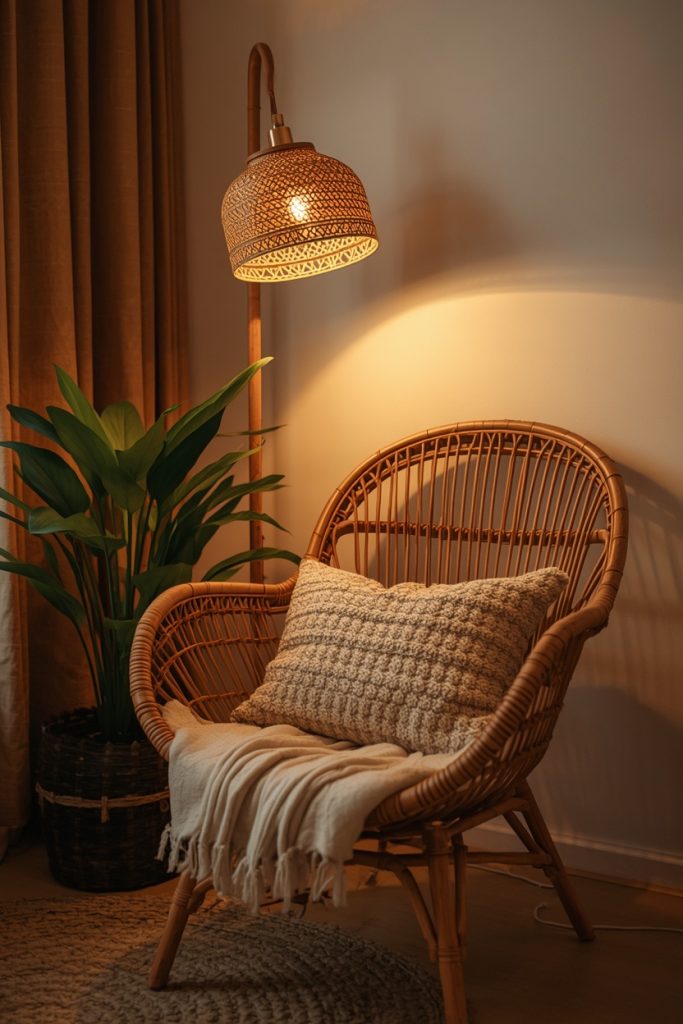
My wife bought a rattan egg chair on Facebook Marketplace for $55 from a woman who was moving and needed it gone by Saturday. It’s the single most-commented-on piece of bohemian furniture in our whole place. Guests sit down in it and immediately look around the room differently, like the chair told them something about the space that the other furniture hadn’t.
Rattan, wicker, and cane furniture carry an organic warmth that upholstered or metal pieces don’t; the material itself looks like something that grew rather than something manufactured, which aligns with the whole ethos of bohemian interior design. A bohemian chair in rattan doesn’t need to match anything else in the room. In fact, the slight visual contrast between the natural woven material and softer upholstered sofa textures is part of what makes the combination look collected and intentional.
New rattan accent chairs run $120–$300 at World Market, IKEA (the GRÖNLID and JUTIS styles), and Wayfair. Facebook Marketplace and estate sales regularly turn them up for $30–$80. The hanging egg chair version, the kind suspended from a stand or a ceiling hook, runs $150–$350 new at Amazon or Target and creates a strong visual focal point in a corner. Pair any rattan chair with one floor lamp positioned slightly behind it and a plant nearby. That three-element corner setup is the fastest way to make a room feel like a designed space.
04- Mix Patterns and Textures in Your Throw Pillows
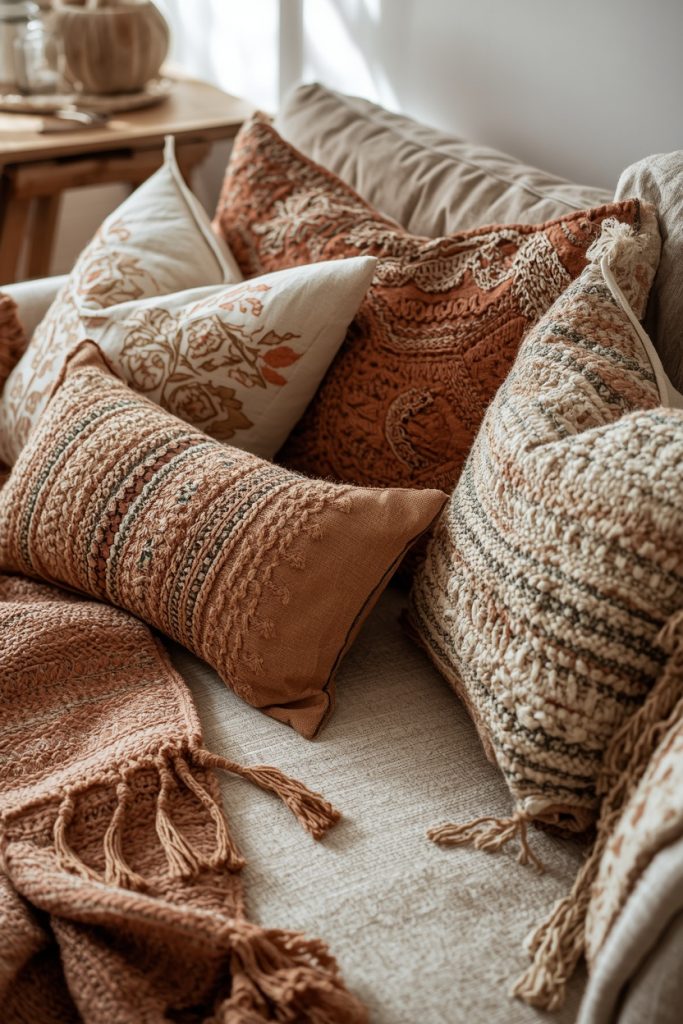
The rule I use for bohemian pillows never buy a set. A matching set of cushions looks like someone decorated the sofa in one store visit. The boho pillow approach is about building a collection gradually, one from TJ Maxx, one from a craft fair, one your grandmother gave you, one you found at an estate sale still in its original case. The variety of origins is what makes the arrangement look genuinely eclectic rather than eclectic-from-a-catalog.
Pattern mixing works when the color palette holds consistent across all the variations. My current sofa has six cushions: two embroidered in warm rust and cream, one chunky-knit in oatmeal, one printed with a small geometric in terracotta and sand, one in a faded tapestry print, and a lumbar in plain mustard linen. Five completely different patterns and textures have the same color family throughout. The palette discipline makes the mix read as curated rather than random.
TJ Maxx and HomeGoods carry genuinely good boho-style cushion covers for $8–$18 each. Etsy sellers offer hand-block-printed and embroidered covers in the $15–$35 range that have the kind of artisan quality mass retailers can’t match. Swap covers rather than whole cushions one set of quality foam inserts can work with different cover collections across seasons. Inserts at the right size (18×18 inch and 20×20 inch for most sofas) run $8–$15 each at IKEA or Amazon.
You may also like: 17 Christmas living room decorating ideas that feel cozy and genuine – 25 small apartment living room ideas that fix the real problems – 15 modern living room decor ideas worth trying in 2026 – 17 outdoor patio makeovers that actually transform a backyard space
05- Put Plants at Three Different Heights
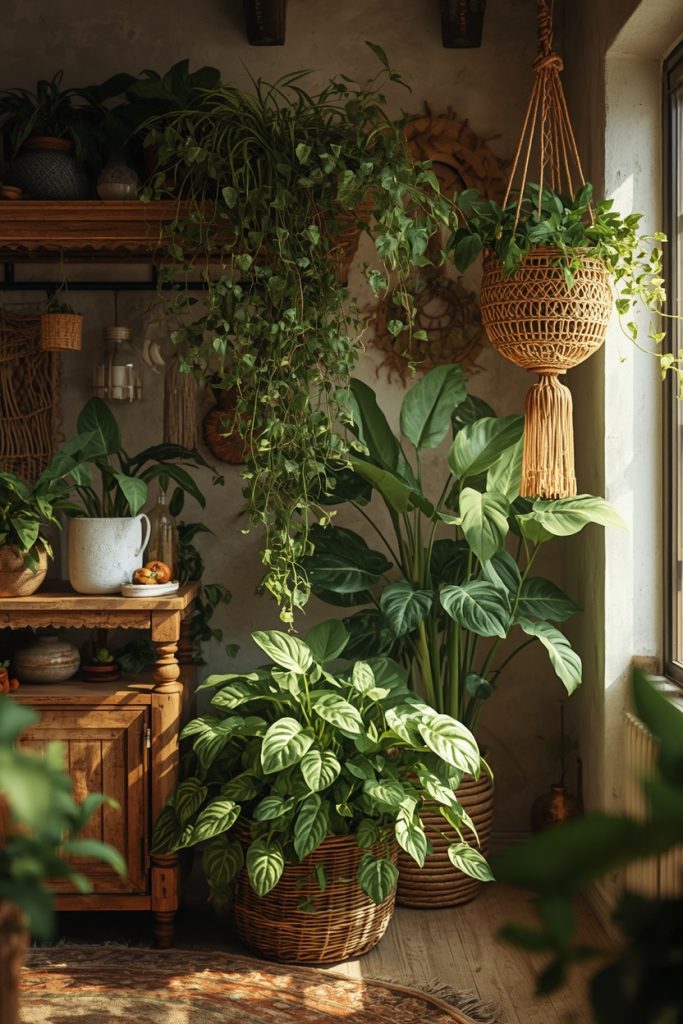
Our living room has eleven plants. This sounds like a lot and it is a lot, but the room doesn’t feel crowded, it feels lush, which in a bohemian interior is the right direction. The reason eleven plants in one room works where five plants might look cluttered is height distribution. One tall snake plant in the corner at floor level. Three medium plants on shelves and side tables at mid-height. Three trailing pothos and philodendrons from high shelves, cascading downward. Two hanging planters from the ceiling. The vertical spread fills the room’s full height and makes the green feel like an environment rather than decoration.
For low-light rentals, most of us pothos, snake plants, and ZZ plants handle neglect and poor light better than almost anything else. I’ve left my golden pothos unwatered for two weeks during travel and come back to find it had just grown. These plants actively want to survive in apartments. Fiddle leaf figs, on the other hand, are gorgeous and temperamental and I have killed three. Know your light situation before buying anything that requires direct sun.
Macramé hanging planters from Etsy run $12–$30 each and add a hand-crafted textile element to the plant display simultaneously. Terra cotta pots in 4-inch to 10-inch sizes cost $2–$8 each at any garden center or nursery. The pots in a bohemian home decor context don’t need to match mismatched terra cotta, ceramic, and woven pot covers actually look better than a uniform set.
06- Hang an Ornate Vintage Mirror as a Wall Anchor
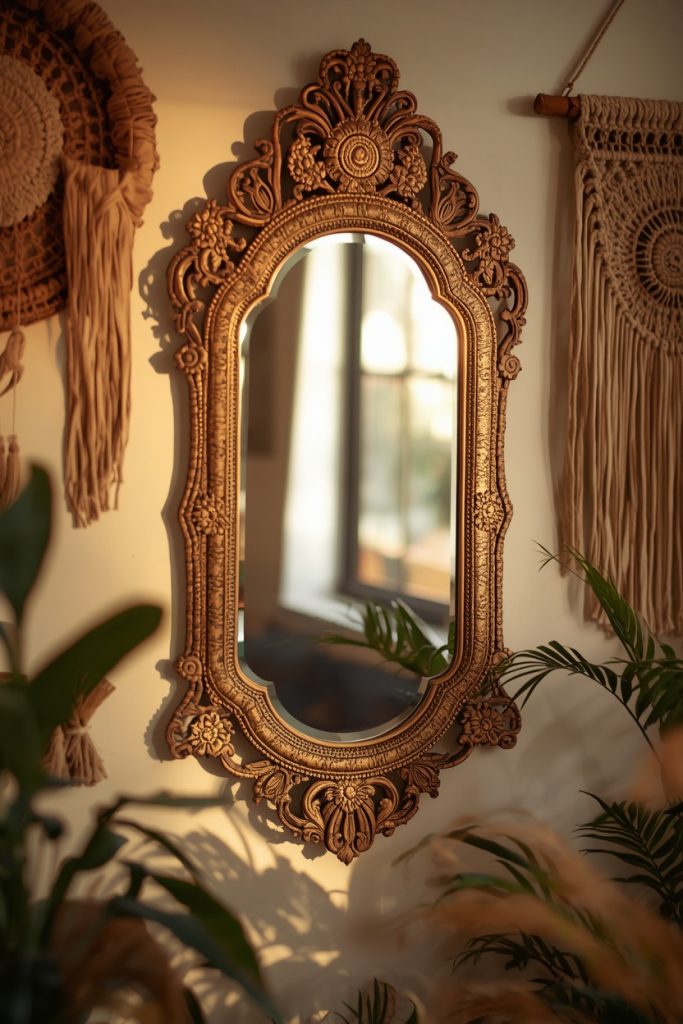
A bohemian mirror is different from a regular decorative mirror in one specific way: it has character. The frame tells a story inlaid mosaic, carved wood, hammered metal, painted rattan. A plain frameless mirror or a basic silver-frame mirror is just a reflective surface. An ornate vintage mirror with an interesting frame is a piece of furniture that happens to reflect the room back at you.
I found ours at an estate sale, a large carved wood frame with a slightly aged patina, the kind of thing that had probably hung in someone’s bedroom for forty years. Paid $28 for it. We hung it above the credenza in the living room and it instantly became the piece that photographs best in any image of the room. The reflected light also helps in rooms that feel dark or small; a mirror positioned across from the main window doubles the natural light in the space.
Estate sales and thrift stores are the best sources for genuinely interesting bohemian mirrors at low prices. Failing those, Anthropologie carries ornate framed mirrors at $150–$400 and World Market has Moroccan-style options for $60–$130. For a bohemian wall arrangement, grouping three or four mirrors of different shapes and sizes together creates a gallery effect that looks more dynamic than one large mirror on its own.
07- Layer Three Warm Light Sources and Turn the Overhead Off
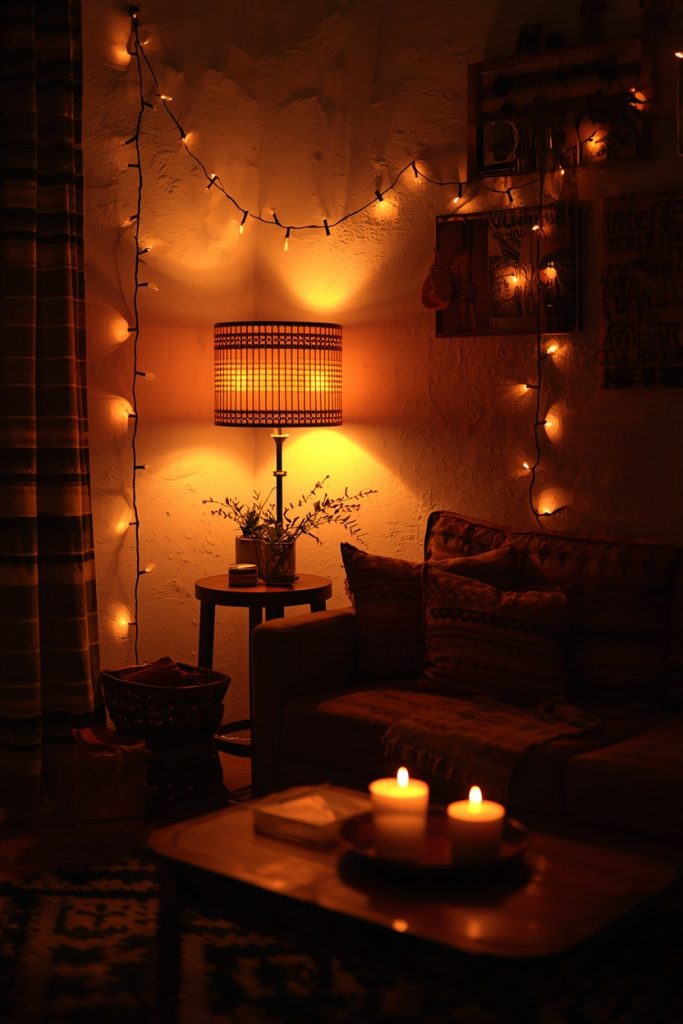
The overhead light in our living room, the fan-light situation I mentioned at the start, hasn’t been switched on in about fourteen months. Every evening we run: a floor lamp with a warm bulb behind the sofa, a string of Edison lights draped along the top of the bookshelf, and several candles grouped on the coffee table. The bohemian living room atmosphere created by those three sources combined is completely different from anything the overhead fixture ever produced.
Boho lighting works because of warmth and irregularity. Multiple light sources at different heights create pools of warm light rather than even flat illumination and the slight variation between those pools (the lamp is brighter, the candles flicker, the string lights are steady but soft) gives the room a quality that feels alive rather than lit. This is the single change that most dramatically shifts a room from place where people sit to place people want to stay.
A 2700K warm white bulb for the floor lamp costs $4–$6 and takes thirty seconds to swap. A 48-foot string of Edison-style café lights runs $35–$45 at Amazon or Home Depot. Candles in clusters of three on a tray IKEA pillar candles at $3–$5 each handle the ground-level layer. Put the floor lamp on a $12–$15 plug-in dimmer from any hardware store and you gain full control over the main light source without touching any wiring.
08- Build a Gallery Wall That Mixes Textiles, Art, and Objects
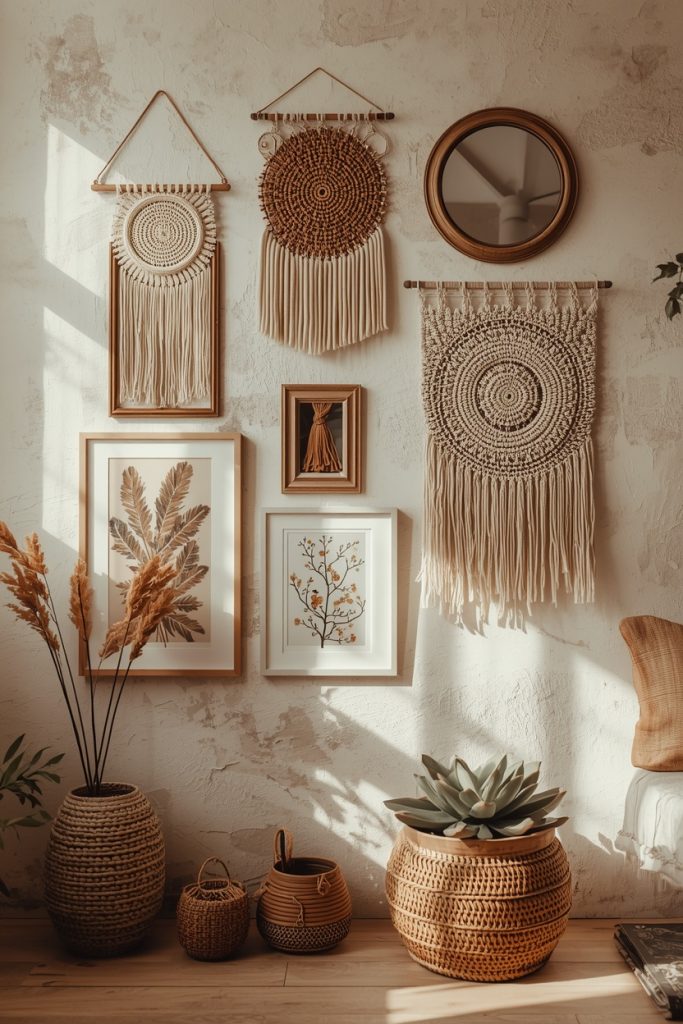
A standard gallery wall uses frames. A bohemian wall arrangement goes to further frames, yes, but also a small woven wall hanging, a decorative plate, a macramé piece, a dried botanical arrangement, a small round mirror, a wooden carved object. The mix of two-dimensional and three-dimensional elements, flat and textured surfaces, is what gives a boho gallery wall its depth and collected feeling.
The system I use: lay everything on the floor first and arrange it as if the floor were the wall. Spending time with the arrangement I usually leave it for two days before committing to holes. The pieces that feel right together on the floor will feel right on the wall. The pieces that look awkward on the floor will look awkward hanging too. Moving things on the floor costs nothing. Moving things on the wall after you’ve committed leaves holes that need filling.
Color discipline matters even in an eclectic mix. All the framed prints in our gallery wall share warm tones terracotta, sand, warm green, aged cream. The textile pieces match that same warm family. Nothing is cool-toned, nothing is stark white or grey. That shared palette is what makes five completely different items read as one intentional arrangement rather than random things stuck to a wall.
Budget approach: Etsy digital downloads of botanical prints, abstract art, and vintage-style illustrations cost $3–$8 per file. Print them at a local print shop for $5–$12 depending on size. Frame them in IKEA RIBBA frames at $5–$15 each. A full gallery wall of seven pieces can cost under $100 total this way.
09- Add Floor Cushions and a Pouffe for Low-Level Seating
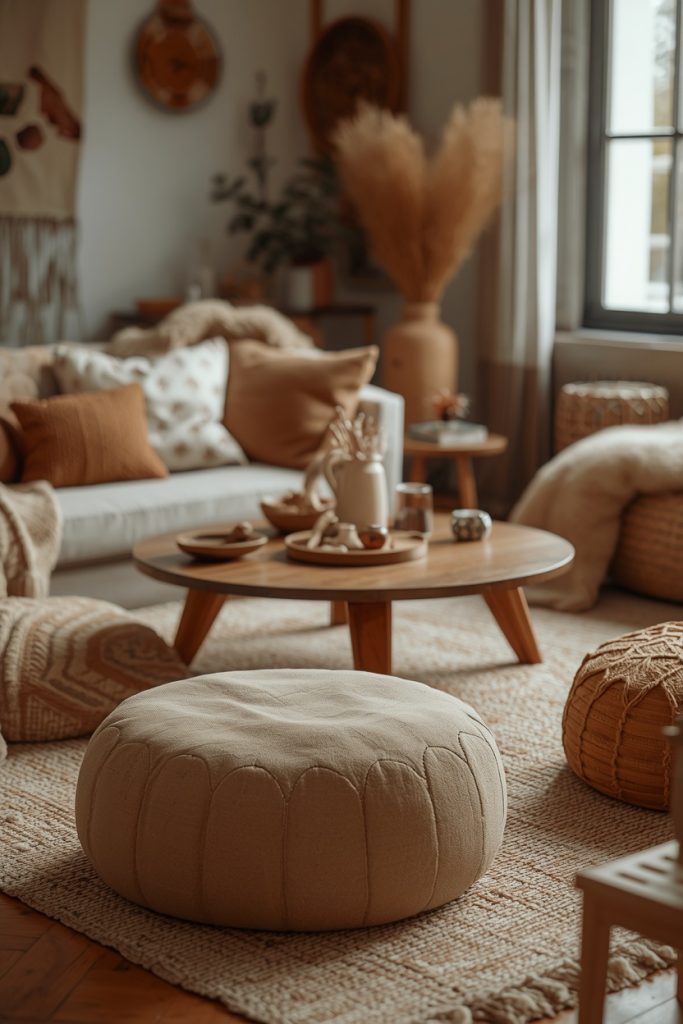
Something shifts in how people use a room when floor-level seating is available. At our last dinner party eight people in a 155-square-foot living room four guests ended up on the floor cushions and pouffe for most of the evening by their own choice, even though there was space on the sofa. Lower seating makes people lean toward each other rather than sitting upright and apart. The room feels more social.
Large floor cushions in a bohemian living room aren’t just overflow seating; they’re part of the visual layering. Stacked in a corner or fanned around a low coffee table, they add color and texture at ground level where most rooms have nothing going on visually. In a bohemian interior design context, the floor is a usable decorative surface, not just a plane to put furniture legs on.
Moroccan-style floor pouffe ottomans run $45–$90 at World Market and Amazon; the embroidered leather or faux-leather versions look particularly rich and age well with regular use. Large floor cushion covers in block-print or embroidered fabric cost $18–$35 each from Etsy or TJ Maxx; stuff them with poly-fill from a craft store ($8–$12 per bag) for a firm seat. A low wooden tray or a flat woven tray on the floor between the cushions serves as the coffee table in this kind of arrangement and costs almost nothing.
10- Style the Bed with Layered Linen, Quilts, and Mismatched Pillows
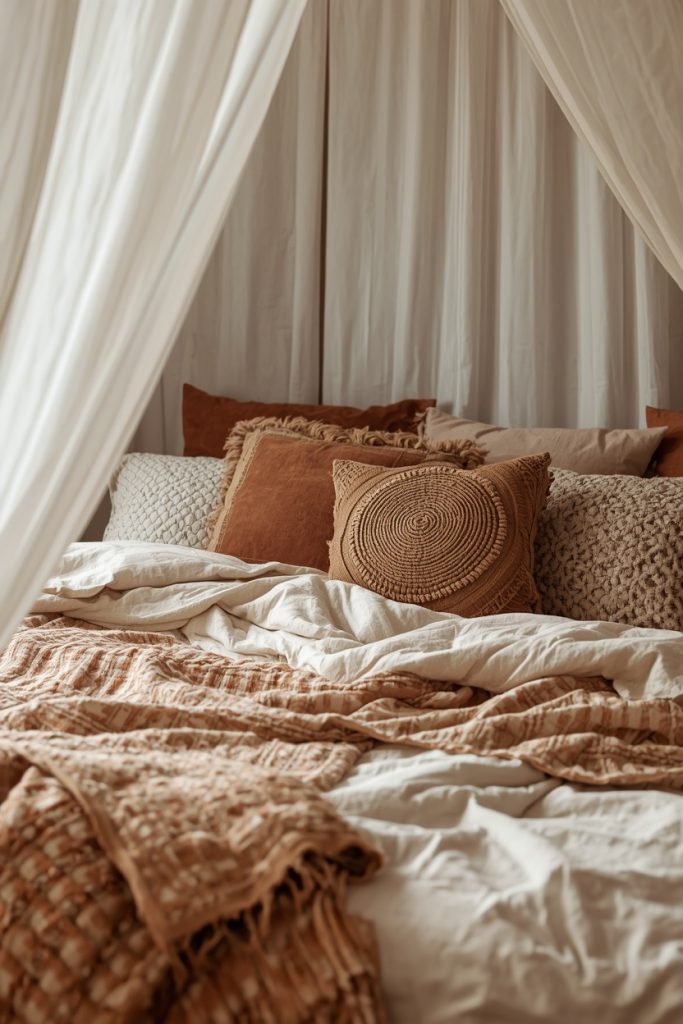
A bohemian bed looks nothing like a hotel bed. Hotel beds are tight, tucked, and uniform. A boho bed is layered, slightly undone, and looks like someone actually sleeps in it enthusiastically. The layers are the whole thing: a plain linen duvet cover as the base, a vintage quilt or a kantha blanket draped across the foot, a chunky knit throw tossed over one corner, and a collection of mismatched pillows at the head that mix embroidered covers with plain linen and at least one velvet in a rich jewel tone.
Kantha quilts hand-stitched recycled cotton quilts from India are one of the best boho bedding finds available. They’re lightweight, incredibly soft after a few washes, full of color and pattern, and cost $35–$65 for a full/queen size at World Market or on Amazon. Each one is slightly different because they’re handmade from repurposed fabric, which means yours won’t look exactly like anyone else’s fitting for a style built on individuality.
A fabric canopy above the headboard extends the boho bedroom upward and creates the sense of an enclosed sleeping nook. Sheer fabric panels draped from a ceiling hook or a curtain rod mounted high above the bed cost $20–$40 for the fabric at IKEA or any fabric store. Fairy lights woven through the canopy frame add the warm ambient glow that makes a bedroom feel genuinely restful rather than just decorated.
11- Style Open Shelves Like a Curated Collection, Not a Storage Unit
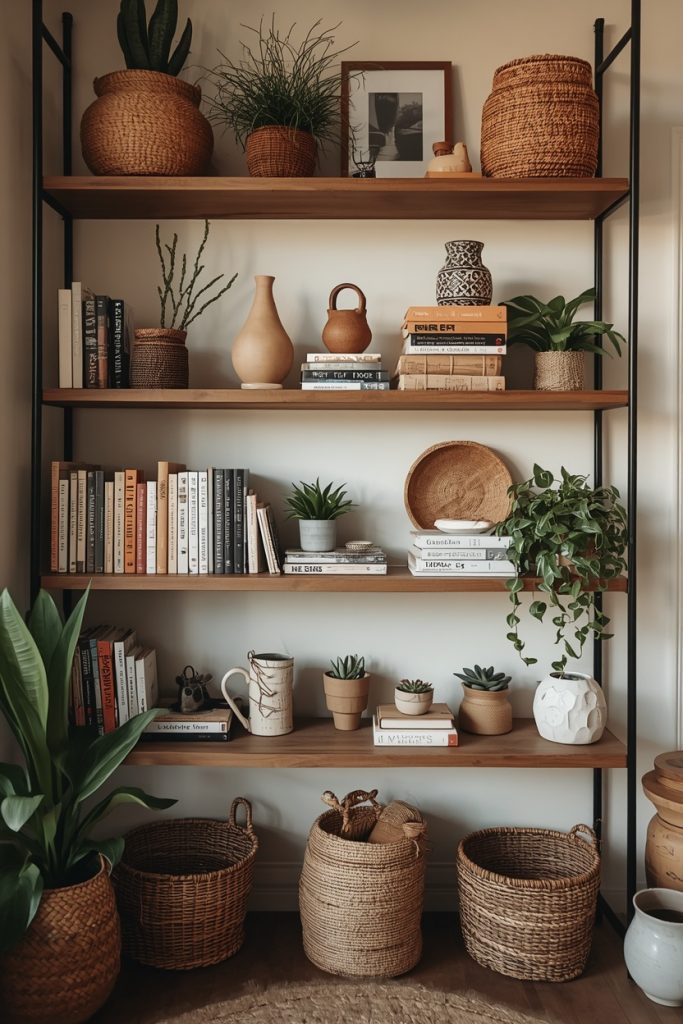
Shelves in a bohemian home decor context are display surfaces, not storage solutions. Anything purely functional, extra batteries, mail, random cables goes behind a closed door. Open shelves hold only what contributes to the visual story of the room: books arranged by color or size, a few ceramic pieces in warm earthy tones, a small plant, a travel souvenir with an interesting shape, a woven basket holding something you don’t want to see but need to access.
The spacing principle I follow: fill about 65% of each shelf and leave 35% open. Group objects in odd numbers three things read as an arrangement, two read as a pair, one reads as abandoned. Vary the heights within a group so the eye moves upward through it rather than scanning flat across. Tuck a trailing plant on the highest shelf so the leaves cascade downward and soften the whole composition.
Books spine-in (pages facing out) create an interesting uniform texture for one section of shelf. This works especially well on the lower shelves where you want less visual complexity, saving the upper shelves for the more decorative items that benefit from being at eye level. A few candlesticks at different heights interspersed with the objects warm the shelf composition in the evening when they’re lit.
12- Hang Global Textiles and Tapestries on the Walls
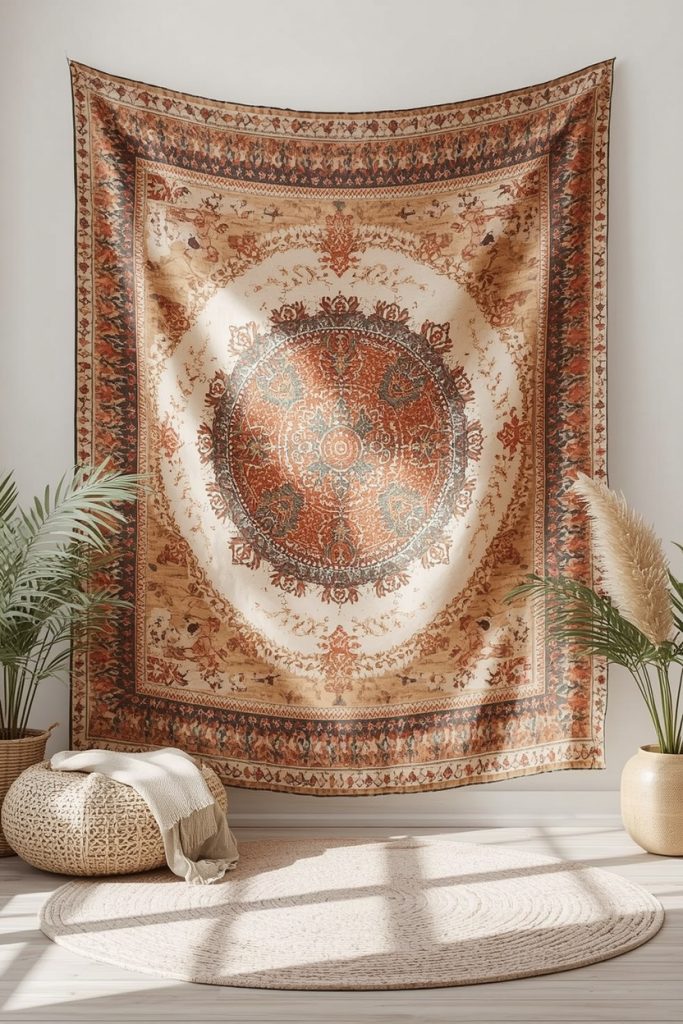
Block-print fabric panels from India, hand-woven Peruvian wall textiles, batik hangings from Indonesia, Moroccan flat-weave rugs hung vertically on a wall all of these qualify as bohemian wall decor and all of them cost a fraction of what a framed art piece of equivalent visual impact would run. A large block-print cotton tapestry from an import retailer or Amazon covers a full wall for $25–$55. The color saturation and pattern density in these pieces does more visual work per dollar than almost anything else in home decor.
Hanging them doesn’t require frames. A wooden dowel rod ($2–$4 at any hardware store), some jute twine, and two wall hooks is the standard approach. Loop the twine through small loops sewn at the top of the tapestry, tie it to the dowel, hang the dowel from the hooks. The whole installation takes about fifteen minutes and holds well enough that ours has been up for three years without moving.
Anthropologie sells beautiful global-textile wall hangings at $80–$250 for the larger sizes. Ten Thousand Villages carries fair-trade textile pieces at $45–$150. For anyone building a bohemian interior on a tighter budget, Amazon’s selection of Indian block-print wall tapestries at $25–$45 covers the same visual ground for considerably less money look for cotton rather than polyester, and for hand-stamped irregularities in the printing that signal the item was actually block-printed rather than digitally reproduced.
13- Bring Bohemian Touches into the Kitchen
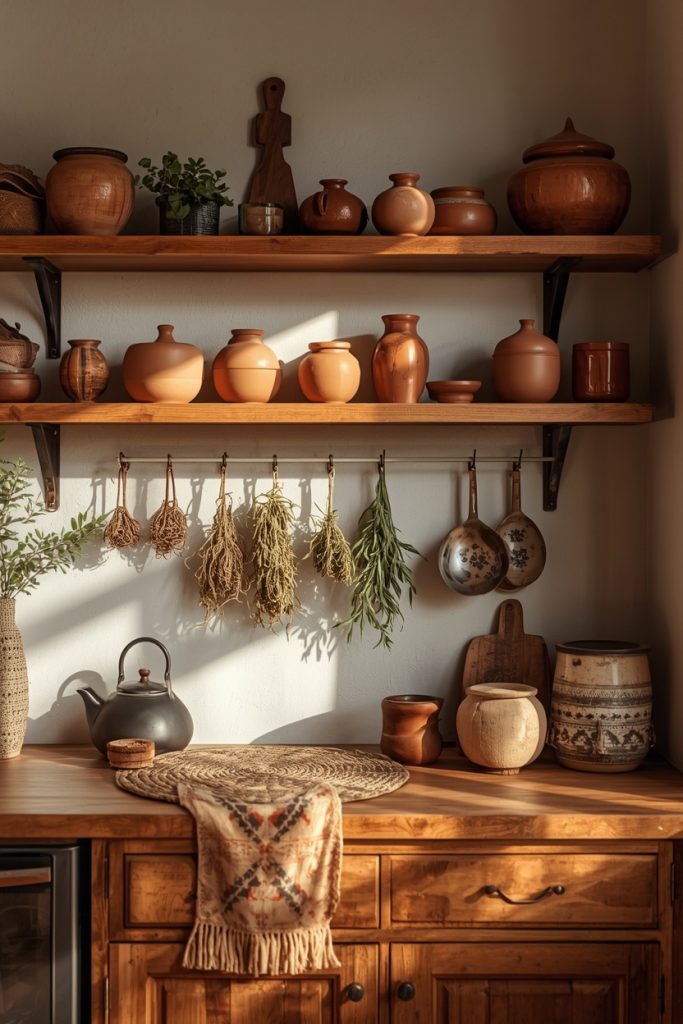
A bohemian kitchen is less about renovation and more about layering personality over an existing space. Most rental kitchens are white, functional, and generic. You can shift that feeling significantly without touching the cabinets or spending more than $100 total. The approach: warm elements wherever you can place them.
A woven jute mat in front of the sink ($22–$35 at most home stores) adds texture underfoot and looks far more interesting than a rubber mat. Open shelving even just one floating shelf you add yourself for $15–$25 gives you a surface to style with colorful pottery, mismatched mugs, and a small plant or two. Hanging a bunch of dried herbs (lavender, eucalyptus, rosemary) from a small hook near the window costs almost nothing and adds scent and visual warmth simultaneously.
Replacing standard kitchen hardware cabinet knobs and drawer pulls with ceramic, rattan-wrapped, or brass options costs $4–$12 per piece and changes the character of even the most generic white cabinets. Most cabinet hardware swaps require only a screwdriver and take about twenty seconds per pull. For renters, this is reversible to reinstall the original hardware before you move out and no one will know the difference. Replace overhead fluorescent lighting with a warm-toned plug-in pendant if your fixture allows it. That single swap shifts the whole kitchen from utilitarian to something worth spending time in.
14- Use Woven Baskets as Storage and as Wall Decor
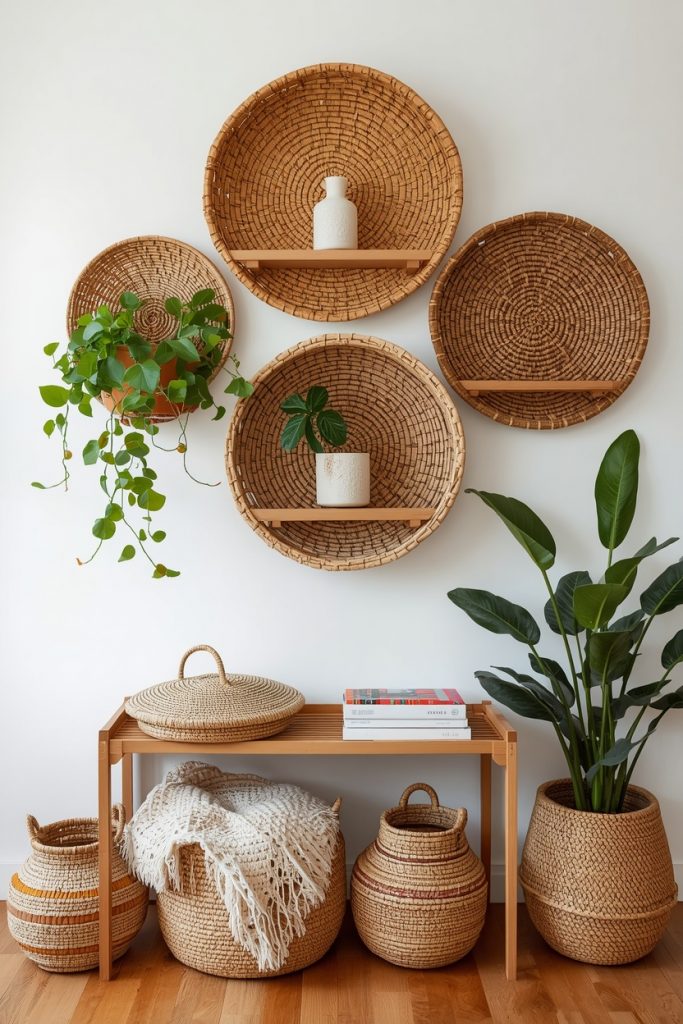
Baskets in a bohemian home serve double duty: they hold things and they look good doing it. We have nine baskets scattered across our place: two large ones holding blankets beside the sofa, three medium ones on shelves storing things we don’t want visible, two small ones on the kitchen counter holding fruit and loose items, and two mounted flat on the wall as decorative pieces in the hallway. Nine baskets sounds excessive. In practice it looks layered and intentional, not excessive.
Wall-mounted baskets are something most boho decor articles skip and they shouldn’t. A collection of three or five baskets mounted flat on a wall of different sizes, similar weave styles reads as art rather than storage. Seagrass and rattan baskets in round and oval shapes look best for this. Hang them with simple picture hooks through the basket weave at the top. World Market sells these in sets of three for $30–$55. Individual baskets at TJ Maxx or HomeGoods run $8–$22 depending on size.
For storage baskets, seagrass holds its shape longer than cheaper alternatives and smells faintly of the ocean for the first few months, which is a genuinely nice side effect. Rattan baskets with lids work well for blanket storage; they stack cleanly and look like furniture rather than a storage solution hastily borrowed from the garage.
15- Layer Candles, Incense, and Dried Botanicals for Scent and Atmosphere
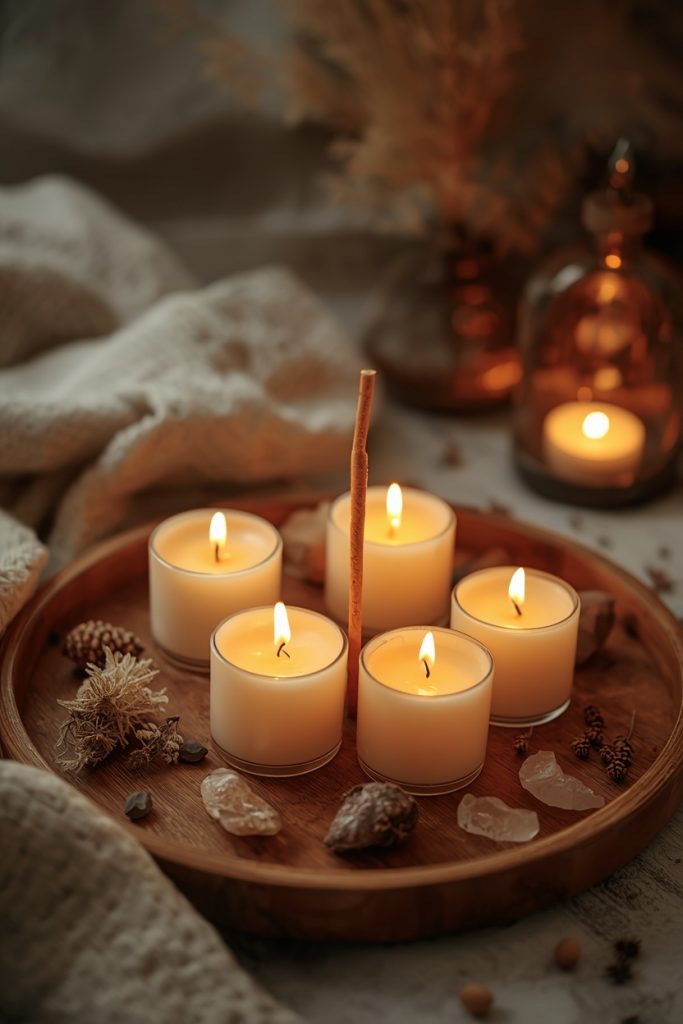
Bohemian spaces engage more senses than just sight. The rooms that feel most immersively boho when you walk into them almost always smell of something specific: palo santo, sandalwood incense, earthy beeswax candles, dried lavender, and clove. The scent tells you where you are before you’ve fully looked around the room. It’s one of those details that almost never appears in decor guides because you can’t photograph it, but it does more atmospheric work than most visual elements.
A palo santo bundle costs $8–$15 for a small bundle at most crystal and apothecary shops or on Etsy. Nag champa incense, the warm, slightly sweet sandalwood-based scent that’s been associated with bohemian interiors since the 1970s, runs about $5–$8 for a box of 20 sticks. Beeswax pillar candles cost $12–$20 each and burn much longer than paraffin while giving off a subtle honey scent rather than the slightly chemical smell of cheap candles.
Group them on a wooden tray or a slate tile on the coffee table. Add a few crystals or smooth river stones, a dried eucalyptus or lavender stem, one small ceramic dish for the incense ash. The tray contains everything and makes it read as a deliberate ritual collection rather than miscellaneous objects clustered together by coincidence.
16- Build the Whole Room Around an Earthy Color Palette
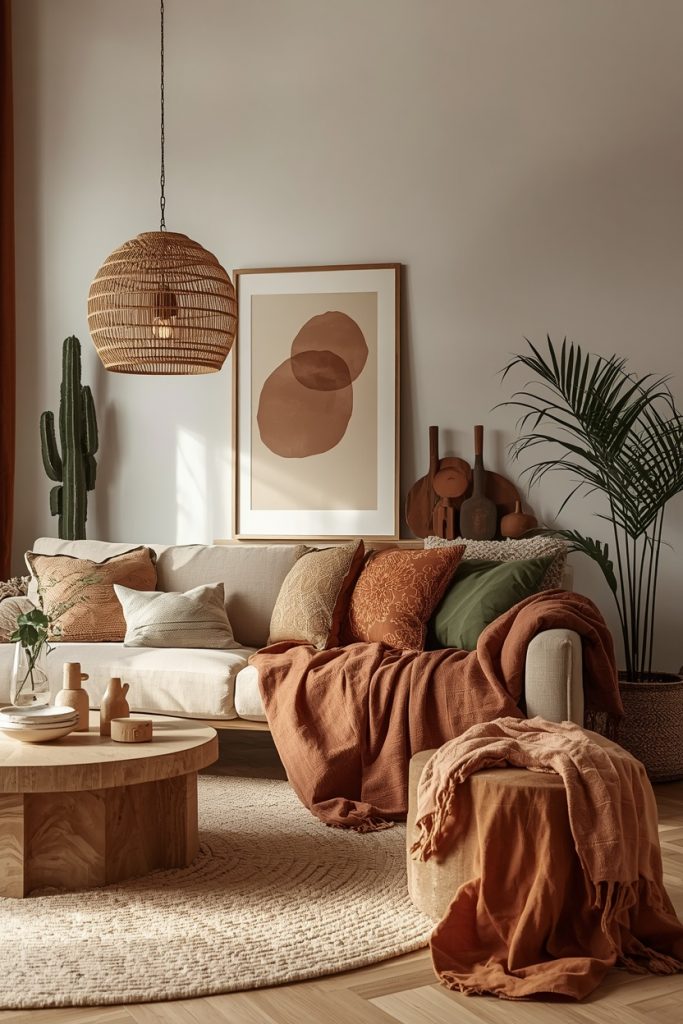
The color palette of a bohemian home decor scheme isn’t random even though it looks eclectic. The rooms that hold together visually where mismatched patterns and mixed textures read as collected rather than chaotic almost always share a warm, earthy undertone across every element. Terracotta, warm cream, aged rust, forest green, ochre yellow, sand, raw wood tones. These colors exist in nature together and look natural together in a room.
Cool tones fight the boho palette. A grey sofa in an otherwise earthy bohemian room looks wrong in a way that’s hard to name but immediately visible. A white wall behind warm rust and terracotta accents can work if the white has a cream or warm undertone (Benjamin Moore Chantilly Lace is too stark; White Dove or Creamy work much better). Cool blue, stark grey, and sharp white all push back against the warmth that makes a bohemian interior design feel settled and inviting.
Repainting walls in a rental isn’t always an option, but you can shift a white-walled room significantly through fabric and surface choices alone. A warm terracotta throw over the sofa, earthy-toned cushions, a warm-toned rug, amber pendant lamp bulbs, and wood-grain furniture together carry enough warmth to pull the room toward the boho palette even when the walls stay white. The fabric and textile layer does most of the heavy lifting in any color palette.
17- Build the Character of the Room from Thrifted and Vintage Finds
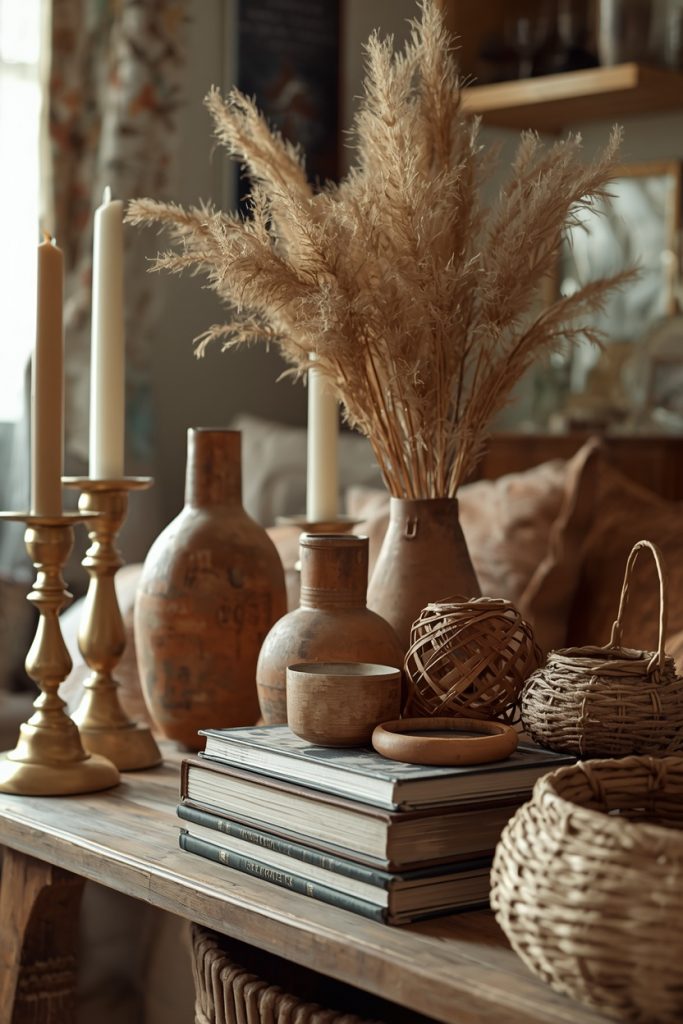
The best bohemian furniture and decor in our place didn’t come from any store. The carved wood mirror: $28 at an estate sale. The brass candlesticks on the mantle: $6 for the pair at Goodwill. The ceramic vessels on the shelf: $4–$8 each at various thrift stores over two years of regular checking. The vintage kilim rug in the bedroom: $45 from a flea market vendor who was ready to pack up for the day.
Thrifted pieces carry something new objects rarely have the visible evidence of previous use. A ceramic bowl with a small chip in the rim. A brass candlestick with real patina built up over decades. A wooden tray with worn edges where someone held it thousands of times. These signs of age and use give a room the layered, collected feeling that bohemian home decor requires and that no amount of new purchases from a single store can replicate.
The thrift and estate sale approach takes patience. Not every visit produces something worth buying. The skill is learning to identify quality material (solid wood, real brass, hand-thrown ceramics, natural fiber textiles) quickly so you can assess pieces fast and move on when they’re not right. Facebook Marketplace and Craigslist let you filter by category and price range, search rattan, vintage rug, ceramic, and brass regularly and set saved searches so new listings notify you. Over time, this sourcing approach produces a collection that genuinely looks like yours rather than like a room decorated from a catalog.
What to prioritize at thrift stores: Natural materials age well and look better with use of brass, solid wood, real leather, hand-thrown ceramics, and natural fiber textiles. Synthetic materials faux wood, plastic, polyester fabric tend to look worse with age rather than better. In a boho context especially, real materials matter because the style is built on the authenticity of natural, handmade things.
How to Start Your Bohemian Home Decor Without Buying Everything at Once
The worst approach to building a bohemian interior is trying to do it all in one weekend. The rooms that actually look good are built incrementally one piece at a time, over months, with each new addition responding to what’s already there rather than arriving as part of a preplanned set.
✅ WHERE TO START THE FIRST FOUR MOVES
- Swap the bulbs to warm white 2700K: $12–$15 for a six-pack. The single fastest way to shift the atmosphere of any room toward warm and inviting.
- Add one layered rug situation: a jute base plus a printed top rug. $80–$140 combined. Anchors the room and adds immediate visual depth.
- Hang something on the main wall: a macramé piece, a textile tapestry, or a grouping of objects. Under $50 if you use Etsy downloads and a thrift store mirror.
- Bring in two plants at different heights: one floor-level snake plant, one trailing pothos on a shelf. $15–$35 total at a garden center. The greenery does more for a room than most people expect until they try it.
Do those four things and your room already reads as bohemian. Everything after that is refined.
Common Mistakes in Bohemian Home Decor
❌ WHAT GOES WRONG MOST OFTEN
- Buying everything at once from one store. A cart full of boho-style items from Target all purchased the same day never looks as good as the same number of pieces collected from different sources over time. The variety of origins creates authenticity.
- Too many cool tones. Grey, white, and silver-toned accents fight the warm earthy palette that makes boho interiors feel settled. Check every new purchase against the warm-tone family: does it belong to terracotta, cream, rust, green, ochre, or wood? If not, it probably doesn’t belong in the room.
- Underfilling the space. Bohemian rooms look better with more in them than with less. A sparse boho room looks unfinished. Layer rugs, add cushions, hang more on the walls, bring in more plants. The lushness is the aesthetic.
- Matching everything. A matching set of anything cushions, baskets, frames immediately reads as mass-produced and kills the collected feeling. Mix sizes, origins, and slight color variations throughout every category of object.
- Ignoring the floor. Most of the visual layering in a boho room happens below knee level rugs, floor cushions, low pouffe, large plants, baskets. A room decorated only at eye level and above feels thin and unresolved no matter how much goes on the walls.
- Synthetic materials. Polyester pillows, plastic rattan, faux leather, MDF wood these materials don’t age the way natural materials do and undermine the organic warmth that bohemian home decor depends on. Wherever possible, choose real cotton, real rattan, real wood, real leather, real terra cotta. The tactile and visual difference is significant.
Closing Thought
The reason bohemian home decor appeals to so many people isn’t because it’s on trend, it’s been coming in and out of trend for sixty years and keeps coming back. It appeals because it gives permission to keep what you love, mix what draws you, display what you’ve collected, and let the room grow gradually into something that actually reflects who you are. That’s a different design philosophy from most home decor styles, which tend to ask you to conform to a look rather than build one.
Start with the warm light and the rug. See what the room asks for next. It will tell you.
📌 Save this to Pinterest boho rooms build slowly and you’ll want a reference when inspiration strikes. Got a specific question about a particular room, a budget constraint, or something you tried that didn’t work? Drop it in the comments. Specific questions get specific answers.
FAQs About Bohemian Home Decor
What exactly is bohemian home decor?
Bohemian home decor is a layered, eclectic style built on natural materials, global textiles, warm earthy tones, and the accumulated character of collected objects over time. It pulls from Moroccan, Indian, Turkish, and other global design traditions and puts personal expression ahead of any single aesthetic rule. Boho rooms mix patterns, textures, and eras deliberately; the variety is intentional rather than a problem to solve. Key elements include layered rugs, macramé and woven wall hangings, rattan furniture, plants in abundance, mismatched throw pillows, vintage mirrors, warm candlelit lighting, and natural materials throughout every surface.
How do I start bohemian home decor without spending a lot?
Four changes costing under $150 combined shift any room toward a bohemian feeling immediately. Swap all light bulbs to 2700K warm white ($12–$15 for a six-pack). Layer a printed boho rug on top of a plain jute or flatweave base ($80–$140 combined). Hang a macramé piece or Indian block-print tapestry on the main wall ($25–$55 at Etsy or World Market). Add two plants at different heights: one floor-level snake plant, one shelf pothos ($15–$35 total at a garden center). Those four moves create the foundation. Add thrifted brass candlesticks, vintage ceramic pieces, and mismatched cushion covers incrementally from there rather than trying to buy a complete boho collection in one visit.
What colors define a bohemian interior palette?
Warm earthy tones form the foundation: terracotta, warm cream, aged rust, ochre yellow, forest green, sand, and raw wood tones. These shades exist in nature together and layer naturally in a room. Cool tones grey, stark white, silver-toned metals fight the warmth that makes bohemian interiors feel settled and inviting rather than cold and clinical. If your rental walls must stay white, choose warm-undertoned whites like Benjamin Moore White Dove or Sherwin-Williams Creamy rather than stark cool whites, and let the fabric and textile choices carry the warmth throughout the room.
Can bohemian decor work in a rental apartment?
Rentals suit bohemian decor particularly well because the style doesn’t require permanent architectural changes. Layered rugs cover uninspiring floors. Macramé wall hangings and tapestries hang from small hooks that leave minimal marks. Plants live in pots. The furniture is freestanding. Lighting runs from floor lamps, table lamps, and string lights rather than hardwired ceiling fixtures. The only detail to manage carefully is hardware if you swap kitchen cabinet pulls for more interesting ceramic or rattan-wrapped versions, keep the originals in a labeled bag and reinstall before moving out. Every other element of bohemian home decor travels with you to the next place.
How do I mix patterns without the room looking chaotic?
Color palette consistency makes pattern mixing work. Choose a warm earthy palette and filter every patterned piece through it before bringing it home. A geometric in terracotta and sand, a floral in rust and cream, and a kilim stripe in warm browns all read as cohesive despite being completely different patterns because they share the same color temperature. Where mixing goes wrong is when patterns span multiple color families: cool blue geometric alongside warm orange floral alongside stark black-and-white stripe. Keep the undertones consistent across all patterns and the variation in scale and style between them can be as wide as you like.
What are the best places to find bohemian decor on a budget?
Estate sales and thrift stores are the highest-value sources of genuine vintage pieces with real character at the lowest prices. Check Goodwill, Salvation Army, and local consignment shops on a regular rotation rather than once. Facebook Marketplace and Craigslist work well for larger items like rattan furniture, rugs, and mirrors. Etsy carries handmade macramé pieces, block-print tapestries, ceramic planters, and embroidered pillow covers from independent makers at fair prices. TJ Maxx and HomeGoods turn up good cushion covers, baskets, and small ceramics regularly. World Market stocks rattan furniture and global textile pieces at mid-range prices. IKEA covers the neutral basics: plain linen duvet covers, simple frames, flatweave rugs that work as background layers for more interesting pieces layered on top.