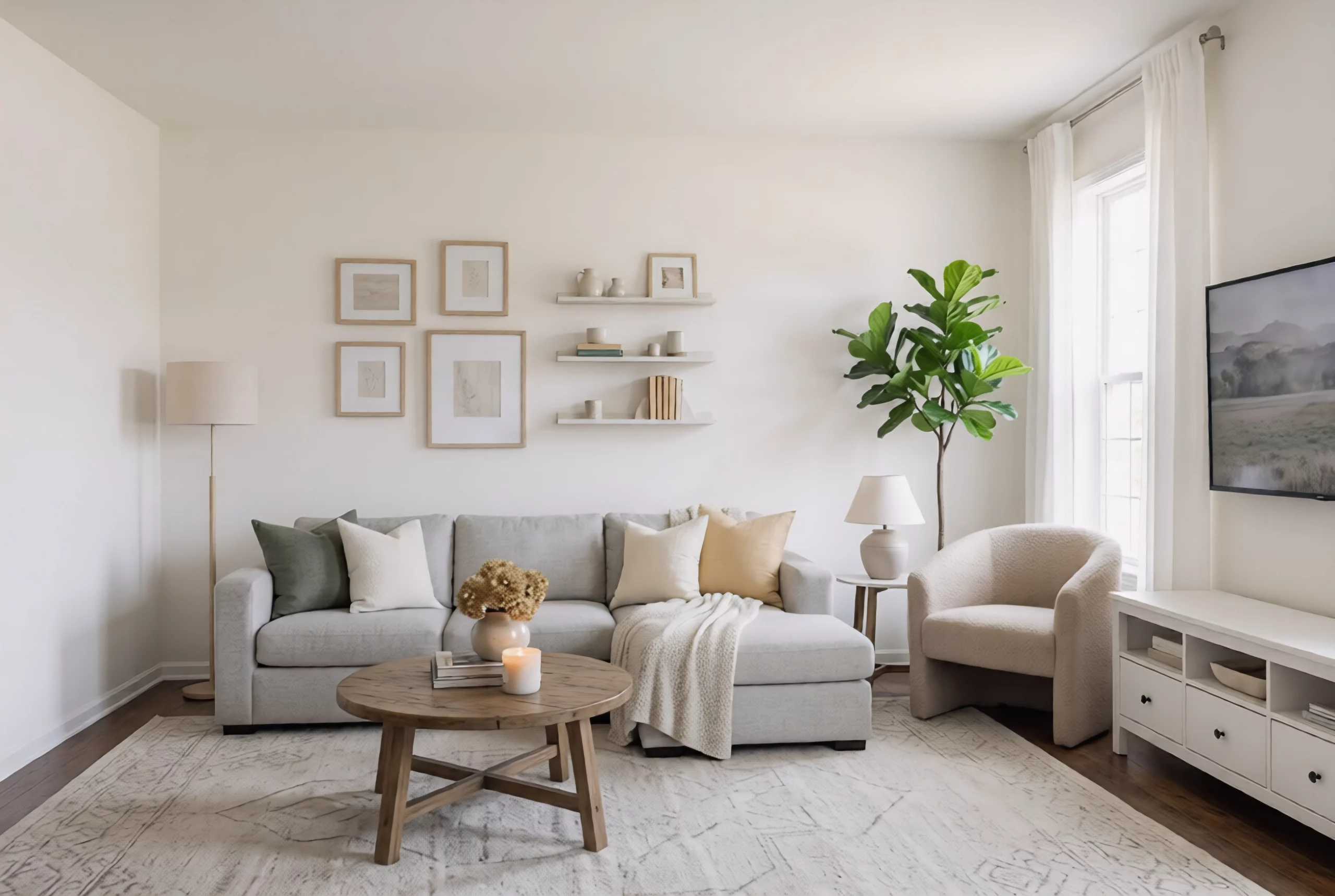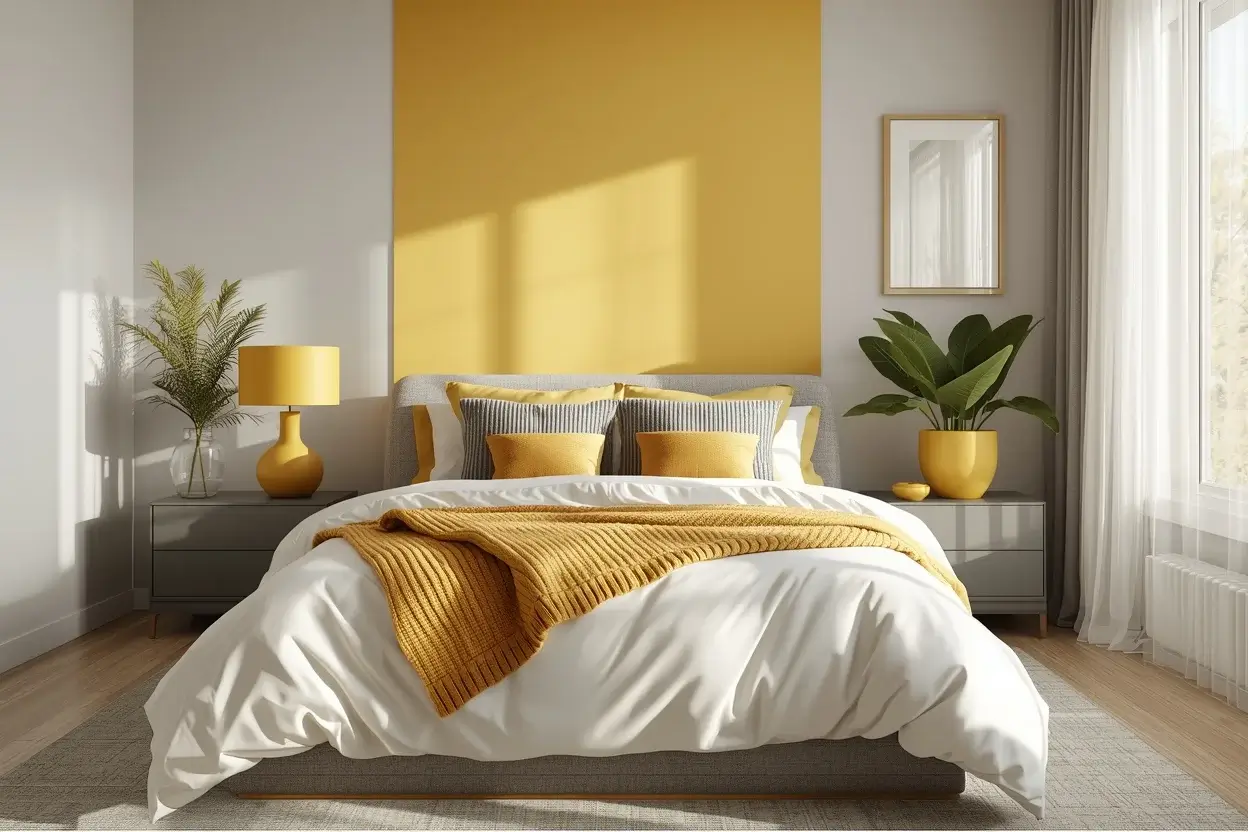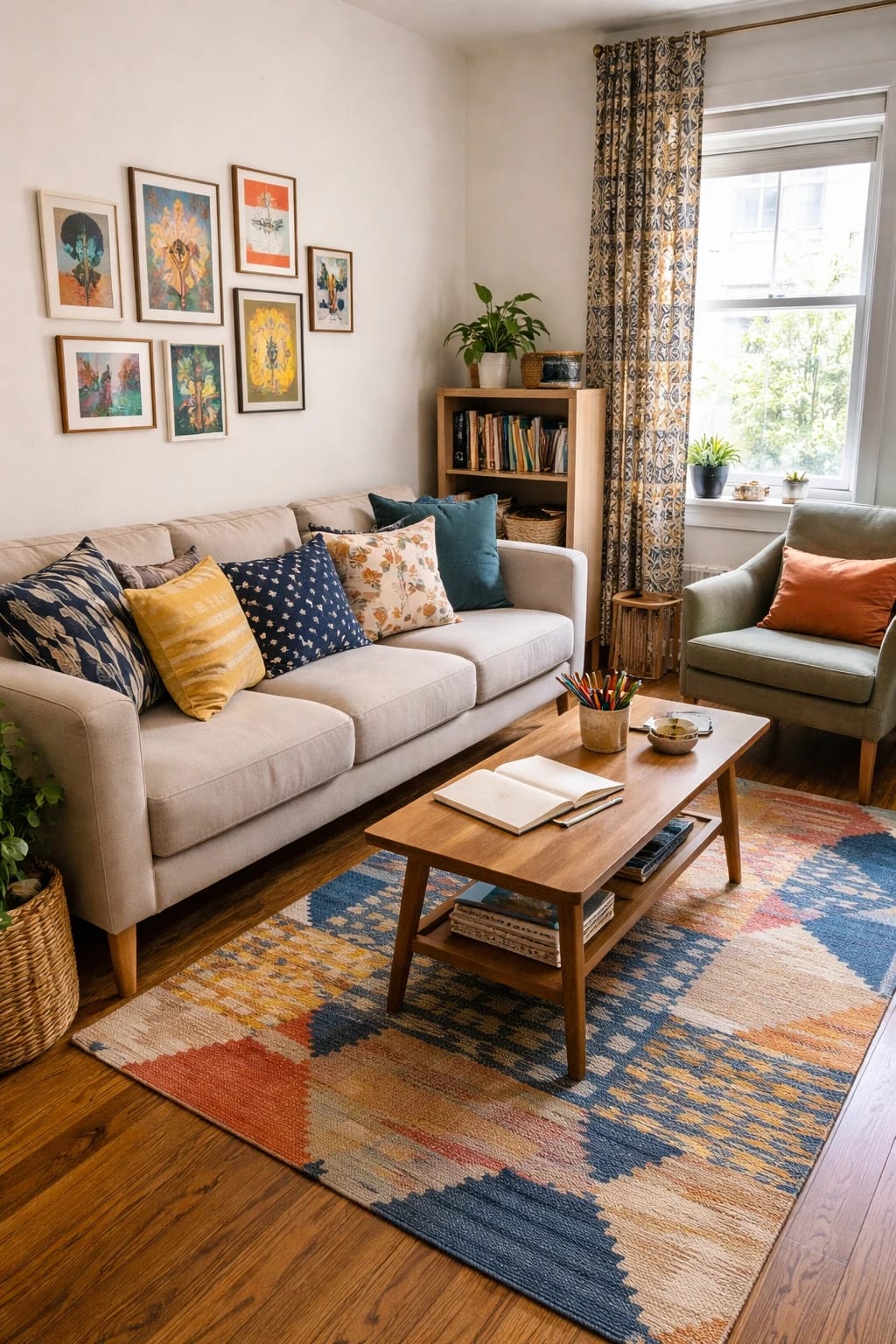
Rented three apartments in four years. Each one had a living room that gave me problems. These are the things that actually fixed them.
The first thing I did when I moved into my second apartment was drag my sofa directly against the longest wall, center the TV opposite it, and call it done. It looked like a waiting room at a car dealership. I lived with it for six months before I finally admitted something was wrong and started actually thinking about what the room needed.
Turned out the sofa placement was only one of about eight problems. The overhead light was wrong. The rug was too small. The walls were completely empty. The one bookshelf I owned was doing nothing useful in the corner I’d shoved it into.
I’ve now had three small apartment living room ideas — 140, 155, and 180 square feet — and I’ve made every fixable mistake at least once across them. These 25 ideas are the things that genuinely shifted how each room looked and felt. A few of them I stumbled on by accident. Most I figured out through frustration after something clearly wasn’t working.
No theory. No mood board advice. Just what worked in actual small rooms I’ve actually lived in.
Where most people go wrong in a small living room
I’ve been in a lot of small apartment living rooms belonging to friends and the same four mistakes show up almost every time. Not because people have bad taste. Because nobody tells you these things when you move into a small place.
THE 4 MOST COMMON SMALL LIVING ROOM MISTAKES — AND WHY THEY HAPPEN
- Sofa pushed flat against the wall. Feels like it saves space. Actually removes visual depth and makes the room look shorter front-to-back. Everyone does this instinctively and almost everyone should stop.
- Rug that’s the wrong size. Usually too small. A rug that doesn’t fit under the front legs of the sofa makes the furniture look like it’s floating randomly on the floor. One of the most common things that makes a living room look unfinished.
- One overhead light — and only that. Single ceiling light flattens a room completely. No shadows, no warmth, no atmosphere. Makes a living room look the same at 8pm as it does at noon under strip lights.
- Treating all four walls the same. Putting one small thing on each wall spreads everything out too thin. One wall should do most of the visual work. The others should mostly stay quiet.
Every idea below fixes one or more of these. Keep that in mind as you read through.
Layout fixes that change how the whole room reads
I spent a lot of money in my second apartment before I realized the problem wasn’t what I owned — it was where everything was. Layout is free. Moving the furniture cost me nothing except a free afternoon and a slightly sore back.
01- Stop pushing the sofa against the wall
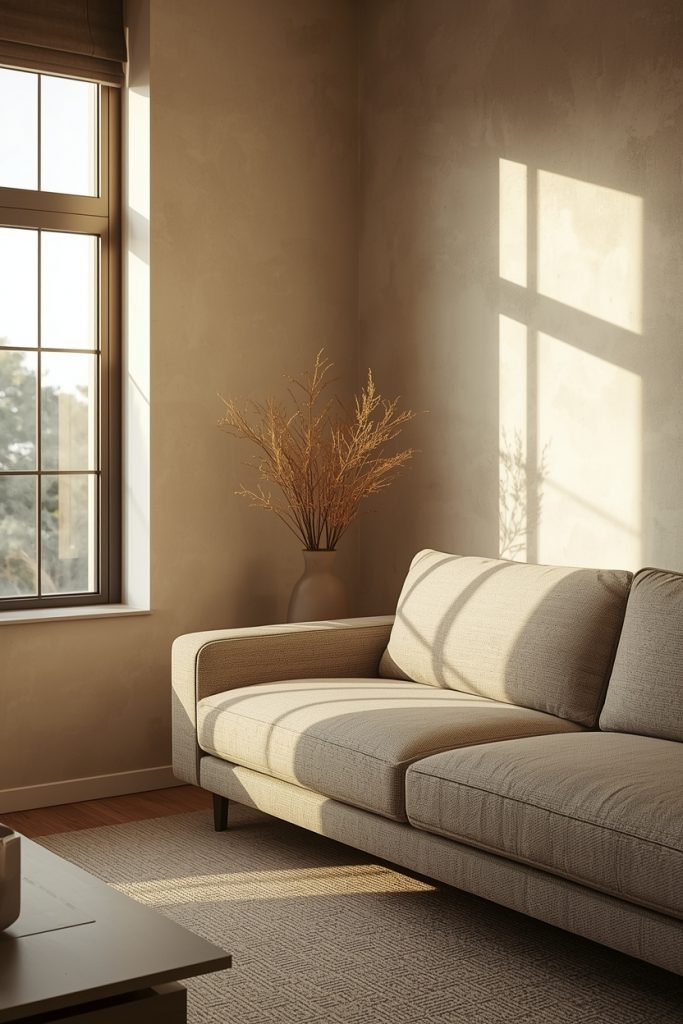
I argued with my flatmate about this for twenty minutes when I suggested it. He thought pulling the sofa forward would make the room feel cramped. We tried it anyway. Six inches of air between the sofa back and the wall changed how the entire room read — it created a visual depth that didn’t exist when everything was flat against the walls.
The reason it works is simple: when furniture touches every wall, the eye reads the room as one flat surface. Gap between sofa and wall creates a plane of space behind the sofa, which gives the room a sense of depth. If you have floor space to spare, push it even further — 10 to 12 inches behind a sofa is enough room for a slim console table with a lamp on it, which gives you another surface and another light source without any additional footprint.
02- Draw your walkways on paper before you place anything
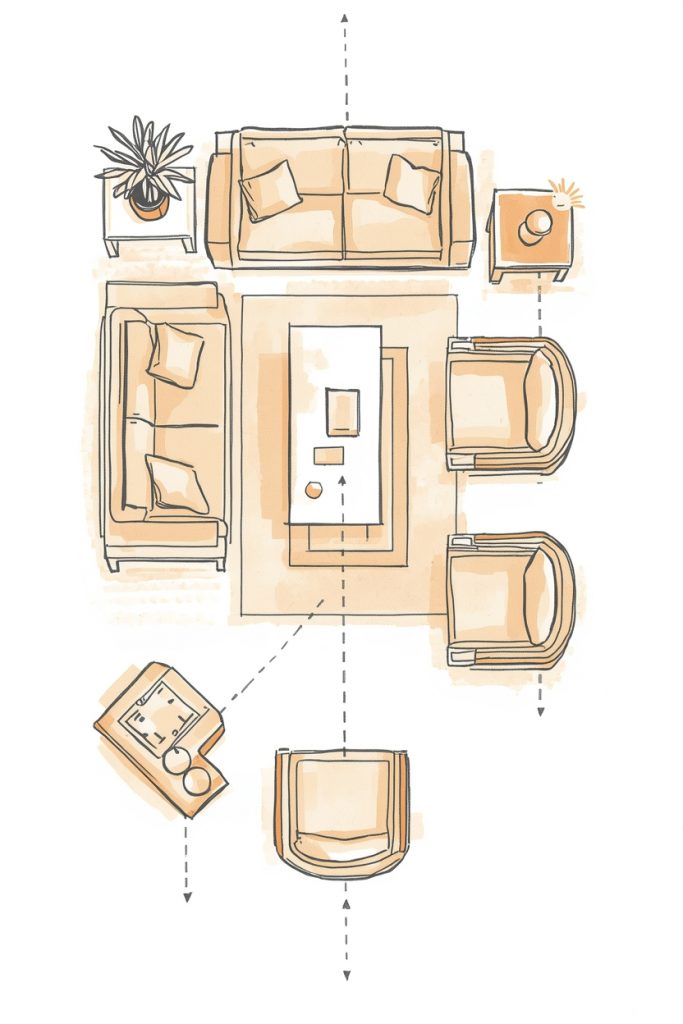
My third apartment had an awkward door position that meant any sofa longer than about 72 inches blocked a natural walking path. I figured this out after struggling past the corner of it every single morning for a month. Took me thirty seconds to fix once I actually sat down and sketched the floor plan on a notepad.
Before you move anything: draw a rough box on paper representing the room. Mark the door. Mark the window. Draw the paths you naturally walk — where you enter, where you go to sit, where you go to the kitchen. Any furniture you place needs to leave those paths clear at a minimum of 30 inches. In a small room, 36 is more comfortable. Arrange around the paths and everything else falls into place more naturally.
Tape trick: Use masking tape on the floor to mark out sofa and table dimensions before you buy or move anything heavy. Takes five minutes and has saved me three bad furniture decisions.
03- Decorate from floor to ceiling — not just at eye level
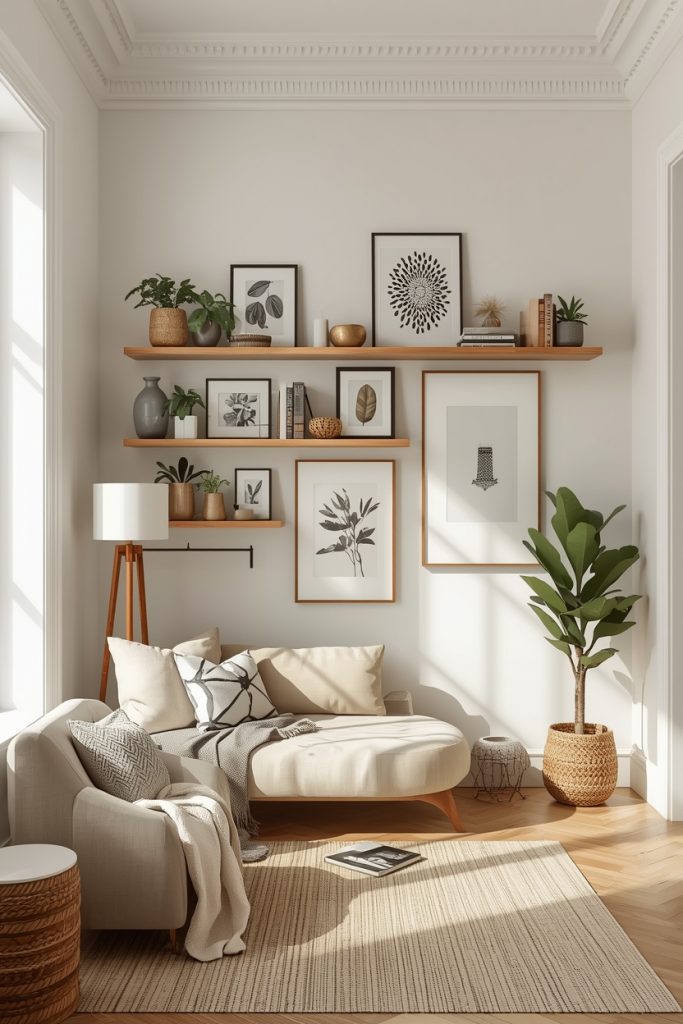
In my first apartment every single thing on my walls sat between 55 and 70 inches off the floor. The top half of every wall was completely empty. The room felt squashed downward — like a hat pulled over somebody’s eyes. The ceiling appeared lower than it was because nothing drew attention up toward it.
Hang one piece of art higher than feels natural — above what you’d consider standard eye level. Add a tall narrow shelf unit that goes close to the ceiling. Put a tall plant in one corner. These vertical moves pull the eye upward and the room feels taller. It’s not a trick exactly, it’s more that most people just never think about the upper third of their walls, and rooms with decorated upper walls consistently feel bigger and more finished than rooms that don’t.
04- Wall-mount the TV and get rid of the chunky unit underneath it
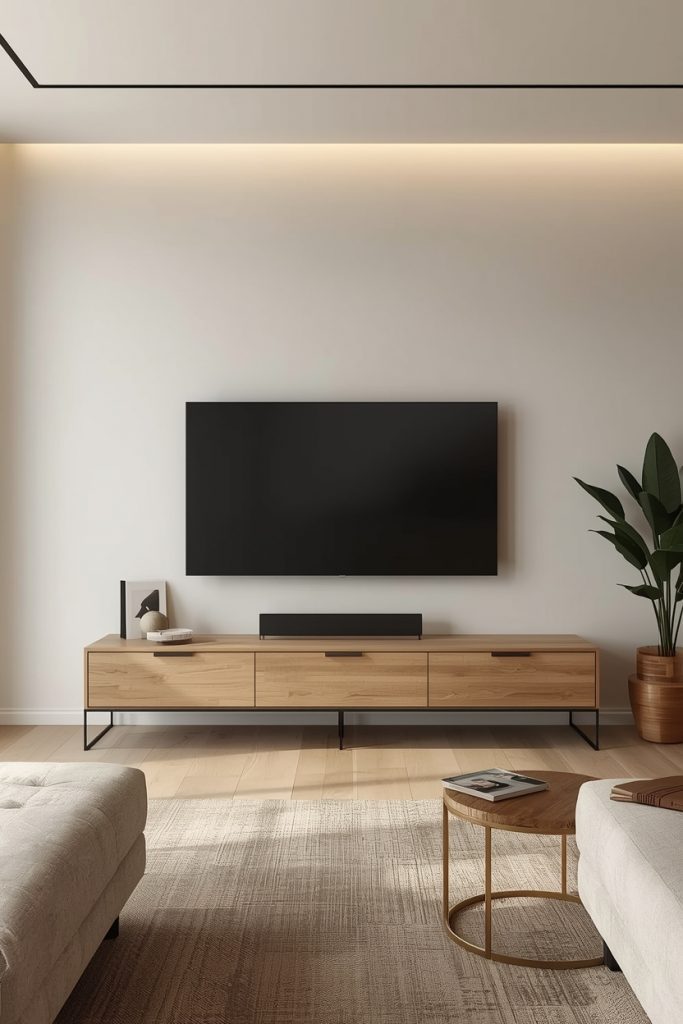
I put off wall-mounting my TV in my second apartment for eight months because I was renting and didn’t want to make holes. Eventually I found a floor-to-ceiling tension pole TV mount — no drilling, no damage, removable in two minutes — and the difference in the room was immediate. The big black entertainment unit had been sitting knee-height across a third of the main wall and cutting the room visually in half.
With the TV mounted and the unit gone, I replaced it with a floating shelf at the same height as a low sideboard. All the same function, a fraction of the visual weight. The floor became visible across the full width of that wall and the room looked considerably larger. If you’re renting and worried about holes, look up tension pole TV mounts — they’re more solid than they sound.
You may also like: 30 Cozy Small Studio Apartment Ideas – 11 Aesthetic Living Room Decor Ideas – 17 Colorful Bedroom Ideas That Will Transform Your Space Overnight
05- Give one wall the main job — let the other three rest
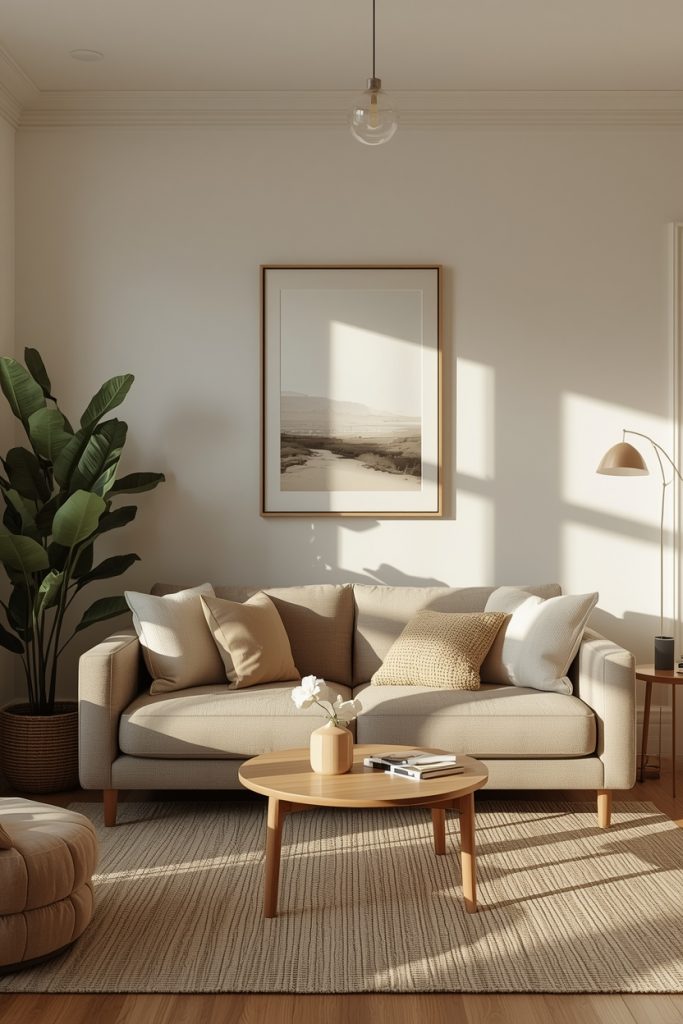
I had a phase in my second apartment where I put something on every wall fairly equally. A small print here. A shelf there. A mirror on one side. A calendar on another. The room looked completely exhausted. Nothing had any weight because everything was the same visual volume.
The fix: decide which wall is doing the main decorating job. For most living rooms it’s the wall the sofa faces, or the wall the sofa sits against. Load that wall — large art, a gallery arrangement, a tall bookcase, whatever your style is. Then make the other three walls deliberately simple. A single small object. Maybe nothing. The contrast between the active wall and the quiet ones gives the room a visual structure that feels intentional and calm rather than busy.
Light and space tricks that cost almost nothing
My third apartment got about forty minutes of direct sunlight per day. North-facing, ground floor, partial tree coverage. I had to solve the darkness problem entirely artificially and it turned out the solution wasn’t more lamps — it was the right lamps in the right places with the right bulbs.
06- Check the number on your light bulbs — and change them if it’s above 3000K
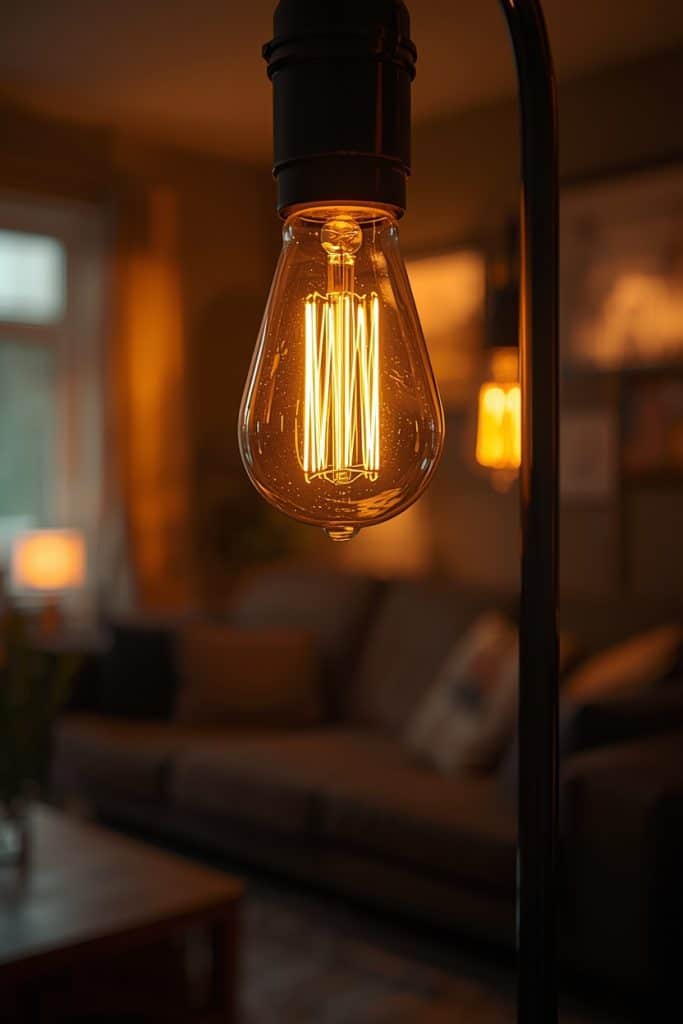
This is the thing I tell every person who says their living room feels cold or clinical: what’s the color temperature of your bulbs? Most rental apartments come fitted with 4000K or 5000K bulbs — marketed as “cool white” or “daylight.” They’re fine for a workshop. In a living room they make walls look grey, floors look flat, and the whole space feel like nobody chose to be there.
2700K is the warm white sweet spot for a living room. The difference when you make the switch is visible in about thirty seconds. Walls look like cream instead of grey. Wood looks warmer. The whole room shifts in temperature. A six-pack runs about $11–13. I buy them in bulk now because changing bulbs is the first thing I do in any new rental.
Check everything: Kitchen, bathroom, hallway too. A warm living room with one cool kitchen tube at the end of it creates a jarring temperature clash that undoes the effect.
07- Move lamps to corners and sofa ends — not the center of the room
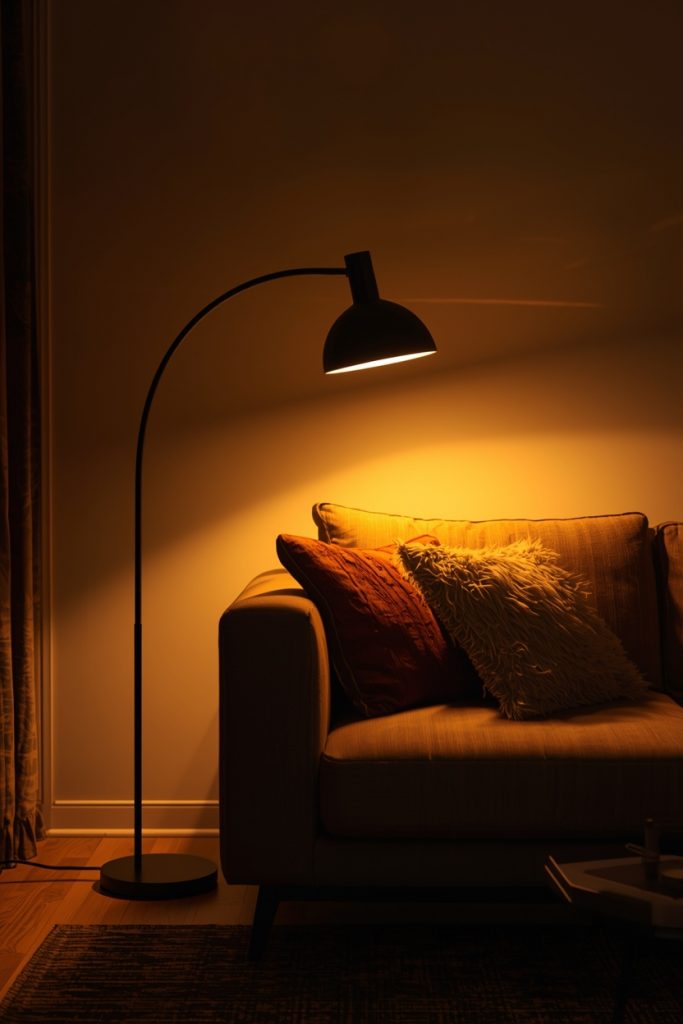
For most of my first apartment I had lamps sitting in the center of side tables in the center of the room. It looked like I was trying to light a medical procedure. Light in the middle of a room just floods the space evenly and creates no atmosphere at all.
Corners and sofa ends. That’s where lamps belong in a living room. A floor lamp tucked into the corner behind the sofa throws light up the wall and across the ceiling — gives the room height and warmth rather than flat illumination. An arc lamp positioned behind one end of the sofa creates a dedicated pool of light just for the seating area and makes it feel like a separate intentional zone rather than just furniture sitting in a room. Two lamps positioned this way with warm bulbs and a dimmer gives more atmosphere than any overhead fixture ever could.
08- Put a large mirror on the wall opposite — or adjacent to — your main window
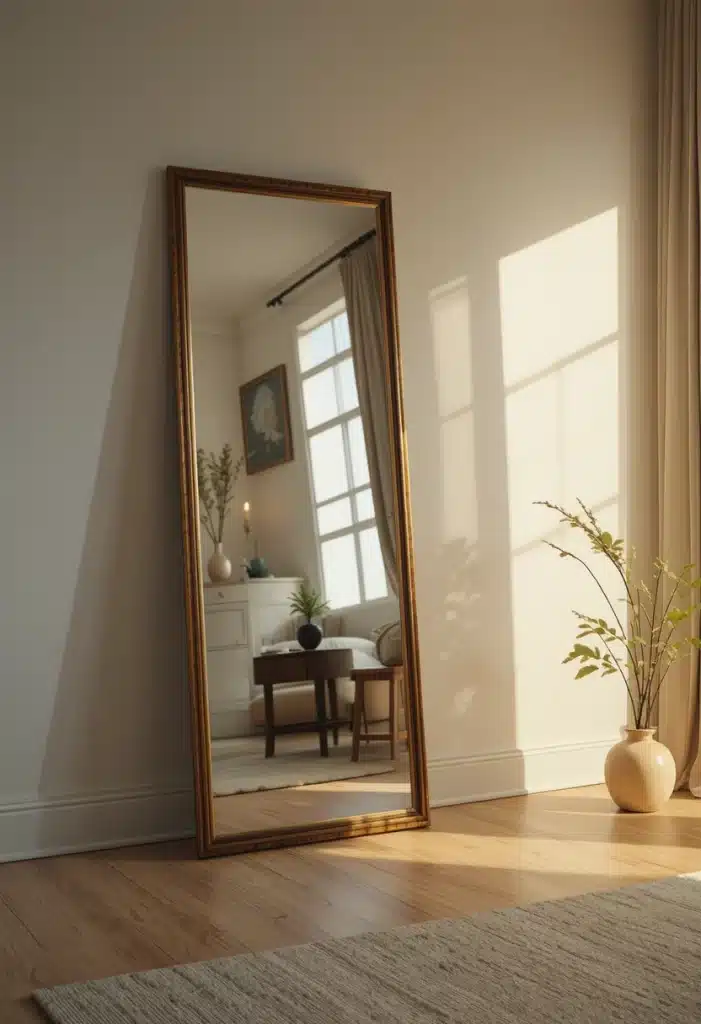
When I moved into my north-facing third apartment I bought a large leaning mirror almost immediately because I knew I’d need help with light. I put it on the wall directly opposite the window. The effect was better than I expected — the room felt brighter from about 9am to 3pm purely because the mirror was throwing natural light back across the space.
Adjacent to the window also works well. Directly beside the window rather than opposite it creates a different effect — it visually extends the window, making it look wider than it is. In a room that feels narrow, this can be especially good. Lean rather than hang if you’re renting. The casual lean looks intentional these days rather than temporary, and you can reposition it in ten seconds if the light isn’t right.
09- Mount curtain rods at ceiling height, not window height
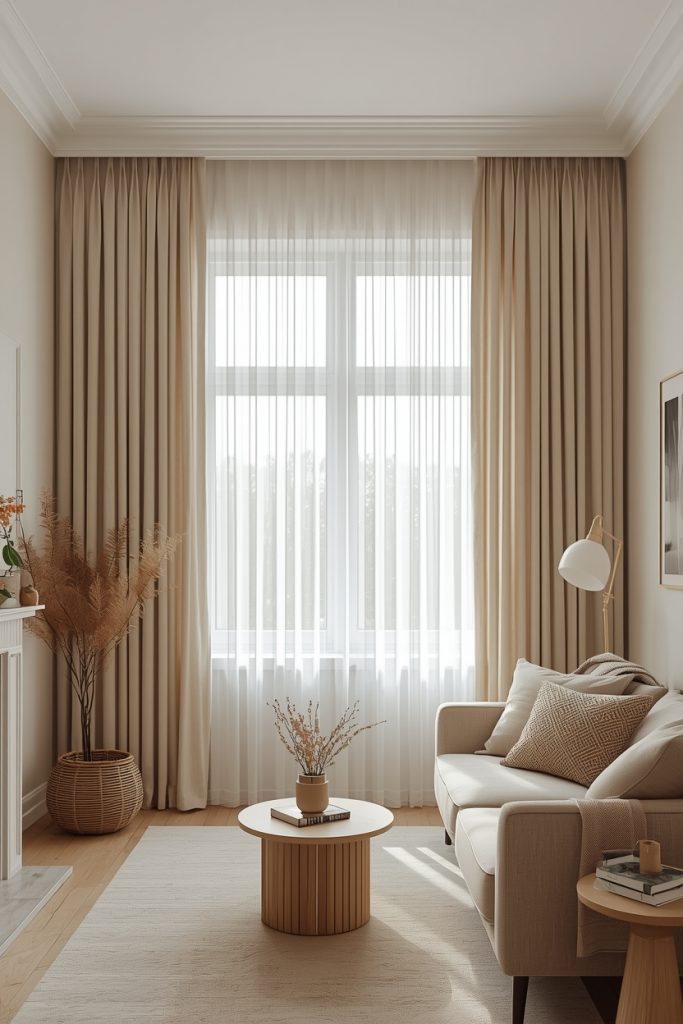
The standard position for a curtain rod is a few inches above the window frame. This is what most people do. It also makes the window look small, the ceiling look lower than it is, and the whole wall look like it ran out of ideas halfway up.
Move the rod as close to the ceiling as the wall allows. Hang panels that run all the way to the floor — 110 to 120 inches is usually right depending on your ceiling height. Extend the rod 10 to 12 inches past the window frame on each side so the curtains sit beside the window when open rather than in front of it. The window looks taller. The ceiling looks higher. The whole wall looks properly designed rather than roughly finished. I’ve done this in every place I’ve lived since I learned it and I’ve never had a single person not notice the difference when they see it done right versus the standard position.
10- Put a plug-in dimmer on your main living room lamp
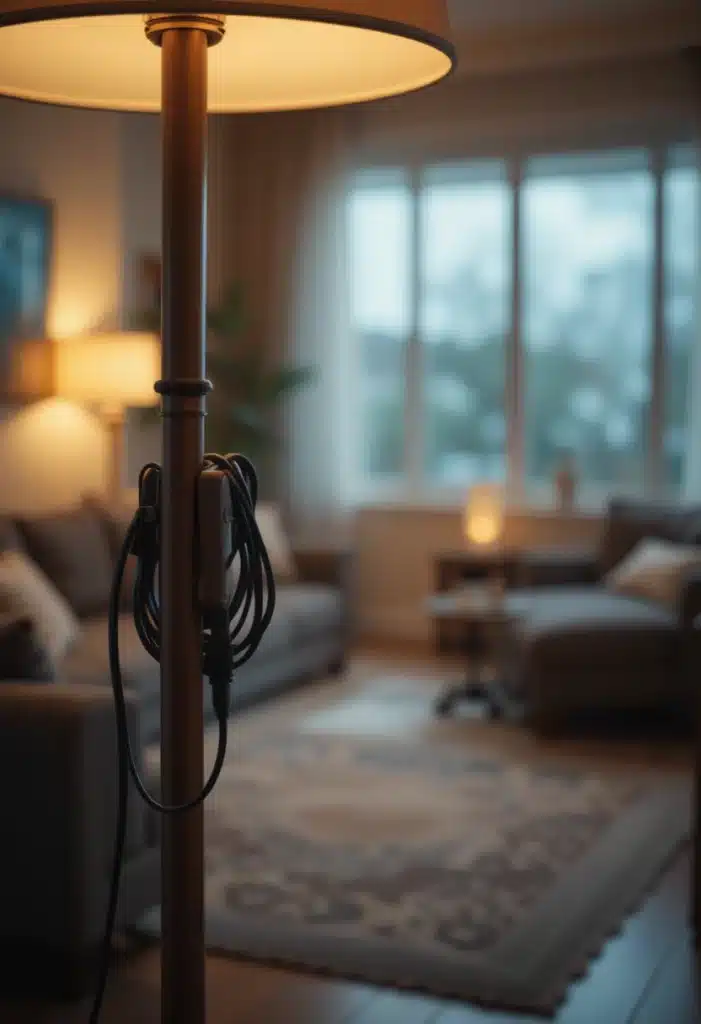
My second apartment had one floor lamp that was either fully on or fully off. That’s it. Two settings: bright room, dark room. I used it on full brightness even when I was watching a film at 10pm because that was the only option. The room felt like it couldn’t relax.
A plug-in dimmer is a small device that sits between the lamp cord and the wall socket. Your lamp plugs into it. You turn a dial to set the brightness anywhere from full to barely-there. It costs $12–15, takes thirty seconds to set up, and works with any dimmable LED bulb. I had no idea how much of my living room’s atmosphere problem was just “I can’t control the light level” until I got one and started using it every day. Morning: bright. Afternoon working: medium. Evening watching something: low. That range changes how the room feels completely.
Very small apartment living room ideas — when the room is genuinely tiny
My 140 square foot living room in my first apartment shared one wall with the kitchen. The kitchen didn’t have a door. So cooking smells, cooking sounds, and the sight of unwashed dishes were all part of the living room experience. These five ideas are specifically for rooms that cramped — where standard small-space advice doesn’t go far enough.
11- Choose the sofa that fits the room — not the one you wish would fit
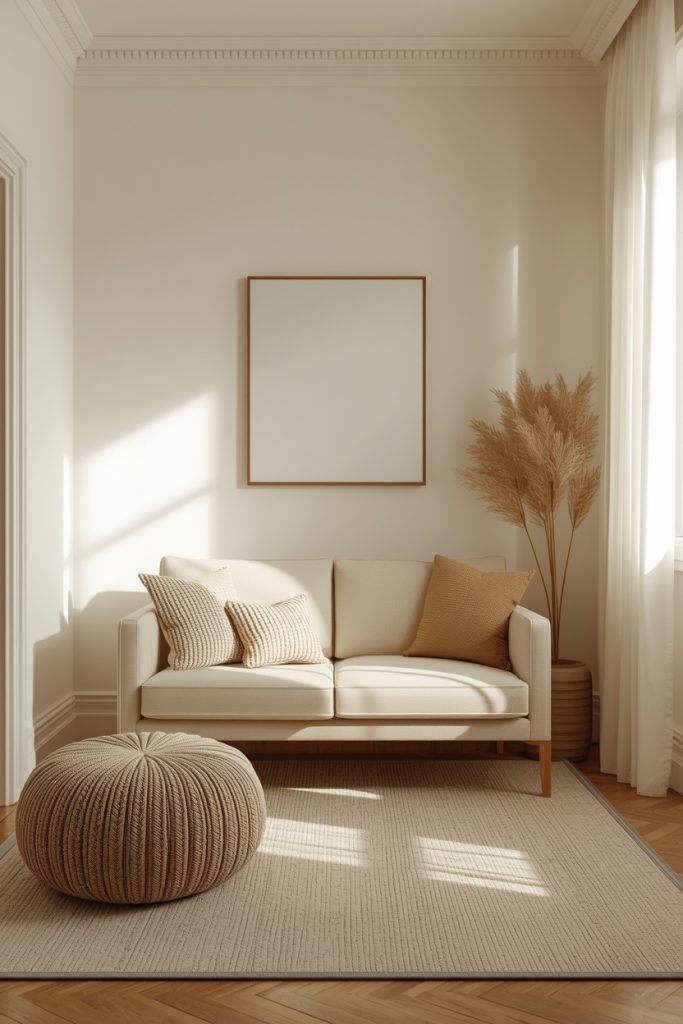
I bought a 86-inch sofa for my 140 square foot living room. I’m still not sure what I was thinking. It took up so much of the floor plan that the room was essentially a corridor with a sofa in it. I returned it three weeks later at significant inconvenience and got a 66-inch loveseat instead. The room went from being unusable to having actual floor space around the furniture.
The rule I’ve used since: the sofa should take up a maximum of half the width of the room. Measure first. Buy second. And get one with visible legs — not a base that goes all the way to the floor. Legs mean you can see the floor beneath the sofa, which keeps the room feeling open rather than heavy. A loveseat with legs in a neutral tone with a well-chosen pouffe beside it gives you effective seating for three without the room paying the price.
12- Use nesting tables instead of a fixed coffee table
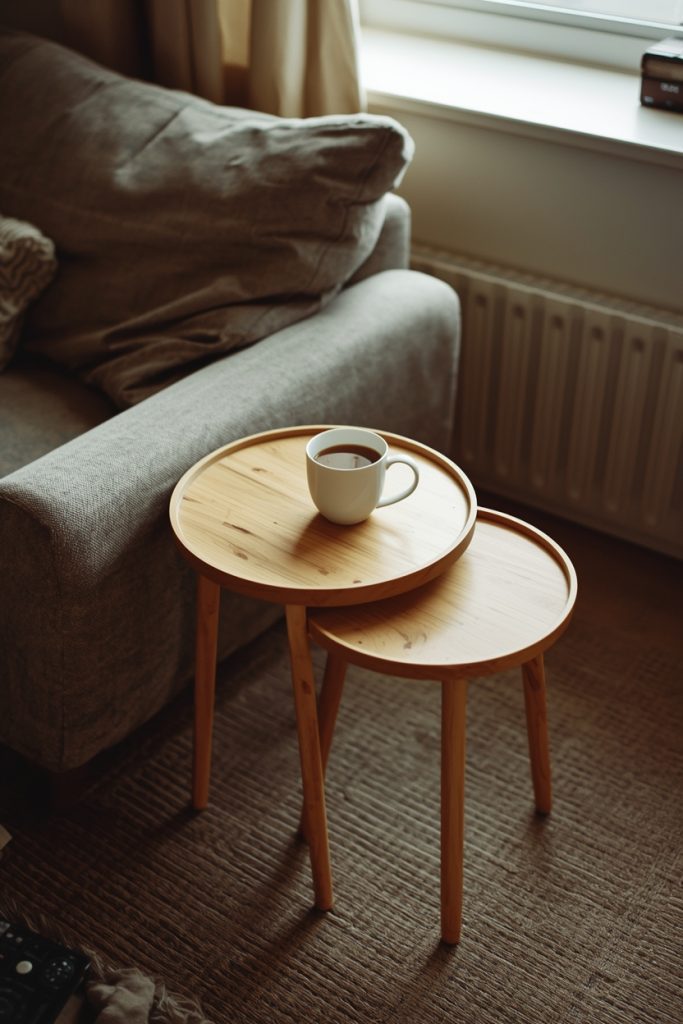
A standard coffee table in a very small living room is a permanent island of occupied floor space sitting in the middle of your room every day, used intensively for about two hours and mostly just in the way for the other fourteen. In a 140 square foot room I found myself stepping around mine more than I used it.
Two nesting tables — one slightly taller, one slightly shorter and tucked underneath — take up the footprint of the smaller one when stacked. Pull the top one out when you need a surface. Pull both out when someone comes over and you need more table space. Push them back when you want the floor. I found mine at a furniture clearance place for $38 total. They’re bamboo. They’ve moved with me twice. In a very small living room the ability to reclaim floor space at will is worth more than a fixed table that looks nice.
13- Convert a deep windowsill or alcove into a seat with storage underneath
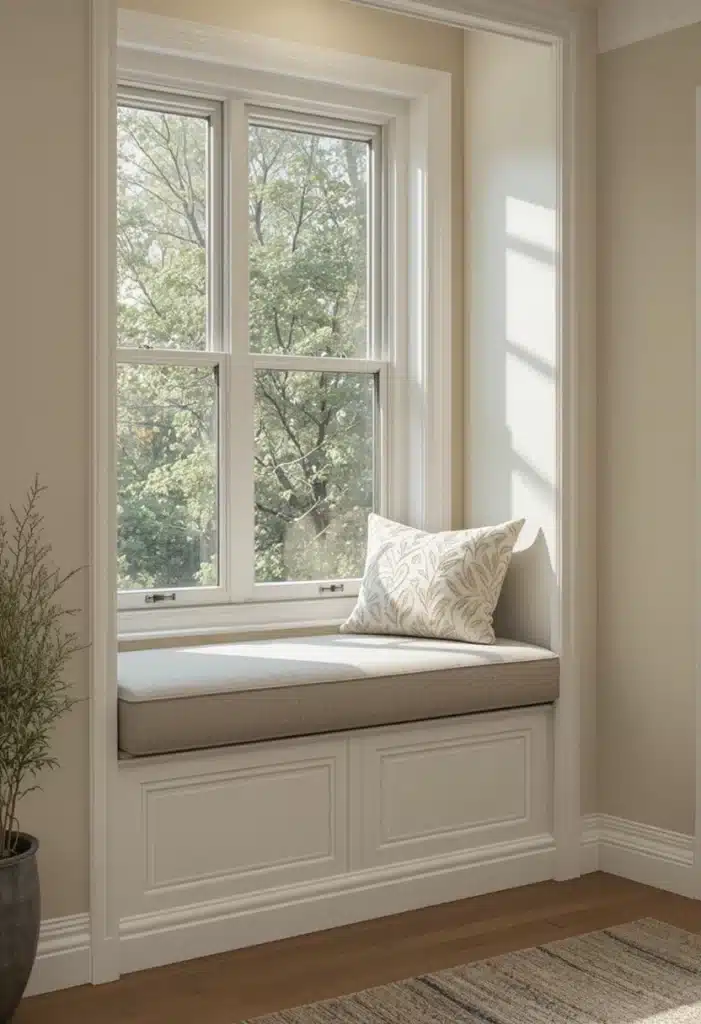
My first apartment had a deep bay window with a ledge that was about 18 inches deep and completely useless as a windowsill — too deep for plants to look right, too narrow to use as a desk, too high to use as a shelf. I spent a Saturday morning building a storage box to sit on it using two IKEA KALLAX units laid on their side and a foam pad cut to size and covered in fabric.
The result: seating for one that stores roughly two boxes of stuff underneath, doesn’t take any floor space, and became the spot in the room I used most. My girlfriend at the time would sit there with a coffee and her phone almost every morning. It’s the kind of thing that makes a small living room feel like it was designed specifically for the space rather than furnished generically.
No tools needed version: A storage bench placed in front of the window achieves a very similar effect. No cutting, no assembly beyond what the bench requires. Take it with you when you move.
14- Replace the coffee table with a lidded storage ottoman
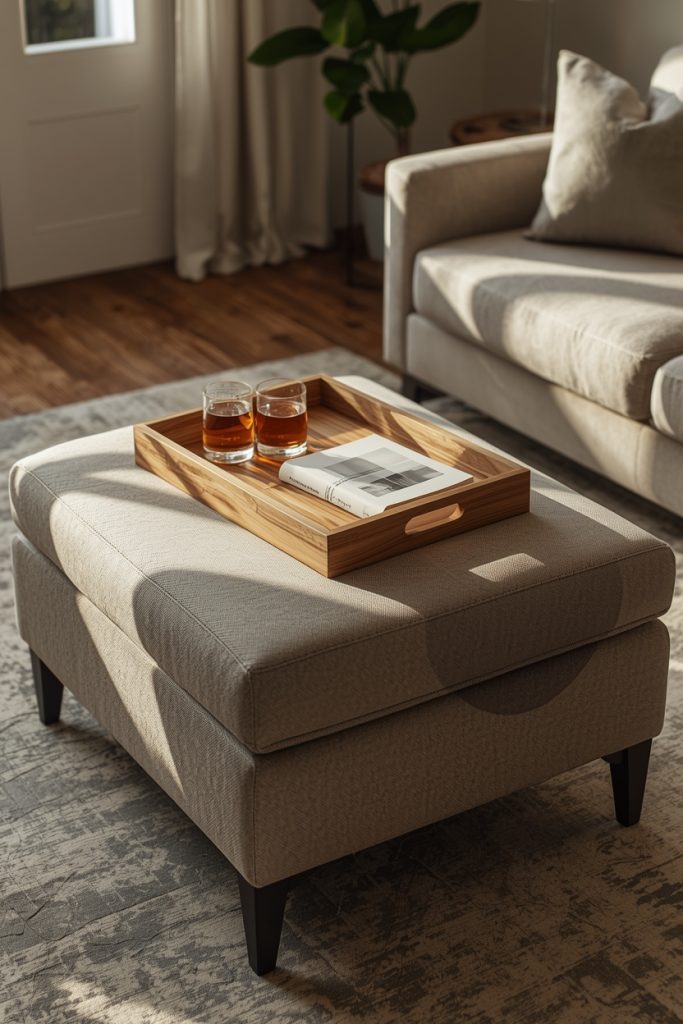
In a small living room where storage is scarce, a coffee table that only holds things on top is a missed opportunity. A storage ottoman with a firm lid does the same surface job when you put a wooden tray on top of it — stable enough for drinks, books, and a remote — and stores anything inside it: extra blankets, board games, charging cables, the things that otherwise end up on surfaces or in corners.
When guests come over it becomes extra seating. When they leave the seat goes back to being a table. The one I have now is round, which I’d recommend for small rooms — you navigate around it without catching yourself on corners multiple times a day. Got it at a HomeGoods for $65 about two years ago and it’s held up fine with daily use.
15- In a tiny room — go tall and narrow with storage, never short and wide
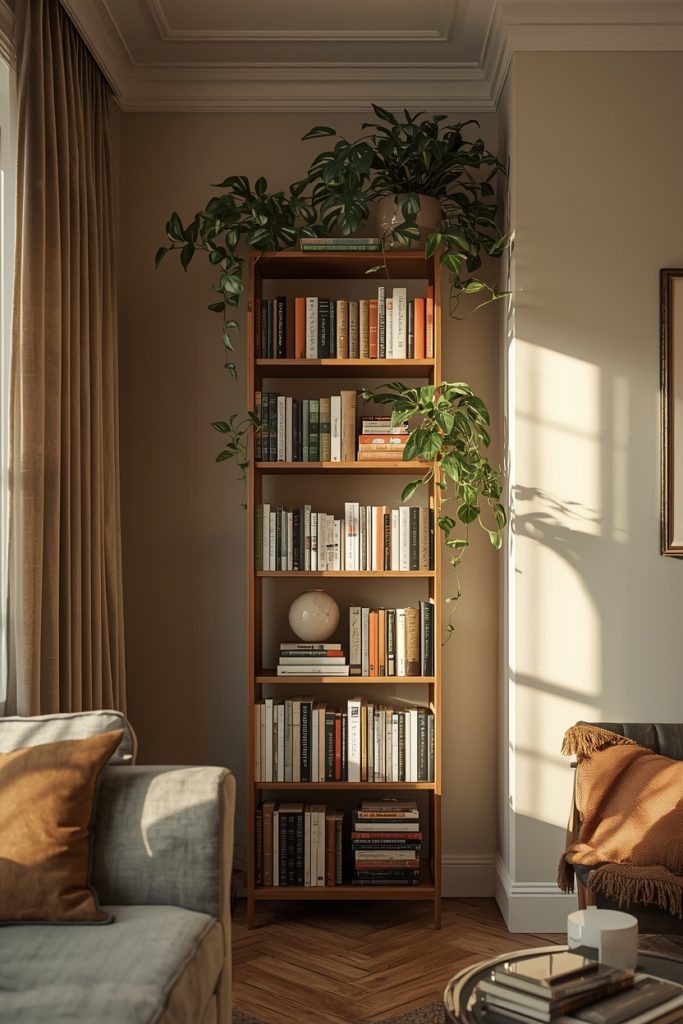
A short wide bookcase takes a lot of wall and gives you storage at only one height. A tall narrow bookcase takes a small wall footprint and uses the full height of the room. In a tiny living room where every inch of floor space matters, a tall narrow unit is not a stylistic choice — it’s a practical necessity.
The visual benefit is real too. A bookcase that goes close to the ceiling draws attention upward and the ceiling feels higher. I have a 75-inch tall, 14-inch wide unit in my current place that holds roughly the same volume as a much wider low unit would — but it takes about half the floor footprint. The remaining floor space it gives back makes the room feel significantly less crowded.
Small apartment living room decorating ideas that don’t make a small space feel busier
Decorating a small living room requires a slightly different discipline than decorating a larger one. More is not more. More is more crowded. These six ideas are about adding personality and warmth without making the room feel like it’s running out of air.
16- Use warm neutrals throughout — and pick an accent color you actually commit to
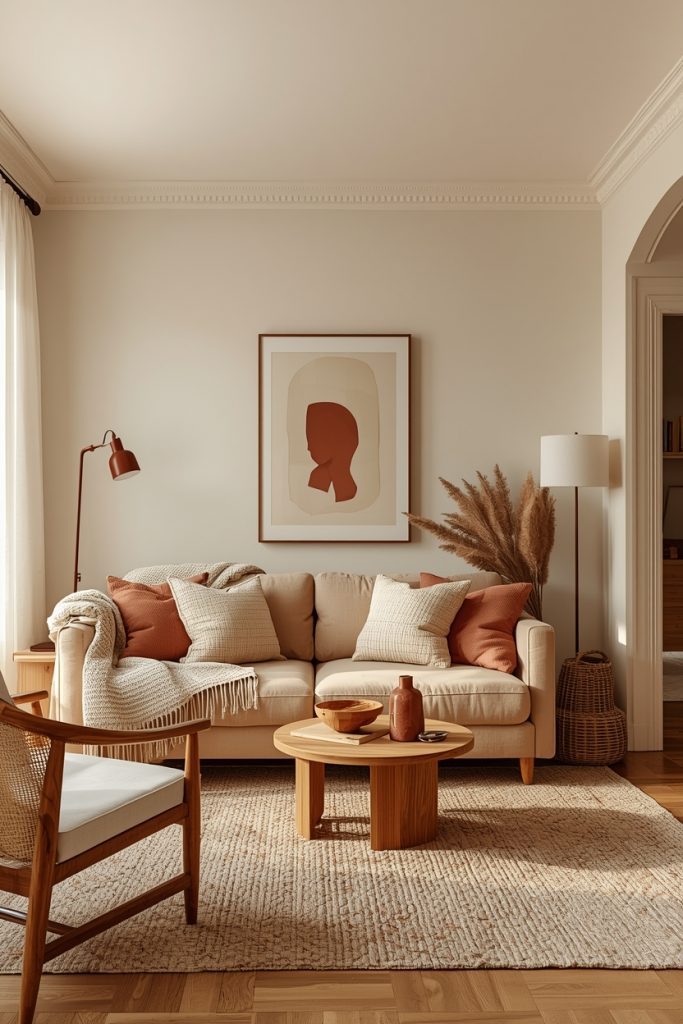
The living room in my first apartment was a mess of colors because I kept buying things I liked individually without thinking about whether they belonged together. A teal cushion. A burgundy throw. A mustard lamp. A grey rug. Every single item was fine in isolation. Together they looked like an argument.
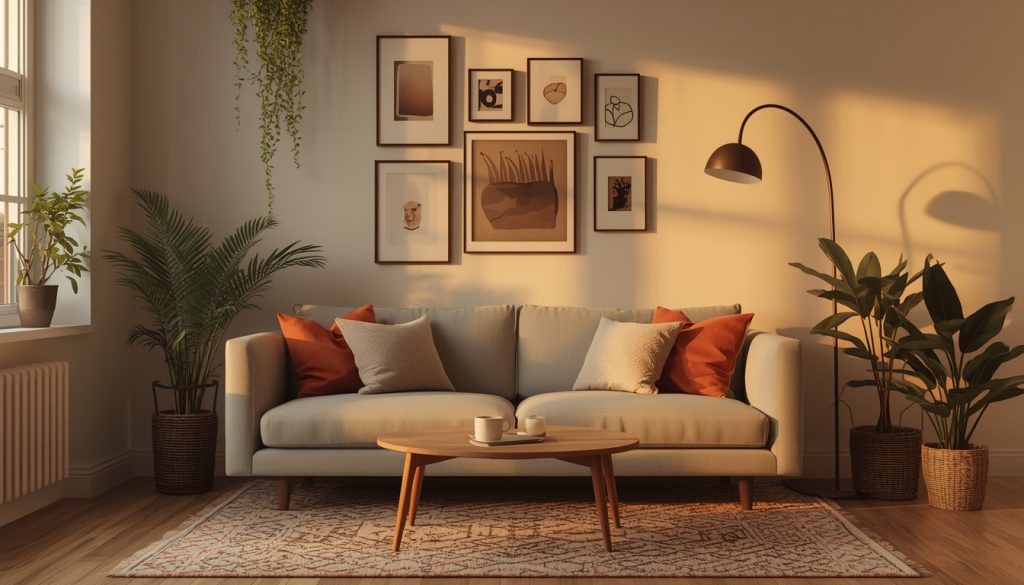
What sorted it was deciding on two things: a warm neutral base and one accent color. Base: cream and oat across the sofa, walls, and curtains. Accent: terracotta for cushions, the plant pot, and one small vase. Everything else in natural wood. The room immediately looked cohesive — not because I bought expensive things, but because everything stopped competing. Pick your base and accent before you buy anything new. Then stick to them.
17- Get a rug large enough for the sofa’s front legs to actually sit on it
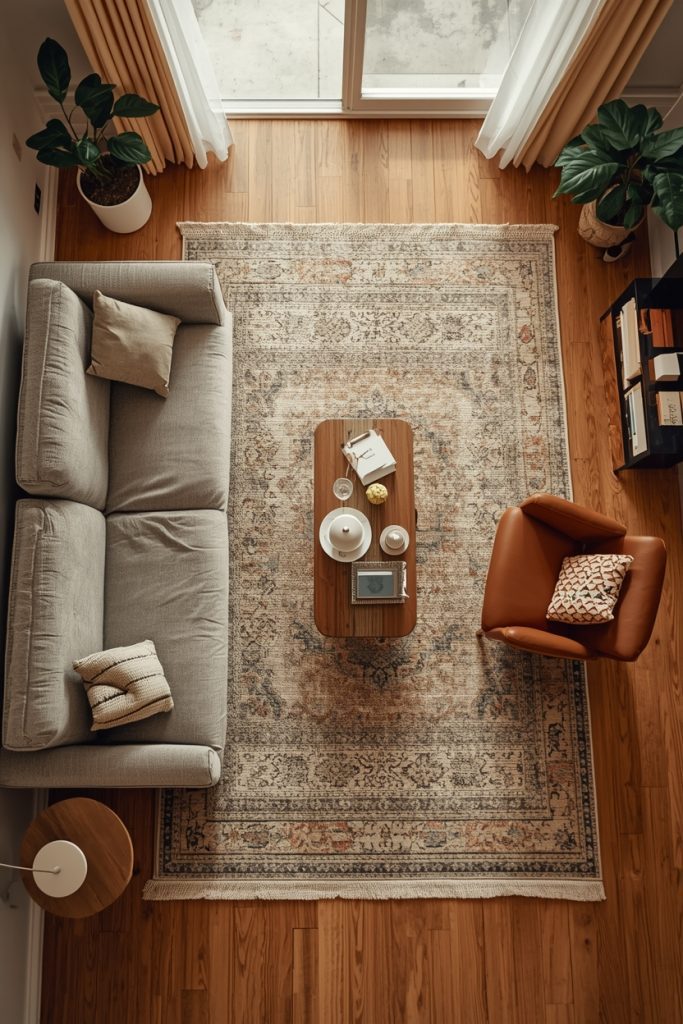
I bought two wrong-sized rugs before I understood this rule. First one: only the coffee table sat on it. The sofa and chairs floated completely off it. Looked like the rug was a mat rather than something defining a zone. Second one: slightly bigger but still not quite right — one sofa leg on, the other off. Still looked awkward.
The minimum that works: front legs of the sofa on the rug. Coffee table on the rug. If there’s an accent chair, its front legs on the rug. That configuration creates a “room” on the floor — a defined zone that the eye reads as a living area rather than furniture scattered on a floor. When I finally bought a rug properly sized for my current room, my neighbor came over and asked if I’d bought a new sofa. Same sofa. Different rug size.
18- Build a gallery wall using one large print and smaller ones around it
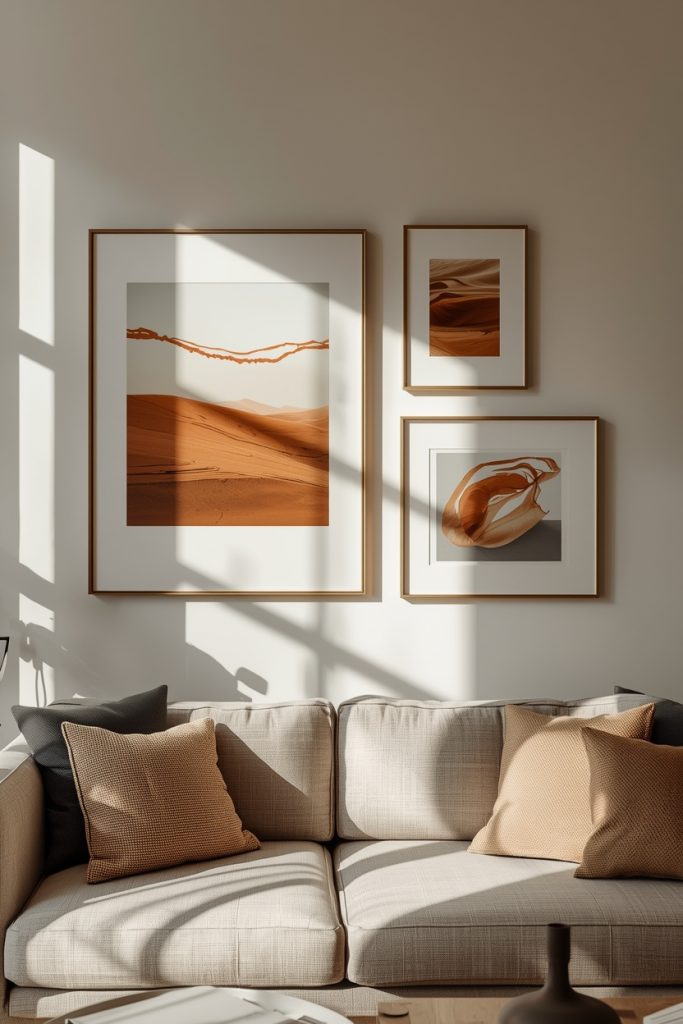
I’ve seen a lot of gallery walls in small apartments go wrong because every print was roughly the same size and the arrangement looked like a grid. Neat but forgettable. The arrangements that actually look good have a mix of sizes — one genuinely large anchor piece and smaller prints arranged around it.
My current one: a 24×30 inch print slightly left of center as the anchor, two 8x10s to the right at slightly different heights, one 5×7 below the largest. All warm tones — dusty terracotta, cream, warm brown. All in thin black frames except the largest which is brass. Total cost: under $50. The large print came from Printful, the smaller ones from Etsy digital downloads I printed at Walgreens. Lay the whole arrangement on the floor before touching the wall. Non-negotiable — I learned this the hard way with misaligned holes I had to fill with toothpaste when I moved out.
19- Layer at least three textures on the sofa — fabric, knit, velvet
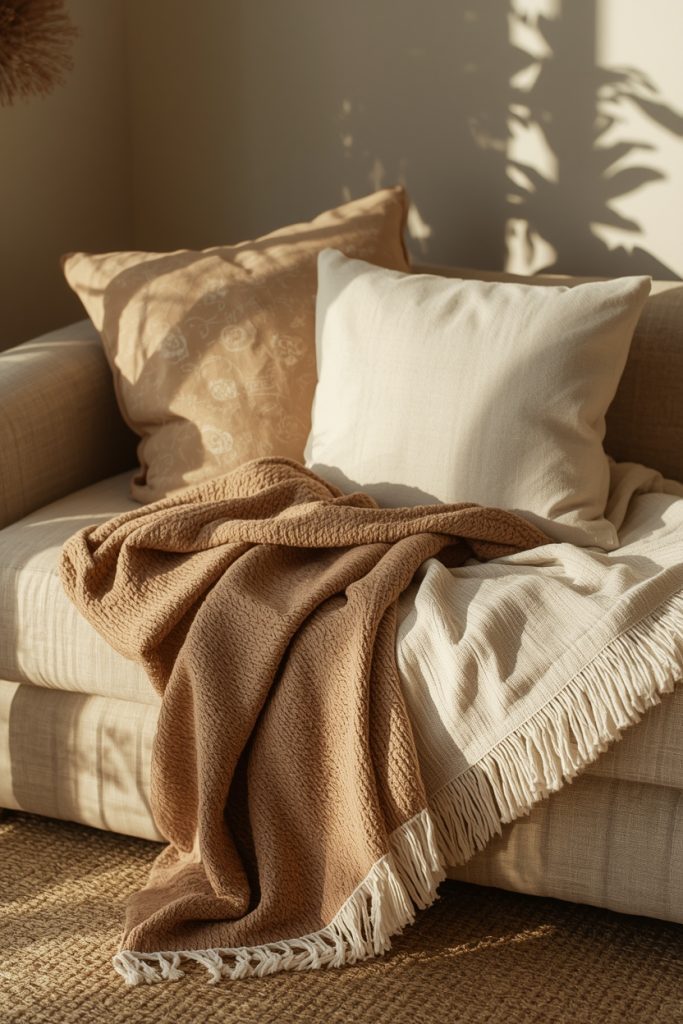
A sofa with matching cushions in the same fabric as the sofa upholstery looks like it came fresh out of a furniture showroom, which is fine for a furniture showroom and lifeless for a home. The sofas in small living rooms that look best are the ones where multiple textures are layered — something woven, something knitted, something with a sheen.
Mine currently has: a linen sofa (smooth base), a chunky woven throw tossed over one arm (rough texture), two velvet cushions in a slightly darker warm tone (soft with light-catching sheen), and one plain cotton lumbar cushion in a contrasting size. None of them match. All of them belong to the same warm palette. The combination looks genuinely considered without me having spent much — the throw was £22, the cushion covers were under $15 each.
20- Use plants to fill vertical height — not just to cover horizontal surfaces
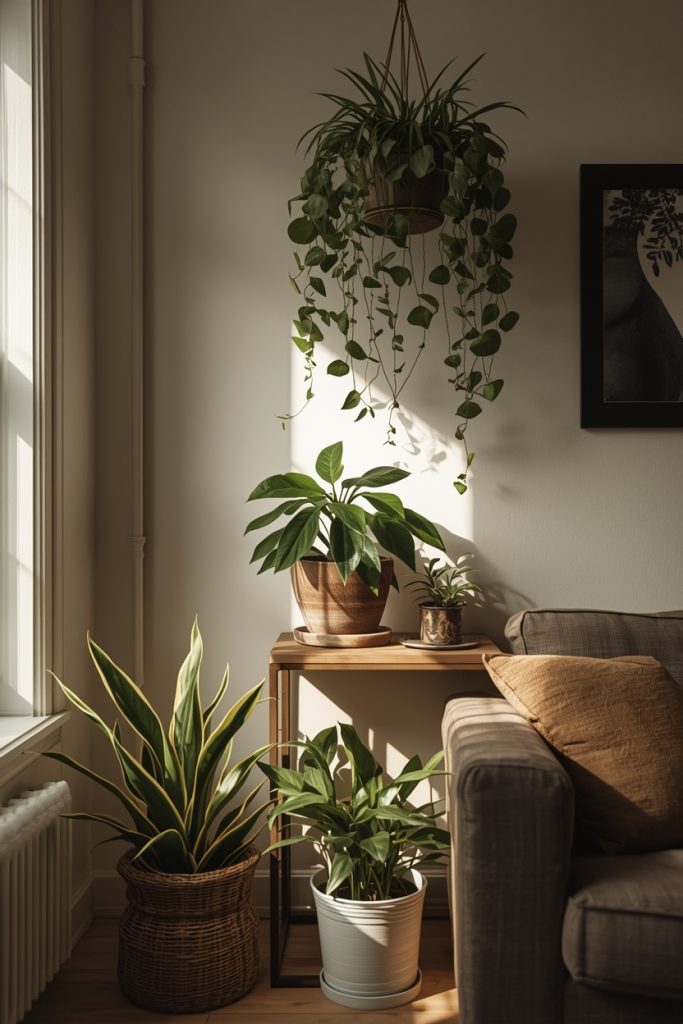
For years I put plants on windowsills and the occasional shelf and wondered why my living room still felt a bit flat. The problem was they all sat at the same height. One level of greenery is a garnish. Three levels of greenery — floor, mid-height shelf, ceiling-adjacent hanging — fills the vertical space of the room and makes it feel genuinely alive and layered.
A tall snake plant or rubber tree on the floor in a corner. A medium-sized monstera or peace lily on a shelf or stand at mid-height. A trailing pothos or string of pearls on a high shelf or in a hanging planter. That combination covers three completely different heights in the room, pulls the eye through the space vertically, and makes the room feel more designed than almost any other single change. Snake plants and pothos are the two most forgiving options if your room gets inconsistent light.
21- Paint one wall a warm color — even if you think you don’t want to
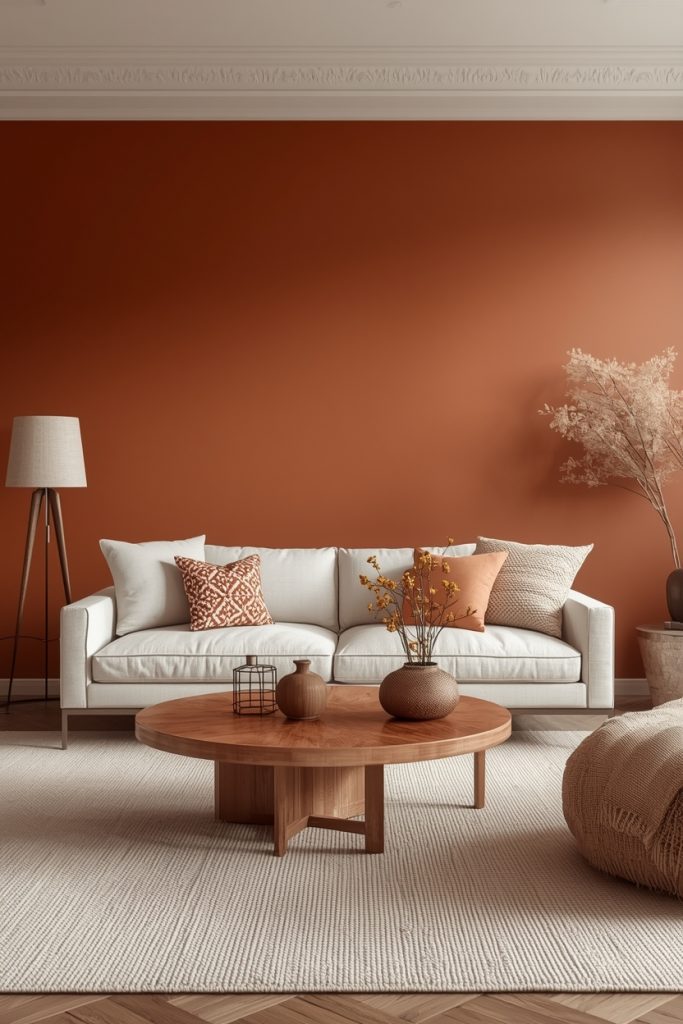
I was against this for a long time. Four cream walls felt safe. Intentional. Calm. Then I painted the wall behind my sofa a terracotta-adjacent warm rust color as an experiment — I’d bought a small tester pot to try on one section and ended up doing the whole wall in the same afternoon because it looked so good.
The effect in a small living room is to give the main seating area a genuine sense of enclosure — like the colored wall is embracing the sofa from behind. The room feels cozier and more defined. Importantly, one warm wall against three neutral ones doesn’t make the room feel smaller — it makes it feel more deliberate. If you’re renting: ask your landlord first, or use peel-and-stick textured wallpaper on the single wall as a renter-safe alternative.
The last details that make a small living room feel finished
These four are the things that register as “this room feels complete” without people being able to say exactly why. They’re small. Two of them cost nothing to change. All four matter.
22- Style flat surfaces with the odd-number rule — and leave one area empty
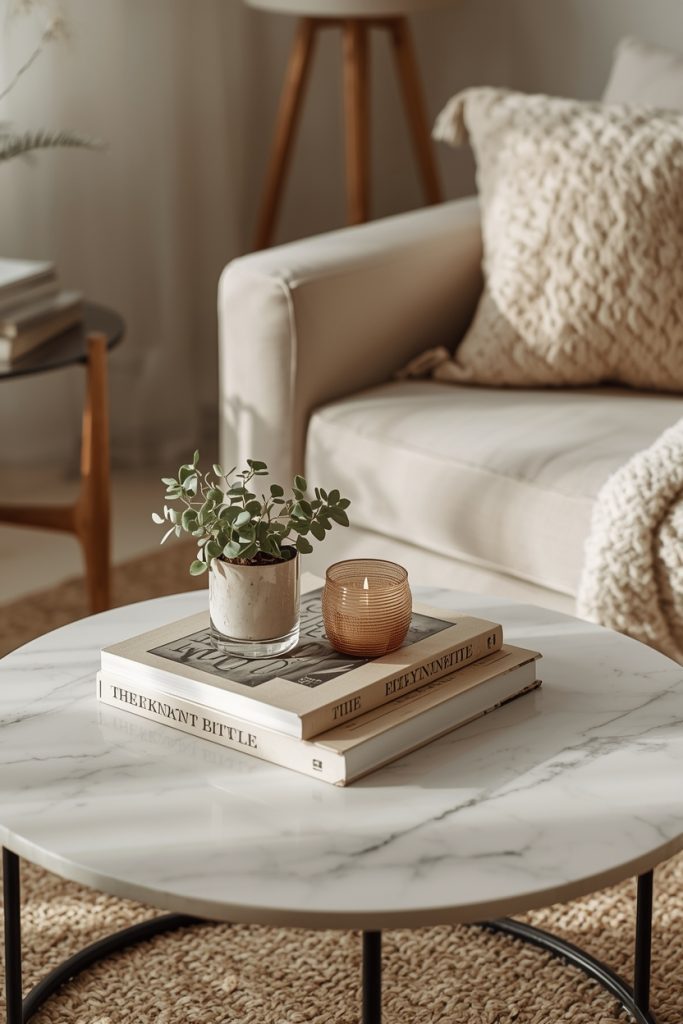
Every surface in my living room used to either be completely empty or completely covered. The empty ones looked unfinished. The covered ones looked messy. A friend who works in property staging told me about the odd-number rule and it genuinely changed how I approach every surface in the house.
Group things in threes on any surface: a short candle, a medium plant, a tall vase or lamp. The odd number creates visual balance that feels natural rather than symmetrical and staged. Vary the heights within the group. Then — and this is the part most people skip — leave some surface area intentionally empty next to the grouping. The empty space makes the objects look chosen and significant rather than accumulated and random. I applied this to my coffee table, my windowsill, and my shelf and every surface immediately looked twice as considered.
23- Run warm string lights along the ceiling edge — not around the window
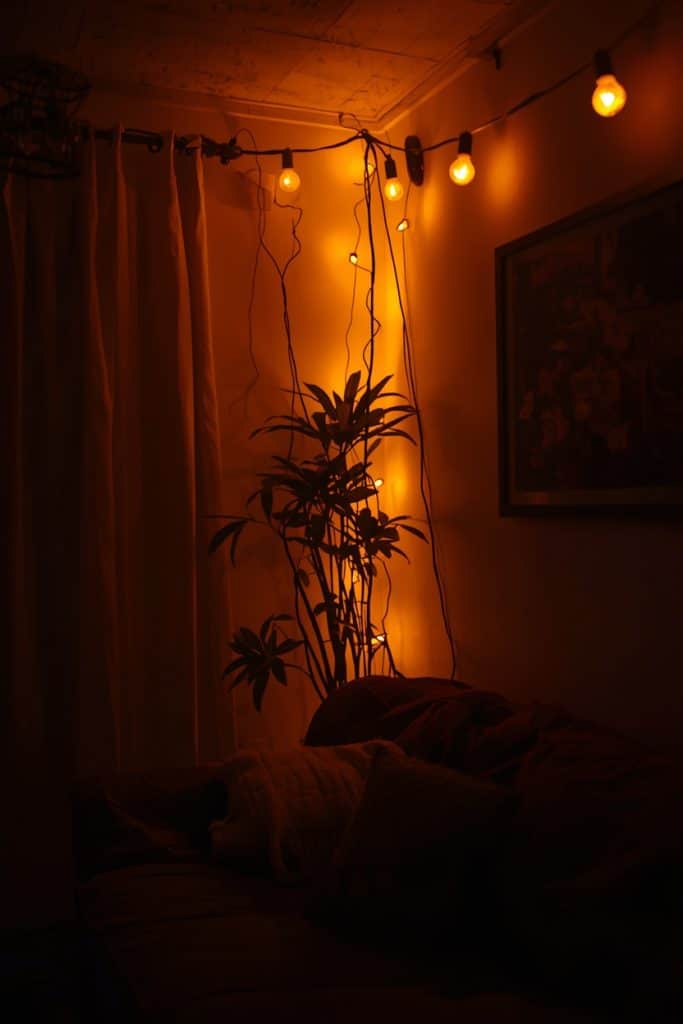
There’s a version of string lights that looks like a student dorm room and a version that looks genuinely considered. The difference is entirely about placement. Around a window frame: dorm room. Along the ceiling perimeter where the wall meets the ceiling, mounted with small adhesive cable clips: something else entirely.
A continuous run of warm white micro-lights mounted along that ceiling join creates a soft glow that wraps the room from above — warm, low, and completely different from any lamp. Turn everything else off and turn only these on: the ceiling appears lower, the room feels enclosed and intimate, and the whole space takes on an atmosphere that no ceiling fixture or floor lamp creates. I’ve had guests ask me what kind of lighting I had installed in the ceiling. It’s a $14 string of lights from Amazon on adhesive clips. No installation at all.
24- Choose a room scent and use it consistently
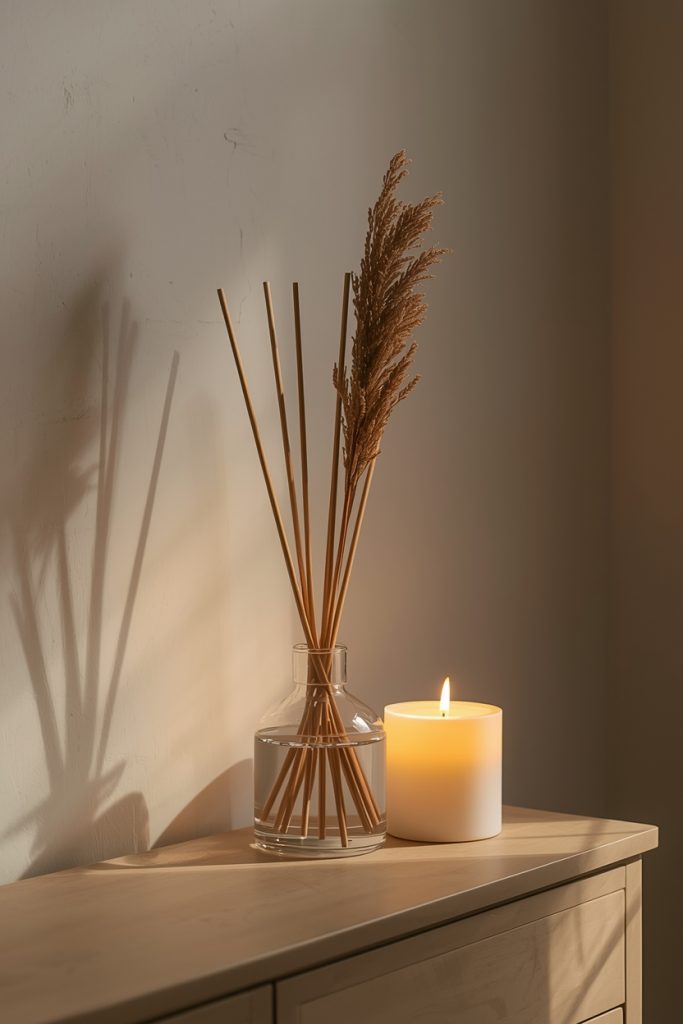
I noticed this first in someone else’s apartment before I thought to apply it to my own. A friend’s place always smelled of the same cedar and tobacco reed diffuser the moment you walked in. It wasn’t overpowering — just there, in the background. The effect was that walking into his living room always felt immediately relaxing. The smell had become synonymous with “comfortable, familiar, off-duty.”
I set up a diffuser with the same scent in my living room about two years ago and never changed it. Cedar and sandalwood. Every time I walk in from outside, especially after a difficult day, there’s a near-instant physical shift. Sounds dramatic but it’s a real phenomenon — scent memory is faster than any visual processing. A consistent scent in your living room does something quiet and persistent that no decor item achieves. A reed diffuser lasts two to three months. About $18–22 for a decent one. Ongoing cost is low.
25- Put the books you’re actually reading somewhere visible in the living room
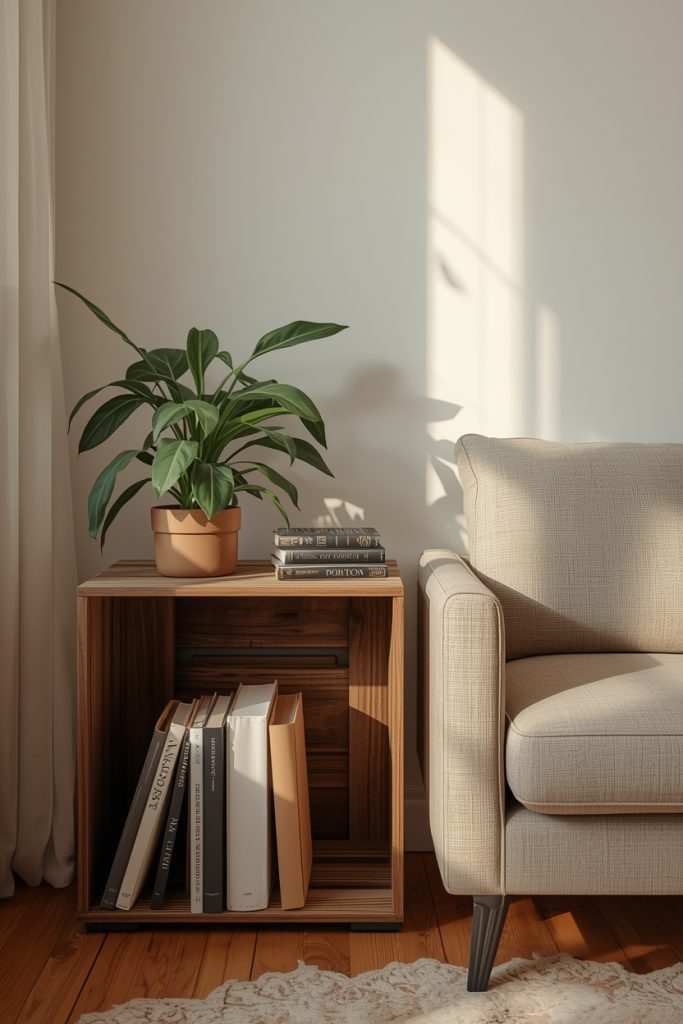
This last one is small but I notice it every time I’m in someone’s living room. The rooms that feel most like homes — not just well-decorated rooms, but places where someone’s life is happening — usually have books somewhere that are clearly being read. Not a perfect styled shelf with spines all facing the same way. Actual books: a stack beside the sofa, a couple on the coffee table, one left open face-down on the armrest.
It communicates something no cushion or plant can communicate: a person lives here and has a life here. It takes a small living room from “nicely decorated” to “someone I might actually want to know lives here.” It costs nothing. You already own the books. Just bring three or four of them into the living room and leave them somewhere natural and slightly imperfect. The room immediately has more character than it did before.
Where to spend money first — small apartment living room on a budget
If I had to restart from scratch with limited money and one of my old small living rooms, this is the exact order I’d spend in. Everything in the first three rows costs under $45 and changes how the room reads the same day you do it.
| WHAT TO BUY | WHY IT MATTERS IN A SMALL LIVING ROOM | COST |
| 2700K warm white LED bulbs — 6 pack | Changes the temperature and mood of the entire room within seconds of switching on. Do this before anything else. | ~$12 |
| Plug-in lamp dimmer | Gives you lighting control across the whole day. Morning bright, evening low. Same lamp, completely different room. | ~$13 |
| Warm string lights — 33 ft | Ceiling perimeter mounting creates atmosphere no floor lamp replicates. Costs almost nothing. | ~$14 |
| Larger area rug (if current one is too small) | Gets the sofa legs on the rug. Defines the living zone. Single most visible furniture-adjacent change. | $60–120 |
| Velvet cushion covers — 2 or 3 | Instant sofa texture upgrade. No new furniture needed. Vary the sizes. | ~$15 each |
| Gallery wall prints — Etsy downloads + print shop | Makes the main wall look finished and personal. One large, two small, same color family. | ~$40 total |
| Linen curtain panels — pair | Hung from ceiling height, they transform the window and add texture to hard painted walls. | ~$20–30 |
| Reed diffuser — cedar, sandalwood, or amber | Consistent room scent. The most underrated change in any living space. | ~$18–22 |
| Nesting tables — set of 2 | Flexible surface with almost no permanent footprint. Better than a fixed coffee table in very small rooms. | ~$35–50 |
| Large leaning mirror | Doubles light, creates depth, makes small rooms look significantly bigger. Lean it, don’t hang it. | ~$35–55 |
✅ IF YOU’RE DOING JUST THREE THINGS THIS WEEK
- Swap the bulbs to 2700K — $12
- Get a plug-in dimmer for the main lamp — $13
- Pull the sofa 6 inches from the wall — $0
Two small purchases and one furniture move. Your living room will look and feel different by tonight. That’s the foundation everything else builds on.
Questions I get asked most about small apartment living rooms
How do you actually make a small apartment living room look bigger?
Five things — all relatively cheap, none requiring structural work. Pull the sofa 4 to 6 inches away from the wall rather than flat against it. That gap creates visual depth the room doesn’t have when everything touches the walls. Get a rug properly sized so the sofa’s front legs sit on it — it defines a zone rather than just sitting on the floor. Lean a large mirror opposite or adjacent to the window so it bounces natural light around. Mount the TV and lose the chunky unit beneath it. And hang curtains from ceiling height rather than just above the window frame. Those five together change the room significantly without buying new furniture or repainting.
What colors work best in a small apartment living room?
Warm neutrals. Cream or oat as the main base across the biggest surfaces — sofa, walls, curtains. Warm beige or sand as a secondary tone for the rug and additional soft furnishings. One earthy accent — terracotta, warm rust, dusty camel — used in cushions, one plant pot, and one or two small objects. Natural wood in any shade acts as a neutral that bridges everything. This palette makes a small room feel warm and expansive rather than cold and closed-in. Cool grey and stark white are the colors I’d actively avoid in a small living room — despite what most decorating advice says, they make tight spaces feel clinical rather than bigger.
How do I arrange furniture in a small apartment living room?
Map your walking paths before placing anything. Draw the room on paper, mark the doors and windows, then draw the routes you naturally take through the space. Keep those paths clear at minimum 30 inches wide — 36 if you can. Arrange the furniture around those paths rather than aesthetically. After that: pull the sofa slightly off the wall, pick one wall as the primary visual focus and arrange everything to support it, and make sure every piece of furniture has visible legs where possible. Furniture that sits flat on the floor makes a small room feel heavier and tighter than it needs to be.
What are the best ideas for very small apartment living rooms under 150 sq ft?
Size the sofa properly first — it should take up no more than half the room’s width. Nesting tables instead of a fixed coffee table give you surfaces without permanent floor commitment. A storage ottoman replaces the coffee table function while adding seating and storage. Tall narrow shelving rather than short wide bookcases preserves floor space and draws the eye upward. Converting a deep windowsill or alcove into a window seat with storage underneath adds seating without any floor footprint at all. In rooms this small, every piece of furniture needs at minimum two functions or it probably shouldn’t be in the room.
How do I decorate a small living room without making it feel cluttered?
Give one wall most of the decorating job and keep the others simpler — the contrast creates structure rather than competition. Use one accent color and repeat it in only two or three places; using it everywhere loses the effect. On styled surfaces like coffee tables and shelves, group objects in threes at different heights and leave some surface intentionally empty — the gaps make the objects look selected rather than dumped. And edit regularly: every few months I remove two or three things from my living room that have become visual noise, and the room instantly feels calmer.
Your small living room can be the best room in the apartment
The living rooms I’ve had in small apartments were the rooms I spent the most time in and cared the most about. Not because they were large — they absolutely weren’t — but because I eventually understood that a small room that’s been thought about properly feels genuinely better than a large room that hasn’t.
You don’t fix a small living room by buying more things. You fix it by getting the right things in the right places with the right light. The sofa position costs nothing to change. The bulbs cost $12. Start with those two and see what the room tells you it needs next.
📌 Save this to Pinterest so you can come back section by section as you work through the room. And if something on this list worked particularly well for you — or didn’t — I’d actually like to know. Leave it in the comments.